Measures to reduce state presence in the economy reviewed
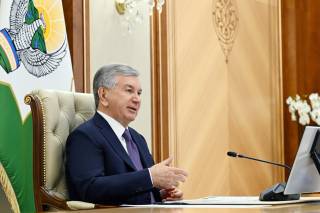
On April 6, President Shavkat Mirziyoyev reviewed proposals to reduce the state’s presence in the economy and accelerate privatization.
In recent years, significant efforts have been made to develop the private sector and attract investment. Currently, the state’s share in the economy stands at 42 percent, with 1,685 state-owned enterprises in operation. Notably, last year, state assets worth nearly 30 trillion UZS were privatized, generating over 10 trillion UZS in budget revenues. The volume of land plot sales has also grown steadily, reaching 6 trillion UZS.
A system of financial incentives for privatization has been introduced, allowing 2.6 trillion UZS to remain at the regional level and 7 billion UZS within mahallas. State-owned enterprises contributed 49 trillion UZS in dividends to the budget. Overall, the number of state-owned enterprises has decreased by 60 percent over the past five years as a result of privatization.
The meeting critically assessed progress in this area, noting that several issues remain unresolved.
It was emphasized that requirements for new owners must be strengthened, particularly regarding job preservation, the introduction of modern technologies, and the improvement of production efficiency. The number of inefficient state-owned enterprises reached 362 last year, underscoring the need to accelerate this process.
At the same time, the system for analyzing state-owned enterprises does not yet fully utilize modern digital tools and artificial intelligence capabilities. In 2024, 451 enterprises in difficult financial conditions incurred losses totaling 14 trillion UZS, while last year, 362 enterprises incurred losses totaling 4 trillion UZS. In this context, it is necessary to conduct an in-depth analysis of state-owned enterprises, introduce new mechanisms to assess their financial stability, and ensure the early identification of risks.
Analytical approaches remain underutilized in the privatization process. It has therefore been decided to adopt a sector-based approach, involving the analysis of each sector individually, the assessment of socio-economic impacts, the evaluation of the competitive environment, and the development of proposals based on these findings.
Particular attention was paid to the rational use of state property in the regions and the involvement of vacant spaces in economic circulation. To this end, it was proposed to introduce a unified management system for such facilities gradually and to reduce the average area per employee from 27 to 12-15 square meters. This will allow 4.9 million square meters of space to enter economic circulation, vacant buildings to be put up for sale or lease, and maintenance and utility costs to be reduced.
At the meeting, special attention was also given to land plots allocated to entrepreneurs that have not yet entered economic circulation. In particular, it was noted that economic activity has not been fully organized on 3,100 of the 11,400 hectares allocated between 2022 and 2025.
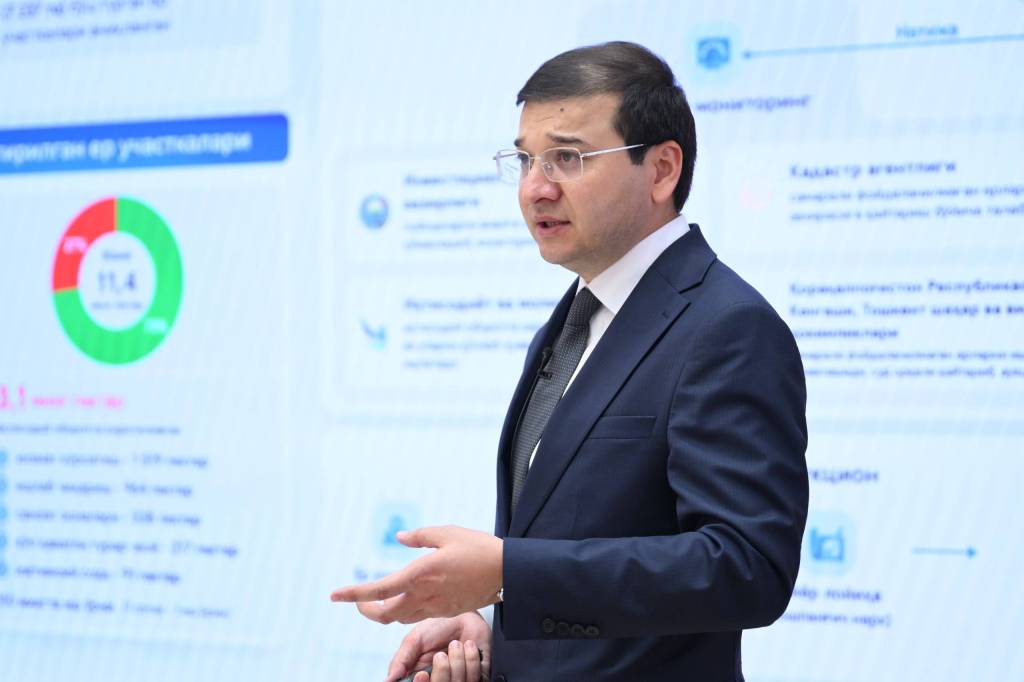
The need for online monitoring of the actual condition of land plots, the auctioning of land plots based on ready-made projects, and the strengthening of criteria for participation in investment projects was noted. To this end, it was proposed to introduce a system for the effective identification of unused land by integrating information systems such as “E-auksion”, “Yerelektron”, the Uzbekcosmos Agency system, “Shaffof Qurilish”, and “UzKAD”. Instructions were also given to strengthen the role of local hokimiyats in bringing such land into economic circulation.
It was decided that, in the future, land plots for business purposes will be auctioned as ready-made business projects, together with all necessary permits.
A report was also presented on the progress of preparations for the privatization of major assets, including UzAuto Motors and its affiliated enterprises, as well as Navoiyazot and thermal power plants.
It was proposed to establish a digital technology project office within the State Assets Management Agency. Under this system, it is planned to conduct online monitoring of all privatization processes, introduce artificial intelligence into the financial analysis of state-owned enterprises, and improve revenue distribution processes.
The Head of State instructed responsible officials to further reduce the state’s presence in the economy, ensure the effective use of assets, and accelerate privatization processes based on modern approaches.
UzA