
According to available data, about 4,400 wild plant species are registered in Uzbekistan. Scientists predict that this figure will increase even more because the country's unique nature and landscapes await new research.

In Uzbekistan, particularly on the Chatkal, Kurama, Ugam, and Pskem ranges in the Western Tien-Shan, Nurata, Zarafshan – in the Pamir-Alay, as well as on the Gissar and Turkestan ranges, in the Kyzylkum and Ustyurt deserts, which occupy 80 percent of the country's territory, there is a whole world of new, previously unexplored plant species.

To identify rare specimens of flora growing in these territories and introduce their names into world science, long-term research will be required, so scientists at the Institute of Botany of the Academy of Sciences of the Republic of Uzbekistan have established close cooperation with foreign colleagues. A delegation consisting of the Ambassador Extraordinary and Plenipotentiary of China to Uzbekistan, the Vice President of the Chinese Academy of Sciences, the Director of the Xinjiang branch of the Xinjiang Institute of Geography and Ecology, and other specialists visited the institution.

The parties discussed issues of protecting ecosystems, preserving biological diversity, and comprehensively studying plants to develop mutually beneficial scientific relations and plan promising new projects.
“This meeting creates the basis for further strengthening inter-institutional interaction, developing the exchange of scientific information, and joint implementation of fundamental scientific projects that are of high relevance and practical importance today”, Academician Komiljon Tojiboyev said.

The scientists also agreed to jointly conduct research in plant phylogeny, evolutionary history and taxonomy, bioclimatology, and assessing the impact of climate change on biodiversity.

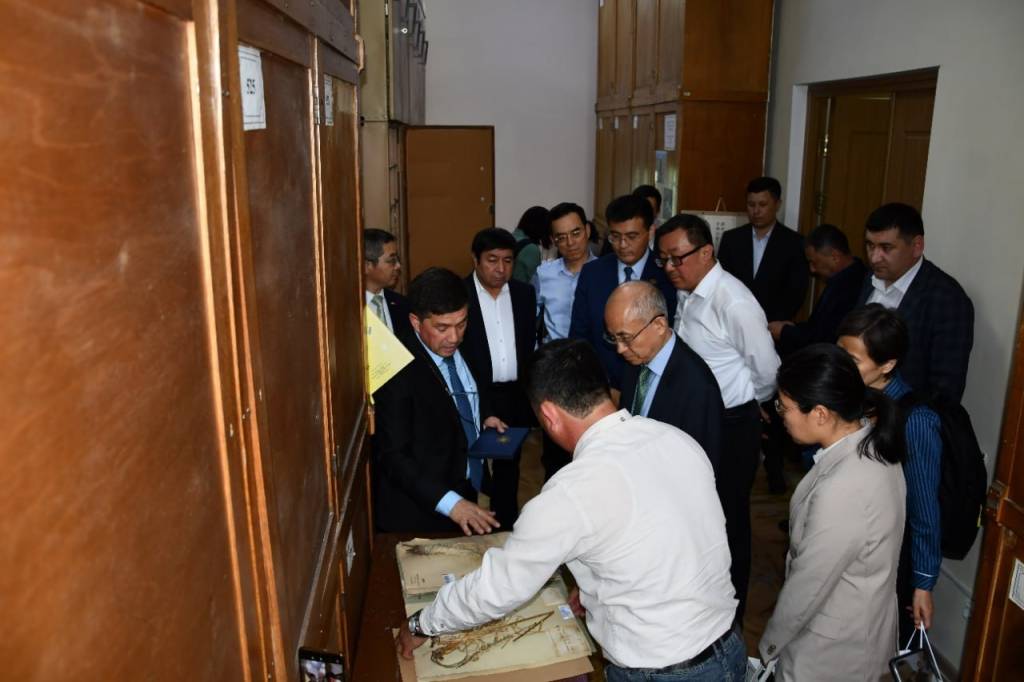
The guests got acquainted with materials and unique specimens from the fund of the National Herbarium of Uzbekistan after the meeting.

Nigora Rakhmonova, UzA

English
Chinese
Turkish
Tajik
Kyrgyz
Turkmen
Japanese
Arabic
English
French
Spanish
Русский
German
Ўзбек
Oʻzbek
Қазақ
Uzbekistan – China: Cooperation in the scientific field at a new stage of development

According to available data, about 4,400 wild plant species are registered in Uzbekistan. Scientists predict that this figure will increase even more because the country's unique nature and landscapes await new research.

In Uzbekistan, particularly on the Chatkal, Kurama, Ugam, and Pskem ranges in the Western Tien-Shan, Nurata, Zarafshan – in the Pamir-Alay, as well as on the Gissar and Turkestan ranges, in the Kyzylkum and Ustyurt deserts, which occupy 80 percent of the country's territory, there is a whole world of new, previously unexplored plant species.

To identify rare specimens of flora growing in these territories and introduce their names into world science, long-term research will be required, so scientists at the Institute of Botany of the Academy of Sciences of the Republic of Uzbekistan have established close cooperation with foreign colleagues. A delegation consisting of the Ambassador Extraordinary and Plenipotentiary of China to Uzbekistan, the Vice President of the Chinese Academy of Sciences, the Director of the Xinjiang branch of the Xinjiang Institute of Geography and Ecology, and other specialists visited the institution.

The parties discussed issues of protecting ecosystems, preserving biological diversity, and comprehensively studying plants to develop mutually beneficial scientific relations and plan promising new projects.

“This meeting creates the basis for further strengthening inter-institutional interaction, developing the exchange of scientific information, and joint implementation of fundamental scientific projects that are of high relevance and practical importance today”, Academician Komiljon Tojiboyev said.

The scientists also agreed to jointly conduct research in plant phylogeny, evolutionary history and taxonomy, bioclimatology, and assessing the impact of climate change on biodiversity.

The guests got acquainted with materials and unique specimens from the fund of the National Herbarium of Uzbekistan after the meeting.

Nigora Rakhmonova, UzA