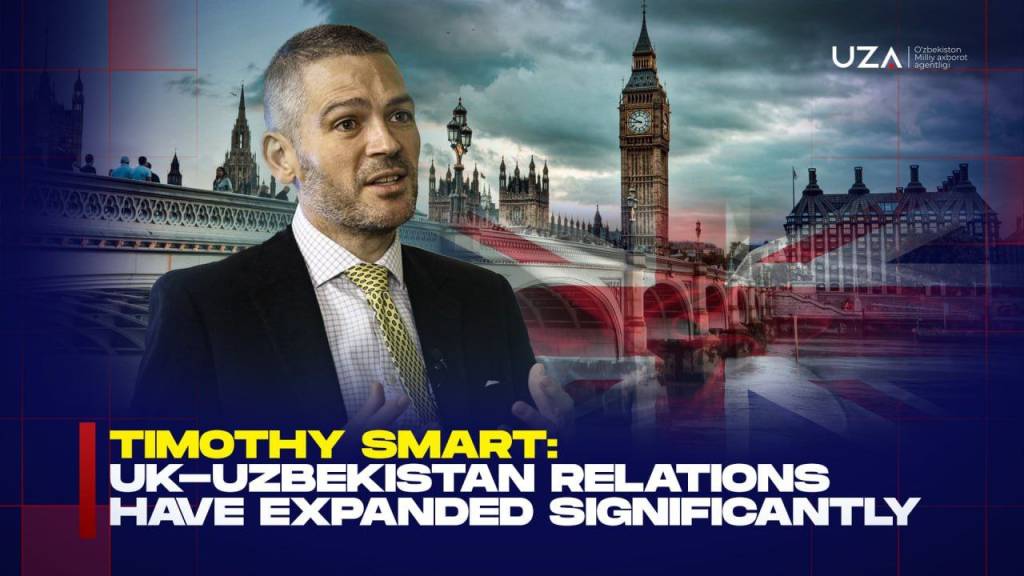
Timothy Smart: UK – Uzbekistan relations have expanded significantly
On February 18 this year, 34 years have passed since the establishment of diplomatic relations between the Republic of Uzbekistan and the United Kingdom of Great Britain and Northern Ireland. Over this period, relations between the two countries have evolved into a history of consistent cooperation, high mutual trust, and a strong strategic partnership.
In recent years, bilateral relations have advanced to a qualitatively new stage. In particular, cooperation in political dialogue, trade, economic and investment ties, education, safe migration, infrastructure development, and the green economy has been developing rapidly. The large-scale reforms being implemented in Uzbekistan have created new opportunities to deepen engagement with British business circles and government institutions.
In this regard, UzA correspondent spoke with the British Ambassador to Uzbekistan, Timothy Smart. During the interview, the current state of bilateral relations and key prospective projects were discussed.
– Mr. Ambassador, February 18 marks the establishment of diplomatic relations between our countries. How would you describe the evolution of UK–Uzbekistan relations over the years?
– I am very happy that the 34th anniversary of our relations is marked by UK Trade Envoy Lord Alderdice’s visit to Uzbekistan. We were honoured to meet His Excellency President Mirziyoyev yesterday. We are very grateful for the wonderful hospitality of the Government of Uzbekistan and look forward to the CA5+1 Summit of Foreign Ministers, which will be held in London next week.
Over the past three decades, UK – Uzbekistan relations have expanded significantly. What began as a modest diplomatic relationship has matured into a broad and constructive partnership grounded in mutual interests and shared values.
Cooperation has grown across multiple areas: political dialogue, education, trade, security, and cultural exchange. Uzbekistan’s reform agenda in recent years has deepened engagement, creating space for expanded economic cooperation, stronger academic partnerships, and deeper people-to-people ties. Today, the relationship is more dynamic, forward-looking, and mutually beneficial than ever before.
– Migration is becoming an increasingly important issue globally. How do you see cooperation between the UK and Uzbekistan developing in the field of safe and legal migration?
– The UK is committed to working with Uzbekistan to ensure safe migration and to diversify migration routes. Cooperation on safe and legal migration is becoming increasingly important as the UK emerges as a new destination for workers from Uzbekistan. We are implementing a project supporting participation in the UK Seasonal Workers Scheme (SWS) in cooperation with the IOM Uzbekistan and the Uzbek Migration Agency, which is designed to help prospective migrants make informed decisions, understand their rights, and avoid the risks created by misinformation and fraudulent recruitment. By improving access to reliable guidance and strengthening institutional support, the initiative aims to ensure that migration under the SWS is safe, transparent, and beneficial for workers and their families.
The project provides practical assistance at every stage of the migration process – before departure through orientation, English language preparation, awareness campaigns, and hotline consultations, and after return, through financial literacy training, business skills development, and seed grants. Just recently, we awarded four returned participants of SWS with small grants to start to develop their own small business here, in Uzbekistan. The winners will also receive training on business management and financial literacy. In the long term, the goal is to promote safe mobility that contributes to community development while deepening cooperation between the UK and Central Asia in a responsible and mutually beneficial way
– Education is a key pillar of our partnership. What new opportunities are emerging for Uzbek students through cooperation with British universities and institutions?
– Education has been at the foundation of UK – Uzbekistan relations from the very beginning. When Westminster International University in Tashkent opened its doors in 2002, it became the first international university in Uzbekistan and remains one of the country’s leading higher education institutions. Since then, our partnership has grown remarkably. Today, thirteen transnational education institutions are offering UK university degrees in Uzbekistan – an achievement that reflects both the demand for world-class education and the trust placed in British academic standards. Today, 15,000 Uzbek students are studying for a British degree or diploma, here in Uzbekistan, compared to 10,000 last year.
Beyond university campuses, our cooperation spans a wide network of educational initiatives. Joint programmes and branch campuses allow Uzbek students to access British degrees without leaving home, while the Chevening Scholarship programme continues to support exceptional young professionals to study in the UK and return with new skills and perspectives. The British Council, celebrating its 35th anniversary in Uzbekistan this year, has played a vital role in expanding English language education and strengthening cultural and academic ties. At the school level, Cambridge Assessment’s work with the Presidential Schools is helping to raise teaching and learning standards to international levels. Taken together, these partnerships offer young people in Uzbekistan truly world-class academic opportunities and contribute directly to building a highly skilled, globally competitive future workforce.
– The UK has strong expertise in higher education quality standards. How can this experience further support reforms in Uzbekistan’s education system?
– The United Kingdom has long-standing experience in building transparent, internationally recognised quality assurance systems, and we are pleased to share this expertise with Uzbekistan as its education reforms accelerate. British universities and quality bodies are already working closely with Uzbek partners to modernise accreditation frameworks, strengthen university governance, and improve teacher training. What we see is a genuine commitment within Uzbekistan to elevate standards and expand access to high-quality education, and the UK is proud to contribute through technical assistance, institutional partnerships, and open exchange of best practices. The result is a more globally competitive higher education system that benefits students, employers, and society as a whole.
– Trade and investment ties are expanding. Which sectors do you see as the most promising for deeper UK – Uzbek economic cooperation?
– In 2016, bilateral trade was just £73 million. Today, we reached £2.2 billion. There is strong momentum in UK – Uzbekistan economic ties, and several sectors stand out as particularly promising. Just yesterday, we held a very successful UK – Uzbekistan Infrastructure Conference, attended by over 30 British companies who can bring world-class expertise in construction, design, urban planning, infrastructure modernization, financing, healthcare, and more – all areas aligned with Uzbekistan’s reform agenda. We also see growing interest in tourism, cultural heritage development, and responsible mining, including critical minerals essential for the global green transition. As Uzbekistan continues to modernise its business environment and attract international investors, we expect these sectors to offer significant opportunities for deeper, mutually beneficial cooperation.
– Climate change and green growth are high on the global agenda. What practical steps can our countries take together in sustainable development?
– Both the UK and Uzbekistan recognise that climate change requires practical and forward-looking solutions. We are already working together in areas such as renewable energy development, water management, and green finance, and there is considerable scope to expand this collaboration. By sharing technical expertise, encouraging private sector involvement, and supporting transparent regulatory frameworks, we can help accelerate Uzbekistan’s green transition. Strengthening resilience to climate impacts, investing in cleaner technologies, and promoting sustainable urban development are all areas where joint action can make a real difference.
– Mr. Ambassador, on a personal note, what has impressed you most about Uzbekistan during your time here, and what untapped potential do you think the British public has yet to fully discover?
– What has impressed me most is the warmth and generosity of the Uzbek people, along with the country’s remarkable blend of ancient history and rapid modernisation. Cities like Samarkand, Bukhara, and Khiva are world treasures, yet many people in the UK still have only a limited understanding of the extraordinary cultural and natural heritage Uzbekistan offers. I believe tourism is one of the country’s most underappreciated strengths. As more British visitors discover the architecture, cuisine, landscapes, and hospitality of Uzbekistan, I am confident that its reputation as a unique and inspiring destination will grow rapidly.
– Thank you for the insightful interview, Mr. Ambassador.
Interviewed by Musulmon Ziyo, UzA