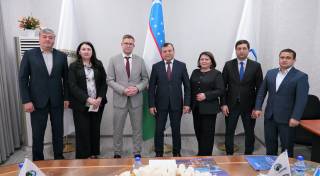
At the Anti-Corruption Agency, a draft National Anti-Corruption Strategy 2030 was presented to civil society institutions, international and national experts, and members of the Public Council.

The draft is based on the priority goals defined in the updated Uzbekistan 2030 Strategy and includes key directions for developing the national anti-corruption system, as well as effective mechanisms for its implementation.

The presentation provided detailed information on the goals and objectives in priority areas such as improving institutional foundations, expanding digitalization and the use of artificial intelligence, introducing integrity standards, ensuring openness and transparency in public service, and strengthening the roles of civil society institutions and the media.

Representatives of Transparency International from Latvia, Kyrgyzstan, and Kazakhstan, as well as domestic and foreign experts, discussed the draft, the mechanisms for implementing the strategy, and the expected outcomes, and shared their experience and recommendations.

As the experts noted, the successful implementation of the project requires close cooperation and active participation by state and public administration bodies, judicial and law enforcement institutions, civil society organizations, the media, and international organizations.

***

The participants discussed the latest results of Transparency International’s Corruption Perceptions Index (CPI) and Uzbekistan’s position in this ranking.

According to Roberto Kukutschka, a research expert at Transparency International, the organization evaluates not short-term changes but long-term trends and annual dynamics of indicators.

Since 2012, at least five sources have recorded positive shifts regarding Uzbekistan. Some sources – including Freedom House, the Economist Intelligence Unit, Varieties of Democracy, and the World Economic Forum – did not record significant growth or noted certain declines.

During the roundtable discussion, Uzbekistan’s achievements were analyzed in detail, and it was noted that, among 182 countries, the nation ranks among the 31 states that have significantly improved their CPI scores.

Within the framework of the event, recommendations were made for improving Uzbekistan’s position in the Index, highlighting the importance of strengthening judicial independence, limiting unlawful influence on political decision-making, increasing transparency of public finances, supporting free media and an active civil society, and creating a safe civic environment for reporting cases of corruption.

Norgul Abduraimova, UzA

English
Chinese
Turkish
Tajik
Kyrgyz
Turkmen
Japanese
Arabic
English
French
Spanish
Русский
German
Ўзбек
Oʻzbek
Қазақ
The role of the national strategy and international indices in combating corruption

At the Anti-Corruption Agency, a draft National Anti-Corruption Strategy 2030 was presented to civil society institutions, international and national experts, and members of the Public Council.

The draft is based on the priority goals defined in the updated Uzbekistan 2030 Strategy and includes key directions for developing the national anti-corruption system, as well as effective mechanisms for its implementation.

The presentation provided detailed information on the goals and objectives in priority areas such as improving institutional foundations, expanding digitalization and the use of artificial intelligence, introducing integrity standards, ensuring openness and transparency in public service, and strengthening the roles of civil society institutions and the media.

Representatives of Transparency International from Latvia, Kyrgyzstan, and Kazakhstan, as well as domestic and foreign experts, discussed the draft, the mechanisms for implementing the strategy, and the expected outcomes, and shared their experience and recommendations.

As the experts noted, the successful implementation of the project requires close cooperation and active participation by state and public administration bodies, judicial and law enforcement institutions, civil society organizations, the media, and international organizations.

***

The participants discussed the latest results of Transparency International’s Corruption Perceptions Index (CPI) and Uzbekistan’s position in this ranking.

According to Roberto Kukutschka, a research expert at Transparency International, the organization evaluates not short-term changes but long-term trends and annual dynamics of indicators.

Since 2012, at least five sources have recorded positive shifts regarding Uzbekistan. Some sources – including Freedom House, the Economist Intelligence Unit, Varieties of Democracy, and the World Economic Forum – did not record significant growth or noted certain declines.

During the roundtable discussion, Uzbekistan’s achievements were analyzed in detail, and it was noted that, among 182 countries, the nation ranks among the 31 states that have significantly improved their CPI scores.

Within the framework of the event, recommendations were made for improving Uzbekistan’s position in the Index, highlighting the importance of strengthening judicial independence, limiting unlawful influence on political decision-making, increasing transparency of public finances, supporting free media and an active civil society, and creating a safe civic environment for reporting cases of corruption.

Norgul Abduraimova, UzA