


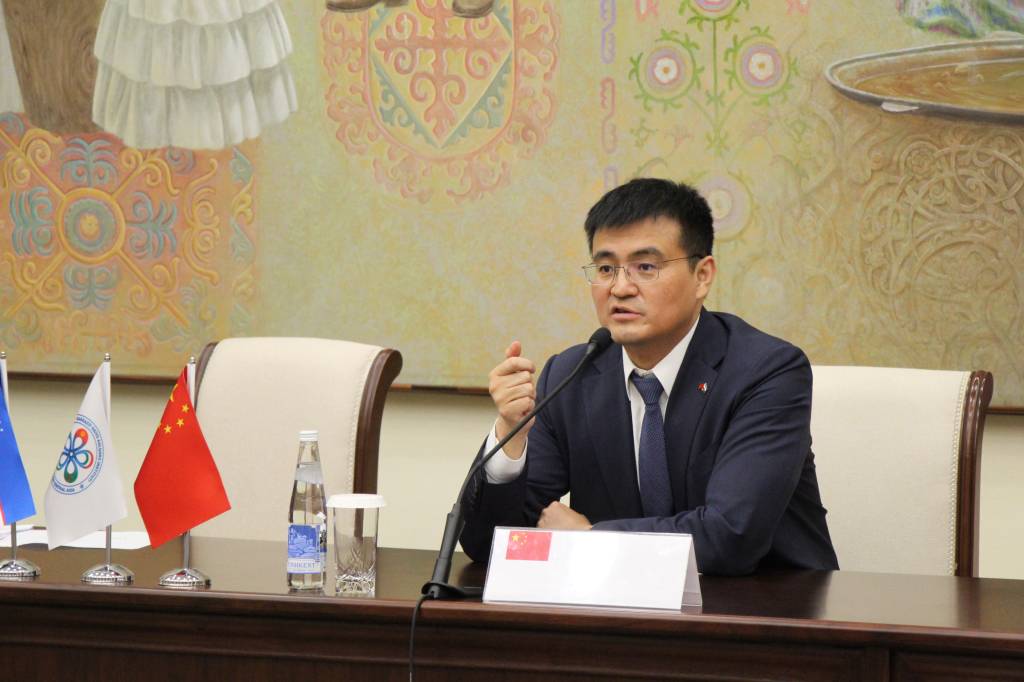
At the International Institute for Central Asia (IICA), an open lecture was delivered by Yu Jun, Ambassador Extraordinary and Plenipotentiary of the People’s Republic of China to Uzbekistan, on “China’s development and the China – Central Asia Format”.
The event served as an essential platform for meaningful exchanges of views on key regional agenda issues, the current foreign policy course of the PRC, and prospects for bilateral partnership.
The event brought together leading representatives of the academic community and research centers, including the Institute for Macroeconomic and Regional Studies, ISRS, the Center for Political and International Initiatives, CERR, as well as faculty and students from academic institutions such as the Academy of Public Administration, UWED, the National University, TSUE, UzSWLU, the Tashkent State University of Oriental Studies, and representatives of foreign media.
Opening the meeting, IICA Director Javlon Vakhabov emphasized that the Ambassador’s speech at the Institute is not only a landmark event, the first of its kind, in strengthening analytical and scientific dialogue, but also a step toward creating a sustainable platform for promoting joint strategic initiatives.
According to him, with the support of the Chinese Embassy in Tashkent, the Institute is actively expanding partnerships with leading research institutions in China, including the China Academy of International Studies, the Institutes of Social Development of Europe and Asia, the Central Asia Research Institute at Shaanxi Normal University, and the Shanghai Academy of International Studies.
In his address, Ambassador Yu Jun outlined the key directions of China’s regional foreign policy strategy, emphasizing the Asian model of good-neighborliness, cooperation, and openness. He underscored that Central Asia holds a special place in the country’s foreign policy as a region bound to China by millennia of historical, cultural, and geographical ties. “All five Central Asian countries hold the status of China’s strategic partners, making the region not only a close neighbor but also a reliable ally in building a ‘community of shared destiny’”, the Chinese Ambassador noted.
The Ambassador paid special attention to the dynamics of economic cooperation. Over the past 30 years, trade volume between China and the Central Asian countries has grown from $460 million to $94.8 billion, while China’s direct investment in the region has exceeded $15 billion. China has taken a leading position as the region’s main trade and investment partner. According to the diplomat, the value of mutual engineering contracts has surpassed tens of billions of dollars, indicating the rapid expansion of practical cooperation.
As the Ambassador emphasized, one of the most important logistical breakthroughs has been the construction of the China – Kyrgyzstan – Uzbekistan railway, which will become the shortest route for transporting goods between East and West Asia. Today, 80 percent of rail container trains traveling from China to Europe pass through Central Asia. In 2024, the number of such trains exceeded 12,000 – an 11.3% increase compared to the previous year.
The speaker also elaborated on issues of technological transformation and digital cooperation. He noted that Chinese companies play a significant role in developing Uzbekistan’s digital infrastructure, establishing data centers, 5G platforms, and artificial intelligence hubs. In this context, China’s active participation in projects aimed at environmental sustainability and green development, including constructing solar power plants and introducing intelligent water-saving systems, takes on particular importance.
In the humanitarian sphere, China and the Central Asian countries demonstrate a strong partnership based on respect and mutual support, the Chinese diplomat noted. In this context, the importance of Confucius institutes was emphasized, as well as the development of the “Luban Workshops” program aimed at training technical specialists according to modern Chinese standards.
Ambassador Yu Jun also shared that, on China’s initiative, successful medical programs are being implemented in Central Asia, including the international “Bright Path” express program, under which thousands of citizens from the region, including Uzbekistan, have received ophthalmological and cardiac surgeries performed by leading Chinese specialists.
After the lecture, a question-and-answer session was held, during which representatives of Uzbekistan’s expert community, academic circles, and analytical centers addressed the Chinese Ambassador with a range of substantive and timely questions concerning the prospects of bilateral relations, cooperation within the SCO framework, and the China – Central Asia format.
An essential symbolic moment of the meeting was the official ceremony of handing over a new collection of specialized Chinese publications to the IICA library. The collection includes works on history, politics, law, culture, ecology, and technology, including “Selected Speeches of Xi Jinping” and modern research on digital transformation and poverty reduction. According to both parties, the donated literature will serve as a valuable resource for research and academic work, expanding the institute’s capabilities in China studies and scientific analysis of contemporary policies.
In conclusion, both sides expressed confidence that the upcoming 2025 China – Central Asia Summit in Astana and the SCO Summit in Tianjin will catalyze new initiatives and decisions. The Institute confirmed its intention to actively provide expert support for bilateral formats and continue close cooperation with the Chinese Embassy in Tashkent to implement joint scientific, educational, and humanitarian projects.
G. Khonnazarov, UzA