
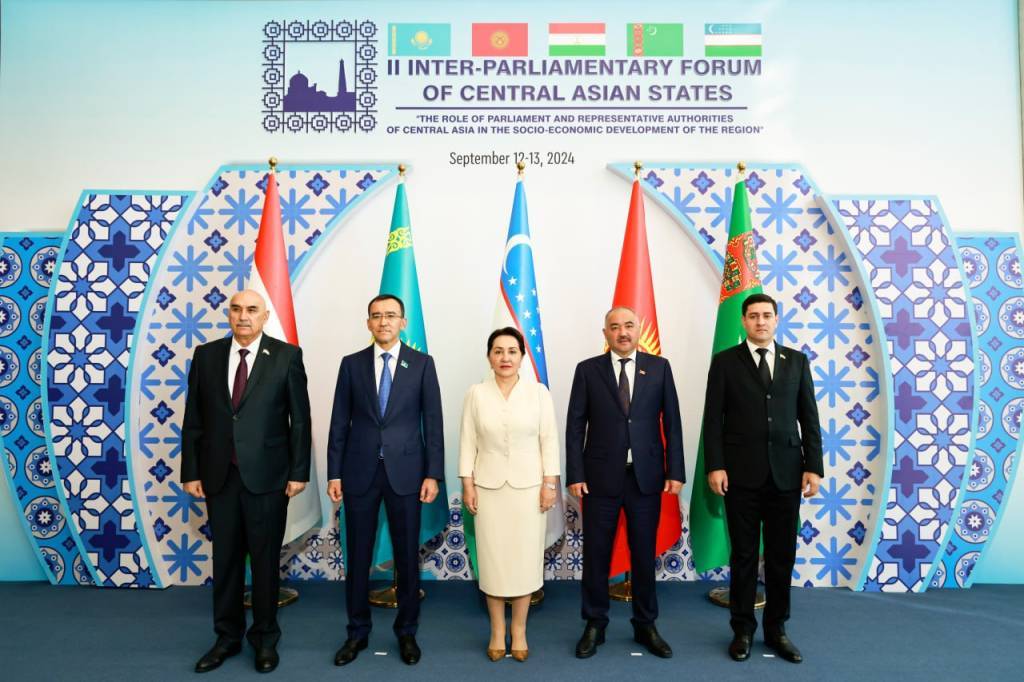
The Second Inter-Parliamentary Forum of Central Asian States continues its work in Khiva.

The Chairperson of the Senate of the Oliy Majlis of Uzbekistan, Tanzila Narbayeva, addressed the event, which was attended by the heads and delegations of the parliaments of Kazakhstan, Kyrgyzstan, Tajikistan, Turkmenistan, and Uzbekistan, members of the Youth Parliament, representatives of local governments and journalists.

The Chairperson of the Senate noted that interparliamentary interaction is crucial for the effective implementation of high-level agreements reached by the leaders of Central Asian states and the further development of cooperation formats. 

“This forum, in essence, reflects the desire of the region’s countries to enhance comprehensive cooperation”, Tanzila Narbayeva said. “We are confident that today, all Central Asian states see their future development as directly dependent on the stability and prosperity of the region. When the President of Uzbekistan Shavkat Mirziyoyev launched large-scale reforms in the country, he defined the Central Asian region as a priority area of ​​foreign policy and put forward an initiative to hold an annual summit of leaders (Consultative Council) in one of the 5 states. This important cooperation format, supported and launched by all the Presidents, has become an effective mechanism for discussing and resolving mutually beneficial regional issues. Thanks to the initiative and political will of the leaders of our countries, intensive integration processes have started in the region in a short period. It would not be an exaggeration to say that at the initial stage, the goal of this format was to eliminate several conflicts in borders, transport, water resources, and trade, but today, it has become a driving force for regional cooperation and development. At the initiative of Uzbekistan, the creation of border trade zones with all Central Asian states has begun. A mechanism for forming such zones with Kazakhstan, Kyrgyzstan, Tajikistan, and Turkmenistan has been established. Uzbekistan’s trade turnover with neighboring countries has increased almost 3 times over the past 7 years (from $2.7 billion in 2017 to $7.2 billion in 2023). Many positive results are related to water, water-energy, and environmental issues”.

Norgul Abduraimova, UzA

English
Chinese
Turkish
Tajik
Kyrgyz
Turkmen
Japanese
Arabic
English
French
Spanish
Русский
German
Ўзбек
Oʻzbek
Қазақ
Tanzila Narbayeva: “Development of Central Asian countries is directly related to the stability and well-being of the region”

The Second Inter-Parliamentary Forum of Central Asian States continues its work in Khiva.

The Chairperson of the Senate of the Oliy Majlis of Uzbekistan, Tanzila Narbayeva, addressed the event, which was attended by the heads and delegations of the parliaments of Kazakhstan, Kyrgyzstan, Tajikistan, Turkmenistan, and Uzbekistan, members of the Youth Parliament, representatives of local governments and journalists.

The Chairperson of the Senate noted that interparliamentary interaction is crucial for the effective implementation of high-level agreements reached by the leaders of Central Asian states and the further development of cooperation formats. 

“This forum, in essence, reflects the desire of the region’s countries to enhance comprehensive cooperation”, Tanzila Narbayeva said. “We are confident that today, all Central Asian states see their future development as directly dependent on the stability and prosperity of the region. When the President of Uzbekistan Shavkat Mirziyoyev launched large-scale reforms in the country, he defined the Central Asian region as a priority area of ​​foreign policy and put forward an initiative to hold an annual summit of leaders (Consultative Council) in one of the 5 states. This important cooperation format, supported and launched by all the Presidents, has become an effective mechanism for discussing and resolving mutually beneficial regional issues. Thanks to the initiative and political will of the leaders of our countries, intensive integration processes have started in the region in a short period. It would not be an exaggeration to say that at the initial stage, the goal of this format was to eliminate several conflicts in borders, transport, water resources, and trade, but today, it has become a driving force for regional cooperation and development. At the initiative of Uzbekistan, the creation of border trade zones with all Central Asian states has begun. A mechanism for forming such zones with Kazakhstan, Kyrgyzstan, Tajikistan, and Turkmenistan has been established. Uzbekistan’s trade turnover with neighboring countries has increased almost 3 times over the past 7 years (from $2.7 billion in 2017 to $7.2 billion in 2023). Many positive results are related to water, water-energy, and environmental issues”.

Norgul Abduraimova, UzA