Kashkadarya oasis is one of the oldest human settlements. Numerous historical monuments found in the region attest to this, including the ruins of the ancient settlement of Yerkurgan, which dates back 2,700 years.

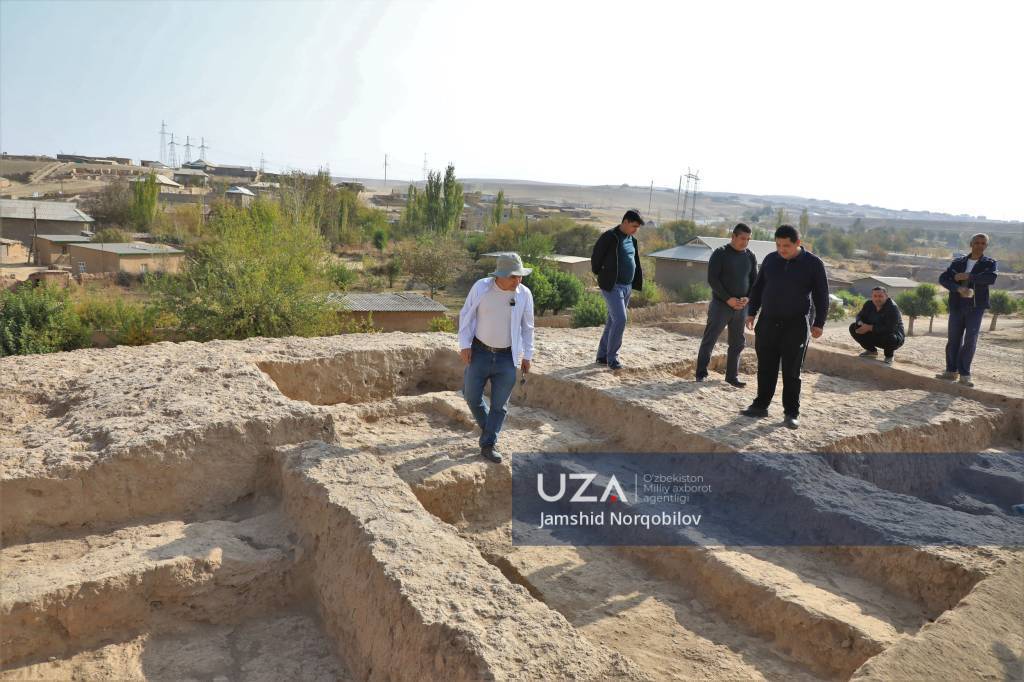
Recently, researchers from the Samarkand Institute of Archaeology discovered another ancient monument on a hill in the village of Pasttol in Qamashi district: the remains of a fortress-city dating back to the 3rd century BC to the 3rd century AD.

Archaeological excavations on this hill, locally known as Baburtepa, confirm that Kashkadarya is a region with an exceptionally ancient history and a unique culture.

“This hill, located south of the village along the main Langar road, covers an area of more than 6 hectares and has a height of 8-10 meters”, says Sanjar Abdurakhimov, a researcher at the Samarkand Institute of Archaeology. “The fortress had a rectangular shape and was first recorded by our mentor Abdusabur Raimkulov. Fieldwork began in 2023, and in 2024, we conducted excavations at three sites. We assume that a palace or a prayer hall was located in the central part. Remains of a large hall and several rooms, as well as fragments of wall paintings, were also discovered. We plan to study them in detail during the upcoming research”.

According to the scholar, defensive walls, guard rooms, pottery workshops, urns, and numerous ceramic artifacts were found on the hill. This indicates that life in the city continued for an extended period.

“The ceramic figurines, urns, and vessels are crafted very delicately”, the researcher says. “Among the finds are figurines characteristic of the Seleucid state and the Kushan period. It has been revealed that pottery and stone-processing crafts were well developed here”.

According to Dilmurod Omonov, a researcher at the Samarkand Institute of Archaeology, more than 100 new archaeological sites were discovered in Kashkadarya oasis in 2025 alone through field excavations.

“These discoveries allow for a step-by-step study of the history of the oasis and the processes of urban development”, the scholar noted. “The monuments are relatively well preserved, which creates significant opportunities for large-scale research in the future”.

Senior researcher at the Samarkand Institute of Archaeology Abdusabur Raimkulov also notes that the territory of Kashkadarya region is one of the most ancient centers of urban development in Central Asia.

“There are more than 1.5 thousand archaeological monuments in this area”, he says. “Urban culture was formed here as early as the 9th-8th centuries BC. The increase in the number of cities is associated with Kashkadarya’s location on the caravan route connecting Bukhara and Khorezm. In the Middle Ages, there were more than 30 major cities in the oasis”.

Archaeological research at Baburtepa serves as an essential source for studying the history of ancient urban planning, culture, and traces of civilization not only in Kashkadarya oasis but throughout Uzbekistan.

[gallery-25946]

Ulmas Barotov, photos by Jamshid Norqobilov, UzA

English
Chinese
Turkish
Tajik
Kyrgyz
Turkmen
Japanese
Arabic
English
French
Spanish
Русский
German
Ўзбек
Oʻzbek
Қазақ
Remains of an ancient fortress-city discovered in Kashkadarya
Kashkadarya oasis is one of the oldest human settlements. Numerous historical monuments found in the region attest to this, including the ruins of the ancient settlement of Yerkurgan, which dates back 2,700 years.

Recently, researchers from the Samarkand Institute of Archaeology discovered another ancient monument on a hill in the village of Pasttol in Qamashi district: the remains of a fortress-city dating back to the 3rd century BC to the 3rd century AD.

Archaeological excavations on this hill, locally known as Baburtepa, confirm that Kashkadarya is a region with an exceptionally ancient history and a unique culture.

“This hill, located south of the village along the main Langar road, covers an area of more than 6 hectares and has a height of 8-10 meters”, says Sanjar Abdurakhimov, a researcher at the Samarkand Institute of Archaeology. “The fortress had a rectangular shape and was first recorded by our mentor Abdusabur Raimkulov. Fieldwork began in 2023, and in 2024, we conducted excavations at three sites. We assume that a palace or a prayer hall was located in the central part. Remains of a large hall and several rooms, as well as fragments of wall paintings, were also discovered. We plan to study them in detail during the upcoming research”.

According to the scholar, defensive walls, guard rooms, pottery workshops, urns, and numerous ceramic artifacts were found on the hill. This indicates that life in the city continued for an extended period.

“The ceramic figurines, urns, and vessels are crafted very delicately”, the researcher says. “Among the finds are figurines characteristic of the Seleucid state and the Kushan period. It has been revealed that pottery and stone-processing crafts were well developed here”.

According to Dilmurod Omonov, a researcher at the Samarkand Institute of Archaeology, more than 100 new archaeological sites were discovered in Kashkadarya oasis in 2025 alone through field excavations.

“These discoveries allow for a step-by-step study of the history of the oasis and the processes of urban development”, the scholar noted. “The monuments are relatively well preserved, which creates significant opportunities for large-scale research in the future”.

Senior researcher at the Samarkand Institute of Archaeology Abdusabur Raimkulov also notes that the territory of Kashkadarya region is one of the most ancient centers of urban development in Central Asia.

“There are more than 1.5 thousand archaeological monuments in this area”, he says. “Urban culture was formed here as early as the 9th-8th centuries BC. The increase in the number of cities is associated with Kashkadarya’s location on the caravan route connecting Bukhara and Khorezm. In the Middle Ages, there were more than 30 major cities in the oasis”.

Archaeological research at Baburtepa serves as an essential source for studying the history of ancient urban planning, culture, and traces of civilization not only in Kashkadarya oasis but throughout Uzbekistan.

[gallery-25946]

Ulmas Barotov, photos by Jamshid Norqobilov, UzA