Public figure Rafik Nishanov will turn 95 in January. He was born in Bostanlyk district. The candidate of historical sciences graduated from Tashkent Pedagogical Institute.

Mr. Nishanov worked as Chairman of Tashkent City Executive Committee, Ambassador Extraordinary and Plenipotentiary of the USSR to Sri Lanka, the Maldives and Jordan. He was the Minister of Foreign Affairs of the Republic of Uzbekistan, the Chairman of the Presidium of the Supreme Council of the Republic, and the First Secretary of the Central Committee of the Communist Party of Uzbekistan.

UzA correspondents Irismat Abdukhalikov and Rakhimjan Sultanov have interviewed Mr. Nishanov. Below is the translation of the interview.

– Dear Rafik Nishanovich, would you mind if we start our conversation with the question about longevity. Could you please advise what is important for living a long life?

– I was born in one of the most beautiful places of Uzbekistan. Our house was not far from Chirchiq river. I still remember the delicious taste of this icy water. These memories make me happy.

Uzbekistan has many regions with amazing air and healing springs. There are few places in the world with such a generous abundance: a lot of varieties of juicy melons, watermelons, grapes, persimmons, figs – the most important vitamin sources.

There were almost three hundred farms in our village, and a collective farm allocated 20 acres each. We grew potatoes, corn, wheat. There were melons, watermelons, vegetables, peas and greens. Traditional breakfast: green tea and hot bread with grape. From an early age I remember the “Samarkand” green tea No. 95, the benefits and taste of which can hardly be overestimated. But, as you can imagine, longevity depends not only on water, clean air and proper nutrition. First of all – from the way of life, the ability to combine fruitful work with good rest. Idleness, however paradoxical it may seem, only harms health. And I would also advise a positive attitude, the ability to discard despondency. One must strive for victory in everything and achieve success.

– What, in your opinion, are the success of Uzbekistan?

– President Shavkat Mirziyoyev made, let’s say, a genuine “quiet” revolution. He resolutely and calmly rejected old attitudes and concepts, created conditions for further progressive development of Uzbekistan. The President, in his impressive speeches at the UN General Assembly, in his addresses to the Oliy Majlis, clearly formulated new ideas and proposed specific ways of Uzbekistan’s strategic development. The personal initiatives of President Shavkat Mirziyoyev to establish close friendly relations with neighboring countries have created a new political reality in the region. Capital protection laws and other innovations have led to increased confidence in business and the flow of investments. For example, our fellow countryman, a true patriot of Uzbekistan, a talented Russian businessman, Alisher Usmanov, allocates funds to support people during the quarantine due to the pandemic, both for the reconstruction of large enterprises and for the construction of new facilities, in particular for the construction of the grandiose Center for Islamic Civilization. Many of his projects are also aimed at development of education, culture, tourism and sports in the country.

– Significant changes have taken place in the domestic and foreign policy of Uzbekistan. Would you please tell us what the “Uzbek Renaissance”, “Renewed Uzbekistan” mean to you?

– Uzbekistan is definitely starting to revive. I believe that it has not only renewal but also a true renaissance ahead. This thought warms me endlessly. And it is not groundless. The native land has all the opportunities for growth: hardworking and talented people, invaluable natural resources. If to use all this properly, more actively develop mutually beneficial cooperation with neighbors, with all CIS countries, to strengthen relations with Russia, China, India and other states, then as quickly as possible, I believe, significant results will be achieved in economic and social development, in improving the wellbeing of the population.

Regarding the Renaissance, I would like to note that there were two Renaissances in the history of our region – the Eastern Renaissance of the IХ-XII centuries and the Temurid Renaissance. In the first case, we are talking mainly about the revival of the knowledge and traditions of ancient science by the brilliant scientists of Mawarannahr – Beruni, Avicenna, Khorezmi. Based on a creative understanding of the ancient heritage, they made a true scientific breakthrough of world significance, without which modern progress would have been impossible.

During the Timurid period, after the destructive invasions of Genghis Khan troops, arts, crafts, architecture, poetry, literature and secular sciences revived and started developing, which gave the right to speak about the concept of the Temurid Renaissance. And if we associate the first and the second renaissance in the Middle Ages with the emergence of true luminaries of science, now the renaissance should embrace all strata of society, from small to large. Only then can it and should influence the change in the life of our people, a significant shift in the development of the economy, science and technology. I think so.

– Some call you a student, even a friend of Sharaf Rashidov, others say the opposite. What do you say?

– Sharaf Rashidovich entered our history as an outstanding public figure. He led the country very effectively for more than 20 years. He was a modest, businesslike, at the same time demanding leader, never raised his voice, never used swear words. He supported my candidacy for the post of the First Secretary of the Oktyabrsky District Committee of Tashkent party, then offered to head Tashkent City Executive Committee. And a few years later – I remember that informal moment well – he called, invited me to “drop by for a minute” (apparently, deliberately emphasizing with this word the benevolent nature of the upcoming conversation) and practically immediately said: “Rafik Nishanovich, take your first flight to Moscow tomorrow, in the morning you need to be in the Central Committee of the Communist Party of the Soviet Union”. Cabinet meetings ended with a very interesting conversation with Leonid Ilyich Brezhnev, who summed up: “Sharaf Rashidovich recommends you for the post of the Secretary of the Central Committee of the Communist Party of Uzbekistan. We support him and wish you success”.

Seven years of friendly work side by side with Sharaf Rashidovich were quite productive. After the death of Sharaf Rashidovich, the June Plenum of the Central Committee of the Communist Party of Uzbekistan was held, convened under the pressure from the Secretariat of the Central Committee of the CPSU. The First Secretary of the Uzbek Central Committee, I. Usmankhodjayev, subjected his predecessor to harsh criticism for incorrect management methods and registration in cotton growing. Then Sharaf Rashidovich was criticized by almost all officials. But in fact, Moscow was to blame, and everyone knows that. But who would dare to express doubts when Leonid Brezhnev himself directly forced Sharaf Rashidovich. And what could Sh. Rashidov do?! Once in the late 60s, returning from Moscow, Sh. Rashidov complained to me: “Again we will have to raise the cotton figures. At lunch, Leonid Ilyich, in the presence of all members of the Politburo, asked me why the plan contains four million nine hundred thousand tons of cotton, which should be rounded up to five million. I just sighed, I couldn’t argue with Brezhnev in front of everyone”, he told me. Despite the miscalculations, shortcomings, annoying delusions, I consider Sh. Rashidov an extraordinary personality and a brilliant leader. My attitude towards him is very positive, because by recommending then to high diplomatic service, Sharaf Rashidovich saved me from future collisions, which affected all the then leadership of the republic.

Returning to the second part of your question, I will say that people are different, as they say, the wind cannot be prevented from blowing, someone knows, and someone does not, so those who do not know say different things like that.

– Would you tell us, was there a pressure in any form in that difficult Soviet period on you, the leaders? Did you have to do or say something that you didn’t really want to?

– I would not consider it pressure. The whole Soviet policy was such that from the high rostrum they said one thing, but did something completely different. The third thing happened in everyday life.

I think a lot about these oddities of the Soviet policy, although I myself was inside the creators of this policy. I will not deny that there was a massive enthusiasm of people at one time or another, in solving certain problems, but at the same time, many ideas and programs proclaimed at the “historical” congresses of the only ruling party remained on paper. For example, the slogan known to many generations made at the XXII Party Congress, that “the current generation of the Soviet people will live under communism”, did not stand the test of time and turned out to be a complete fiction. It was during the same period that the country began to experience problems with the food supply of its citizens. I remember the period when people in Tashkent stood in line for bread from the early morning, and my mother baked breads from corn flour.

– Rafik Nishanovich, the older generation remembers your speech at one of the meetings in Tashkent, where you introduced the expression “sharafrashidovism” into circulation, with a rather negative connotation. What is the reason that you said so?

– To answer this question, we must return to the atmosphere of those days. “Perestroika” (restructuring) was carried out all over the country, and an investigation team led by Gdlyan and his assistant Ivanov was in full swing in our country. Every day they arrested one or the other, sometimes very decent, honest people. But on the other hand, there were also subscripts, as well as other offenses.

Speaking as the Chairman of the Presidium of the Supreme Council with a report on the anniversary of the October Revolution, I first used this term to characterize the authoritarian style of leadership that reigned in Uzbekistan at that time, as well as throughout the then Union. I never expected that the expression “sharafrashidovism” would become so firmly in use. The performance was approved. There were those who shared my attitude, there were dissatisfied ones who said: “Why exacerbate the topic? Why stir up the old?”

Of course, I was jarred by the phrase used by the Center – “Uzbek business”. Is such tactlessness permissible: to call the revealed unsightly facts with the name of an entire people?! Moreover, the people were just the main victim of what was happening. First of all, the evil was directed against them, ordinary people were robbed, their unpaid money was put into exorbitant bribes, Volga cars, palaces, jewelry, both in the republic and in Moscow.

Without opening the gathering, it was impossible to go forward. Perestroika meant the improvement of society. At the second congress of people’s deputies of the USSR in December 1989, deputy V. Yarin, Co-Chairman of the Commission for checking the work of this investigation group, announced the following information: law enforcement agencies in Uzbekistan have investigated over 800 criminal cases. More than five thousand people were convicted, including six hundred leading employees, ten Heroes of Socialist Labor. Money and valuables worth one hundred million rubles were seized from the accused.

I will say without justifying them, did theft and bribery exist only in Uzbekistan? Cotton issue existed almost in all cotton-growing republics. In Transcaucasia, they cheated with tea. And why not cheat if there is no real state guard? Both money and boxes of cognac were taken from there to the State Planning Committee and the Ministry of Finance, so that everything would be fine. In my opinion, Uzbekistan was chosen for the edification of others. The comrades have gone too far. I was not in the country during the initial period of the work of the investigative group of Gdlyan and Ivanov. But I confess that at first I trusted them, sharing the point of view of the movie hero Gleb Zheglov: “a thief should be in prison”. Nevertheless, a strong desire was born, as far as possible, to figure everything out.

As time went on, I corrected a lot for myself. The real crimes of high officials caused disgust. However, I also did not like some of the methods of investigation that were gradually revealed. I found the common practice disgusting: first to jail a person, and then to prove his guilt. It was enough during the investigation of someone’s confession of giving a bribe so that soon another suspect would go to jail. In temporary detention facilities, where the law provides for no more than three days and where bedding, a bath, food is limited, people were kept for months. I do not know how the testimony was obtained, whether the detainees were physically affected, but the group of Gdlyan and Ivanov used psychological pressure precisely. And strong. Many relatives, very old people, disabled people, mothers of many children were in prisons. I know cases when women with eleven or twelve children were taken into custody, placed in cells with recidivists who mocked them. And then “due to the lack of corpus delicti”, those who lost their health, intimidated, demoralized people were released home.

A dull murmur reigned through the country. Many honest countrymen were indignant: why do arrests continue indiscriminately? Familiar and unfamiliar people visited me, humiliated by what was happening. The appeals turned into a real stream when I became the Chairman of the Presidium of the Supreme Council. The number of letters from the wives, mothers, and children of arrested machine operators, bookkeepers, foremen and warehouse managers grew. It was impossible not to response: low-income, large families left without breadwinners, barely cared their families.

I was concerned, it’s one thing to condemn managers for registry, and quite another – to put simple farmers, semi-literate, shy, having no other way to survive than to obey to the will of superiors. I consulted with members of the Presidium, decided to create a Commission and study the “cases”. No matter how much effort is required for this, it is necessary to understand who deserves what, to determine the degree of guilt of each of tens of thousands of convicts. The Supreme Council had the right to pardon. Some of them had their terms reduced.

Who is responsible for people’s tragedy, which is sometimes compared to genocide? Gdlyan and Ivanov never tired of saying that their actions are least directed against the “switchmen”, secondary, third-rate figures. Undoubtedly, in the country they were interested in main officials, through them they wanted to reach out to the members of the Political Bureau. But no matter who the Moscow “dignitaries” were targeting, too many people, willingly or unwillingly, fell into the millstones of the investigation. Namely, the people, that is, those very ordinary people, about whose sorrowful fate the prosecutors verbally worried. I will not fall into subjectivity: At first Sh. Rashidov tried to resist Gdlyan, to defend and prove something, but in less categorical terms. An experienced, authoritative leader could not resist the Center.

Nowhere had the pressure of the Center had such a devastating effect on the economy, and therefore on the standard of living, as in Uzbekistan. Propaganda: “The country needs “white gold”! Our friends from the socialist camp have a need for cotton fiber”, they repeated every time, forced to torment the land, barbarically use water from Amudarya and Syrdarya, which saturated the Aral Sea, “drive” people, filling the shortage of labor with students and schoolchildren.

– Not only “cotton affairs” shook the country, but also other disasters fell on us then, for example, Fergana events.

– I will also tell you about strained interethnic relations. 1989. It was the second week of meetings of the First Congress of People’s Deputies of the USSR. On the evening of June 3, one of the worst phone calls of my life rang at the hotel. It was announced that the trouble had come to Tashlak, Komsomol, Margilan villages, there are devastations of Meskhetian Turks. Organized mobs of thugs break into houses, rob, commit brutal murders, fire the buildings.

On the same night, People’s Deputies – Chairman of the Council of Ministers of the country G. Kadyrov and First Secretary of Fergana Regional Party Committee Sh. Yuldashev arrived in Uzbekistan. G. Kadyrov headed the Republican Government Commission.

Worries at the morning Congress: what’s happening? Gorbachev turned to me: “Can you tell us anything?” But I had not yet had reliable data from the members of the Commission. I informed about this from my place. According to my information, I added, a violent quarrel in the market served as the impetus for the riots: A Meskhetian Turk cursed an Uzbek saleswoman, knocked over a plate of strawberries. A group of nearby Uzbeks protected the woman. The altercation turned into a bloody battle, which ended with the death of a local guy. How I was later criticized for this statement! They accused me of not understanding the scale of what had happened. I understood: how many anger must be put in the souls of people in order for an everyday conflict to bring it down with a mudflow, an avalanche! However, I did not want to make hasty statements. Uzbekistan people also watched TV. One rash phrase of the head of the country could become the detonator of the next wave of aggression. But since we are talking about them, I will say: we must still catch the difference between the concepts of “cause” (which in itself can be accidental, absurd, but leading to tragedy) and “reasons”, which by definition are not accidental. At the same time, I did not think it right to speak hastily about deep things. I have noticed: “The Commission went to the place. When it is finished, we’ll report back in detail”. A day later, I went to Fergana with the Minister of Internal Affairs of the USSR V. Bakatin. On the eve of departure, I contacted G. Kadyrov. By that time, units of internal troops of the Ministry of Internal Affairs of the USSR had been transferred to the country, and a curfew was imposed from nine o’clock in the evening on June 4. Gayrat Kadyrov reported that the situation was partially taken under control.

When Vadim Bakatin and I were exploring the affected areas, we came across trucks with guys holding sticks, crowbars. And this despite the fact that fighters of internal troops were exposed at the most dangerous areas. Seeing the guards accompanying us, truck drivers stopped, young people jumped out of the trucks and ran away.

On the way, after consulting with V. Bakatin, we came to the conclusion that the forces of the Ministry of Internal Affairs should be increased. At the request of the country, the number of troops was increased to 13,000. To protect the Meskhetian Turks from violence, they began to create camps in an emergency order: in Asht district of Tajikistan’s Leninabad region. People were taken out there, tents were set up, food was provided, and temporary settlements were placed under security. I departed for Moscow for a day to coordinate my actions with Mikhail Gorbachev.

Here I must explain how Meskhetian Turks ended up in Uzbekistan. It is known that in 1944, during the war, under the pretext of ensuring the security of the Soviet border, more than 100 thousand Meskhetian Turks living in the border areas of Georgia with Turkey were forcibly deported to Uzbekistan. In addition, a receipt was taken from each of them for allegedly voluntary relocation. For decades, an appeal to the leadership of the former Soviet Union to return them to their Homeland remained unanswered. The leadership was moving away from a political solution to this acute issue. The Meskhetian Turks, who were forced to stay in Uzbekistan on Moscow’s instructions, were ready to do anything for their freedom. Those destructive forces that had emerged in the years of “rebuilding” joined to address this controversial issue. As a result, the story occurred with an overturned plate of strawberries in the market in Fergana, a fight between Meskhetian Turks and Uzbek guys at a beer hall in Quvasoy and events in Parkent. Everything could be tolerated, but the information about the rape of an Uzbek woman by Meskhetian Turks broke the patience. It caused terrible consequences in Fergana, Kokand and Quvasay. Blood was spilled. The Georgian leadership did not want to hear about returning of Meskhetian Turks to their Homeland. By the decision of the Soviet government, Meskhetian Turks were taken from Uzbekistan to Russian Non-Black Earth.

Again I arrived in Fergana with the Chairman of the Council of Ministers of the USSR N. Ryjkov. It was necessary to finish the riots. Then the evacuation of Meskhetian Turks seemed to me and Nikolay Ryjkov the most optimal way to resolve the issue.

I am proud that in 1991, while working in the Supreme Council of the USSR, I was directly involved in the preparation of the Law “On the rehabilitation of repressed peoples”, which recognized deportation “at the state level as a policy of slander and genocide”.

– What could you say about Uzbekistan’s foreign policy today?

– I will say as the oldest politician: the current position of the country in international affairs impresses me. Uzbekistan has opened up to the world, strengthening friendship and cooperation with all countries that are interested in this. Uzbekistan is against military blocs and is ready to participate in the work of creative associations both on a regional and global scale. Believe my experience, this is very important for establishing a genuine atmosphere of friendship and mutual understanding, especially with neighboring countries.

– Although I don’t feel comfortable asking you, but anyway what are you doing right now?

– Now I am an avid reader of memoir literature, especially the memoirs of my close friends, prominent diplomats and politicians. Of course, time takes its toll. But believe me, I was well into my 80s, and I kept getting business offers. In my opinion, if a person has a margin of strength, a willingness to “reformat” the brain, it is difficult to knock him down. This is a quality that I especially appreciate in people, I tried to bring up my children, I instill my six grandchildren, the older ones are independent, and I also have six great-grandchildren. When the younger generation of the family gets together, someone is sure to suggest: “Let’s see grandpa”. We have a rich and long-term video archive with filming. What a pleasure they find in these films!

– We would like to know your opinion about the relationship between friendship of peoples and national interests. 

– Both friendship of peoples and national interests are very capacious, subtle and important concepts. They must be protected. This is a sacred thing, I would say. The question is that in the Soviet period we paid more attention to friendship of peoples, but the national interests of peoples began to be somewhat forgotten. And now we are paying more attention to national interests. Of course, all this is necessary, but you cannot oppose one to the other. They equally need to be protected and consistently implemented. By the way, Uzbekistan shows an example in this regard. The atmosphere throughout Central Asia has improved significantly in recent years. I would say that the air became clear, it became easier to breathe. Friendly and good-neighborly relations are being restored and significantly improved. This will definitely serve a good, bright cause.

To this day, many people speak with respect about the spirit of internationalism in Uzbekistan at that time. In the early 2000s, we also created an international fund. Our goal was to benefit the post-Soviet countries as much as possible with the help of well-known foreign businessmen. I called a well-known entrepreneur-businessman Alisher Usmanov. We have done a lot in many countries, but not in my Homeland. The obstacles that existed at that time did not allow us to carry out our plans. Even for the construction of small construction projects, dozens of approvals were needed, we were hampered by the lack of conversion. President Shavkat Mirziyoyev solved all these issues and, above all, the problem of conversion in a very short time. Now, even in the most remote branch of the Bank, you can convert as much as you need.

You know, despite my age, I am quite knowledgeable about the affairs of the country. Modern technologies allow it. I consider the elimination of forced labor to be another achievement of President Shavkat Mirziyoyev. I am glad that this season for the collection of raw cotton, labor from the outside was not attracted at all. In this regard, I recall the 60s of the last century. Attempts to propose to start a cotton harvesting campaign for students and schoolchildren from October and limit it to one month did not find any support. And I very much hope that in the future it will always be so. Science and technology will be widely introduced, and the cotton grower will harvest the crop himself.

– What to do with teaching children to work from an early age?

Do I mind? I myself was in the field from an early age before starting my social activities in the Komsomol. If this happens together with parents, elders in the family, on the plot of land or on the farm – very good. The main thing is stopping forced labor. Young people should learn. This is the main thing, so the direction in the development of the economy is taken correctly.

What else impresses me in politics of the President of Uzbekistan is the freedom of media. In my time, it was only a dream. Now, it seems to me, there is only one demand of authorities – not only criticize, but also suggest ways to solve these problems, do not violate the law, respect your opponent, write the truth. So, the President of Uzbekistan has the right strategic direction, people support him, and I think that Uzbekistan will achieve great success.

– Rafik Nishanovich, thank you for your frank, detailed and interesting interview.

With the first cosmonaut of the world Yuri Gagarin

UzA

English
Chinese
Turkish
Tajik
Kyrgyz
Turkmen
Japanese
Arabic
English
French
Spanish
Русский
German
Ўзбек
Oʻzbek
Қазақ
Rafik Nishanov: “Uzbekistan has a bright future”

Public figure Rafik Nishanov will turn 95 in January. He was born in Bostanlyk district. The candidate of historical sciences graduated from Tashkent Pedagogical Institute.

Mr. Nishanov worked as Chairman of Tashkent City Executive Committee, Ambassador Extraordinary and Plenipotentiary of the USSR to Sri Lanka, the Maldives and Jordan. He was the Minister of Foreign Affairs of the Republic of Uzbekistan, the Chairman of the Presidium of the Supreme Council of the Republic, and the First Secretary of the Central Committee of the Communist Party of Uzbekistan.

UzA correspondents Irismat Abdukhalikov and Rakhimjan Sultanov have interviewed Mr. Nishanov. Below is the translation of the interview.

– Dear Rafik Nishanovich, would you mind if we start our conversation with the question about longevity. Could you please advise what is important for living a long life?

– I was born in one of the most beautiful places of Uzbekistan. Our house was not far from Chirchiq river. I still remember the delicious taste of this icy water. These memories make me happy.

Uzbekistan has many regions with amazing air and healing springs. There are few places in the world with such a generous abundance: a lot of varieties of juicy melons, watermelons, grapes, persimmons, figs – the most important vitamin sources.

There were almost three hundred farms in our village, and a collective farm allocated 20 acres each. We grew potatoes, corn, wheat. There were melons, watermelons, vegetables, peas and greens. Traditional breakfast: green tea and hot bread with grape. From an early age I remember the “Samarkand” green tea No. 95, the benefits and taste of which can hardly be overestimated. But, as you can imagine, longevity depends not only on water, clean air and proper nutrition. First of all – from the way of life, the ability to combine fruitful work with good rest. Idleness, however paradoxical it may seem, only harms health. And I would also advise a positive attitude, the ability to discard despondency. One must strive for victory in everything and achieve success.

– What, in your opinion, are the success of Uzbekistan?

– President Shavkat Mirziyoyev made, let’s say, a genuine “quiet” revolution. He resolutely and calmly rejected old attitudes and concepts, created conditions for further progressive development of Uzbekistan. The President, in his impressive speeches at the UN General Assembly, in his addresses to the Oliy Majlis, clearly formulated new ideas and proposed specific ways of Uzbekistan’s strategic development. The personal initiatives of President Shavkat Mirziyoyev to establish close friendly relations with neighboring countries have created a new political reality in the region. Capital protection laws and other innovations have led to increased confidence in business and the flow of investments. For example, our fellow countryman, a true patriot of Uzbekistan, a talented Russian businessman, Alisher Usmanov, allocates funds to support people during the quarantine due to the pandemic, both for the reconstruction of large enterprises and for the construction of new facilities, in particular for the construction of the grandiose Center for Islamic Civilization. Many of his projects are also aimed at development of education, culture, tourism and sports in the country.

– Significant changes have taken place in the domestic and foreign policy of Uzbekistan. Would you please tell us what the “Uzbek Renaissance”, “Renewed Uzbekistan” mean to you?

– Uzbekistan is definitely starting to revive. I believe that it has not only renewal but also a true renaissance ahead. This thought warms me endlessly. And it is not groundless. The native land has all the opportunities for growth: hardworking and talented people, invaluable natural resources. If to use all this properly, more actively develop mutually beneficial cooperation with neighbors, with all CIS countries, to strengthen relations with Russia, China, India and other states, then as quickly as possible, I believe, significant results will be achieved in economic and social development, in improving the wellbeing of the population.

Regarding the Renaissance, I would like to note that there were two Renaissances in the history of our region – the Eastern Renaissance of the IХ-XII centuries and the Temurid Renaissance. In the first case, we are talking mainly about the revival of the knowledge and traditions of ancient science by the brilliant scientists of Mawarannahr – Beruni, Avicenna, Khorezmi. Based on a creative understanding of the ancient heritage, they made a true scientific breakthrough of world significance, without which modern progress would have been impossible.

During the Timurid period, after the destructive invasions of Genghis Khan troops, arts, crafts, architecture, poetry, literature and secular sciences revived and started developing, which gave the right to speak about the concept of the Temurid Renaissance. And if we associate the first and the second renaissance in the Middle Ages with the emergence of true luminaries of science, now the renaissance should embrace all strata of society, from small to large. Only then can it and should influence the change in the life of our people, a significant shift in the development of the economy, science and technology. I think so.

– Some call you a student, even a friend of Sharaf Rashidov, others say the opposite. What do you say?

– Sharaf Rashidovich entered our history as an outstanding public figure. He led the country very effectively for more than 20 years. He was a modest, businesslike, at the same time demanding leader, never raised his voice, never used swear words. He supported my candidacy for the post of the First Secretary of the Oktyabrsky District Committee of Tashkent party, then offered to head Tashkent City Executive Committee. And a few years later – I remember that informal moment well – he called, invited me to “drop by for a minute” (apparently, deliberately emphasizing with this word the benevolent nature of the upcoming conversation) and practically immediately said: “Rafik Nishanovich, take your first flight to Moscow tomorrow, in the morning you need to be in the Central Committee of the Communist Party of the Soviet Union”. Cabinet meetings ended with a very interesting conversation with Leonid Ilyich Brezhnev, who summed up: “Sharaf Rashidovich recommends you for the post of the Secretary of the Central Committee of the Communist Party of Uzbekistan. We support him and wish you success”.

Seven years of friendly work side by side with Sharaf Rashidovich were quite productive. After the death of Sharaf Rashidovich, the June Plenum of the Central Committee of the Communist Party of Uzbekistan was held, convened under the pressure from the Secretariat of the Central Committee of the CPSU. The First Secretary of the Uzbek Central Committee, I. Usmankhodjayev, subjected his predecessor to harsh criticism for incorrect management methods and registration in cotton growing. Then Sharaf Rashidovich was criticized by almost all officials. But in fact, Moscow was to blame, and everyone knows that. But who would dare to express doubts when Leonid Brezhnev himself directly forced Sharaf Rashidovich. And what could Sh. Rashidov do?! Once in the late 60s, returning from Moscow, Sh. Rashidov complained to me: “Again we will have to raise the cotton figures. At lunch, Leonid Ilyich, in the presence of all members of the Politburo, asked me why the plan contains four million nine hundred thousand tons of cotton, which should be rounded up to five million. I just sighed, I couldn’t argue with Brezhnev in front of everyone”, he told me. Despite the miscalculations, shortcomings, annoying delusions, I consider Sh. Rashidov an extraordinary personality and a brilliant leader. My attitude towards him is very positive, because by recommending then to high diplomatic service, Sharaf Rashidovich saved me from future collisions, which affected all the then leadership of the republic.

Returning to the second part of your question, I will say that people are different, as they say, the wind cannot be prevented from blowing, someone knows, and someone does not, so those who do not know say different things like that.

– Would you tell us, was there a pressure in any form in that difficult Soviet period on you, the leaders? Did you have to do or say something that you didn’t really want to?

– I would not consider it pressure. The whole Soviet policy was such that from the high rostrum they said one thing, but did something completely different. The third thing happened in everyday life.

I think a lot about these oddities of the Soviet policy, although I myself was inside the creators of this policy. I will not deny that there was a massive enthusiasm of people at one time or another, in solving certain problems, but at the same time, many ideas and programs proclaimed at the “historical” congresses of the only ruling party remained on paper. For example, the slogan known to many generations made at the XXII Party Congress, that “the current generation of the Soviet people will live under communism”, did not stand the test of time and turned out to be a complete fiction. It was during the same period that the country began to experience problems with the food supply of its citizens. I remember the period when people in Tashkent stood in line for bread from the early morning, and my mother baked breads from corn flour.

– Rafik Nishanovich, the older generation remembers your speech at one of the meetings in Tashkent, where you introduced the expression “sharafrashidovism” into circulation, with a rather negative connotation. What is the reason that you said so?

– To answer this question, we must return to the atmosphere of those days. “Perestroika” (restructuring) was carried out all over the country, and an investigation team led by Gdlyan and his assistant Ivanov was in full swing in our country. Every day they arrested one or the other, sometimes very decent, honest people. But on the other hand, there were also subscripts, as well as other offenses.

Speaking as the Chairman of the Presidium of the Supreme Council with a report on the anniversary of the October Revolution, I first used this term to characterize the authoritarian style of leadership that reigned in Uzbekistan at that time, as well as throughout the then Union. I never expected that the expression “sharafrashidovism” would become so firmly in use. The performance was approved. There were those who shared my attitude, there were dissatisfied ones who said: “Why exacerbate the topic? Why stir up the old?”

Of course, I was jarred by the phrase used by the Center – “Uzbek business”. Is such tactlessness permissible: to call the revealed unsightly facts with the name of an entire people?! Moreover, the people were just the main victim of what was happening. First of all, the evil was directed against them, ordinary people were robbed, their unpaid money was put into exorbitant bribes, Volga cars, palaces, jewelry, both in the republic and in Moscow.

Without opening the gathering, it was impossible to go forward. Perestroika meant the improvement of society. At the second congress of people’s deputies of the USSR in December 1989, deputy V. Yarin, Co-Chairman of the Commission for checking the work of this investigation group, announced the following information: law enforcement agencies in Uzbekistan have investigated over 800 criminal cases. More than five thousand people were convicted, including six hundred leading employees, ten Heroes of Socialist Labor. Money and valuables worth one hundred million rubles were seized from the accused.

I will say without justifying them, did theft and bribery exist only in Uzbekistan? Cotton issue existed almost in all cotton-growing republics. In Transcaucasia, they cheated with tea. And why not cheat if there is no real state guard? Both money and boxes of cognac were taken from there to the State Planning Committee and the Ministry of Finance, so that everything would be fine. In my opinion, Uzbekistan was chosen for the edification of others. The comrades have gone too far. I was not in the country during the initial period of the work of the investigative group of Gdlyan and Ivanov. But I confess that at first I trusted them, sharing the point of view of the movie hero Gleb Zheglov: “a thief should be in prison”. Nevertheless, a strong desire was born, as far as possible, to figure everything out.

As time went on, I corrected a lot for myself. The real crimes of high officials caused disgust. However, I also did not like some of the methods of investigation that were gradually revealed. I found the common practice disgusting: first to jail a person, and then to prove his guilt. It was enough during the investigation of someone’s confession of giving a bribe so that soon another suspect would go to jail. In temporary detention facilities, where the law provides for no more than three days and where bedding, a bath, food is limited, people were kept for months. I do not know how the testimony was obtained, whether the detainees were physically affected, but the group of Gdlyan and Ivanov used psychological pressure precisely. And strong. Many relatives, very old people, disabled people, mothers of many children were in prisons. I know cases when women with eleven or twelve children were taken into custody, placed in cells with recidivists who mocked them. And then “due to the lack of corpus delicti”, those who lost their health, intimidated, demoralized people were released home.

A dull murmur reigned through the country. Many honest countrymen were indignant: why do arrests continue indiscriminately? Familiar and unfamiliar people visited me, humiliated by what was happening. The appeals turned into a real stream when I became the Chairman of the Presidium of the Supreme Council. The number of letters from the wives, mothers, and children of arrested machine operators, bookkeepers, foremen and warehouse managers grew. It was impossible not to response: low-income, large families left without breadwinners, barely cared their families.

I was concerned, it’s one thing to condemn managers for registry, and quite another – to put simple farmers, semi-literate, shy, having no other way to survive than to obey to the will of superiors. I consulted with members of the Presidium, decided to create a Commission and study the “cases”. No matter how much effort is required for this, it is necessary to understand who deserves what, to determine the degree of guilt of each of tens of thousands of convicts. The Supreme Council had the right to pardon. Some of them had their terms reduced.

Who is responsible for people’s tragedy, which is sometimes compared to genocide? Gdlyan and Ivanov never tired of saying that their actions are least directed against the “switchmen”, secondary, third-rate figures. Undoubtedly, in the country they were interested in main officials, through them they wanted to reach out to the members of the Political Bureau. But no matter who the Moscow “dignitaries” were targeting, too many people, willingly or unwillingly, fell into the millstones of the investigation. Namely, the people, that is, those very ordinary people, about whose sorrowful fate the prosecutors verbally worried. I will not fall into subjectivity: At first Sh. Rashidov tried to resist Gdlyan, to defend and prove something, but in less categorical terms. An experienced, authoritative leader could not resist the Center.

Nowhere had the pressure of the Center had such a devastating effect on the economy, and therefore on the standard of living, as in Uzbekistan. Propaganda: “The country needs “white gold”! Our friends from the socialist camp have a need for cotton fiber”, they repeated every time, forced to torment the land, barbarically use water from Amudarya and Syrdarya, which saturated the Aral Sea, “drive” people, filling the shortage of labor with students and schoolchildren.

– Not only “cotton affairs” shook the country, but also other disasters fell on us then, for example, Fergana events.

– I will also tell you about strained interethnic relations. 1989. It was the second week of meetings of the First Congress of People’s Deputies of the USSR. On the evening of June 3, one of the worst phone calls of my life rang at the hotel. It was announced that the trouble had come to Tashlak, Komsomol, Margilan villages, there are devastations of Meskhetian Turks. Organized mobs of thugs break into houses, rob, commit brutal murders, fire the buildings.

On the same night, People’s Deputies – Chairman of the Council of Ministers of the country G. Kadyrov and First Secretary of Fergana Regional Party Committee Sh. Yuldashev arrived in Uzbekistan. G. Kadyrov headed the Republican Government Commission.

Worries at the morning Congress: what’s happening? Gorbachev turned to me: “Can you tell us anything?” But I had not yet had reliable data from the members of the Commission. I informed about this from my place. According to my information, I added, a violent quarrel in the market served as the impetus for the riots: A Meskhetian Turk cursed an Uzbek saleswoman, knocked over a plate of strawberries. A group of nearby Uzbeks protected the woman. The altercation turned into a bloody battle, which ended with the death of a local guy. How I was later criticized for this statement! They accused me of not understanding the scale of what had happened. I understood: how many anger must be put in the souls of people in order for an everyday conflict to bring it down with a mudflow, an avalanche! However, I did not want to make hasty statements. Uzbekistan people also watched TV. One rash phrase of the head of the country could become the detonator of the next wave of aggression. But since we are talking about them, I will say: we must still catch the difference between the concepts of “cause” (which in itself can be accidental, absurd, but leading to tragedy) and “reasons”, which by definition are not accidental. At the same time, I did not think it right to speak hastily about deep things. I have noticed: “The Commission went to the place. When it is finished, we’ll report back in detail”. A day later, I went to Fergana with the Minister of Internal Affairs of the USSR V. Bakatin. On the eve of departure, I contacted G. Kadyrov. By that time, units of internal troops of the Ministry of Internal Affairs of the USSR had been transferred to the country, and a curfew was imposed from nine o’clock in the evening on June 4. Gayrat Kadyrov reported that the situation was partially taken under control.

When Vadim Bakatin and I were exploring the affected areas, we came across trucks with guys holding sticks, crowbars. And this despite the fact that fighters of internal troops were exposed at the most dangerous areas. Seeing the guards accompanying us, truck drivers stopped, young people jumped out of the trucks and ran away.

On the way, after consulting with V. Bakatin, we came to the conclusion that the forces of the Ministry of Internal Affairs should be increased. At the request of the country, the number of troops was increased to 13,000. To protect the Meskhetian Turks from violence, they began to create camps in an emergency order: in Asht district of Tajikistan’s Leninabad region. People were taken out there, tents were set up, food was provided, and temporary settlements were placed under security. I departed for Moscow for a day to coordinate my actions with Mikhail Gorbachev.

Here I must explain how Meskhetian Turks ended up in Uzbekistan. It is known that in 1944, during the war, under the pretext of ensuring the security of the Soviet border, more than 100 thousand Meskhetian Turks living in the border areas of Georgia with Turkey were forcibly deported to Uzbekistan. In addition, a receipt was taken from each of them for allegedly voluntary relocation. For decades, an appeal to the leadership of the former Soviet Union to return them to their Homeland remained unanswered. The leadership was moving away from a political solution to this acute issue. The Meskhetian Turks, who were forced to stay in Uzbekistan on Moscow’s instructions, were ready to do anything for their freedom. Those destructive forces that had emerged in the years of “rebuilding” joined to address this controversial issue. As a result, the story occurred with an overturned plate of strawberries in the market in Fergana, a fight between Meskhetian Turks and Uzbek guys at a beer hall in Quvasoy and events in Parkent. Everything could be tolerated, but the information about the rape of an Uzbek woman by Meskhetian Turks broke the patience. It caused terrible consequences in Fergana, Kokand and Quvasay. Blood was spilled. The Georgian leadership did not want to hear about returning of Meskhetian Turks to their Homeland. By the decision of the Soviet government, Meskhetian Turks were taken from Uzbekistan to Russian Non-Black Earth.

Again I arrived in Fergana with the Chairman of the Council of Ministers of the USSR N. Ryjkov. It was necessary to finish the riots. Then the evacuation of Meskhetian Turks seemed to me and Nikolay Ryjkov the most optimal way to resolve the issue.

I am proud that in 1991, while working in the Supreme Council of the USSR, I was directly involved in the preparation of the Law “On the rehabilitation of repressed peoples”, which recognized deportation “at the state level as a policy of slander and genocide”.

– What could you say about Uzbekistan’s foreign policy today?

– I will say as the oldest politician: the current position of the country in international affairs impresses me. Uzbekistan has opened up to the world, strengthening friendship and cooperation with all countries that are interested in this. Uzbekistan is against military blocs and is ready to participate in the work of creative associations both on a regional and global scale. Believe my experience, this is very important for establishing a genuine atmosphere of friendship and mutual understanding, especially with neighboring countries.

– Although I don’t feel comfortable asking you, but anyway what are you doing right now?

– Now I am an avid reader of memoir literature, especially the memoirs of my close friends, prominent diplomats and politicians. Of course, time takes its toll. But believe me, I was well into my 80s, and I kept getting business offers. In my opinion, if a person has a margin of strength, a willingness to “reformat” the brain, it is difficult to knock him down. This is a quality that I especially appreciate in people, I tried to bring up my children, I instill my six grandchildren, the older ones are independent, and I also have six great-grandchildren. When the younger generation of the family gets together, someone is sure to suggest: “Let’s see grandpa”. We have a rich and long-term video archive with filming. What a pleasure they find in these films!
– We would like to know your opinion about the relationship between friendship of peoples and national interests. 

– Both friendship of peoples and national interests are very capacious, subtle and important concepts. They must be protected. This is a sacred thing, I would say. The question is that in the Soviet period we paid more attention to friendship of peoples, but the national interests of peoples began to be somewhat forgotten. And now we are paying more attention to national interests. Of course, all this is necessary, but you cannot oppose one to the other. They equally need to be protected and consistently implemented. By the way, Uzbekistan shows an example in this regard. The atmosphere throughout Central Asia has improved significantly in recent years. I would say that the air became clear, it became easier to breathe. Friendly and good-neighborly relations are being restored and significantly improved. This will definitely serve a good, bright cause.

To this day, many people speak with respect about the spirit of internationalism in Uzbekistan at that time. In the early 2000s, we also created an international fund. Our goal was to benefit the post-Soviet countries as much as possible with the help of well-known foreign businessmen. I called a well-known entrepreneur-businessman Alisher Usmanov. We have done a lot in many countries, but not in my Homeland. The obstacles that existed at that time did not allow us to carry out our plans. Even for the construction of small construction projects, dozens of approvals were needed, we were hampered by the lack of conversion. President Shavkat Mirziyoyev solved all these issues and, above all, the problem of conversion in a very short time. Now, even in the most remote branch of the Bank, you can convert as much as you need.

You know, despite my age, I am quite knowledgeable about the affairs of the country. Modern technologies allow it. I consider the elimination of forced labor to be another achievement of President Shavkat Mirziyoyev. I am glad that this season for the collection of raw cotton, labor from the outside was not attracted at all. In this regard, I recall the 60s of the last century. Attempts to propose to start a cotton harvesting campaign for students and schoolchildren from October and limit it to one month did not find any support. And I very much hope that in the future it will always be so. Science and technology will be widely introduced, and the cotton grower will harvest the crop himself.

– What to do with teaching children to work from an early age?

Do I mind? I myself was in the field from an early age before starting my social activities in the Komsomol. If this happens together with parents, elders in the family, on the plot of land or on the farm – very good. The main thing is stopping forced labor. Young people should learn. This is the main thing, so the direction in the development of the economy is taken correctly.

What else impresses me in politics of the President of Uzbekistan is the freedom of media. In my time, it was only a dream. Now, it seems to me, there is only one demand of authorities – not only criticize, but also suggest ways to solve these problems, do not violate the law, respect your opponent, write the truth. So, the President of Uzbekistan has the right strategic direction, people support him, and I think that Uzbekistan will achieve great success.

– Rafik Nishanovich, thank you for your frank, detailed and interesting interview.
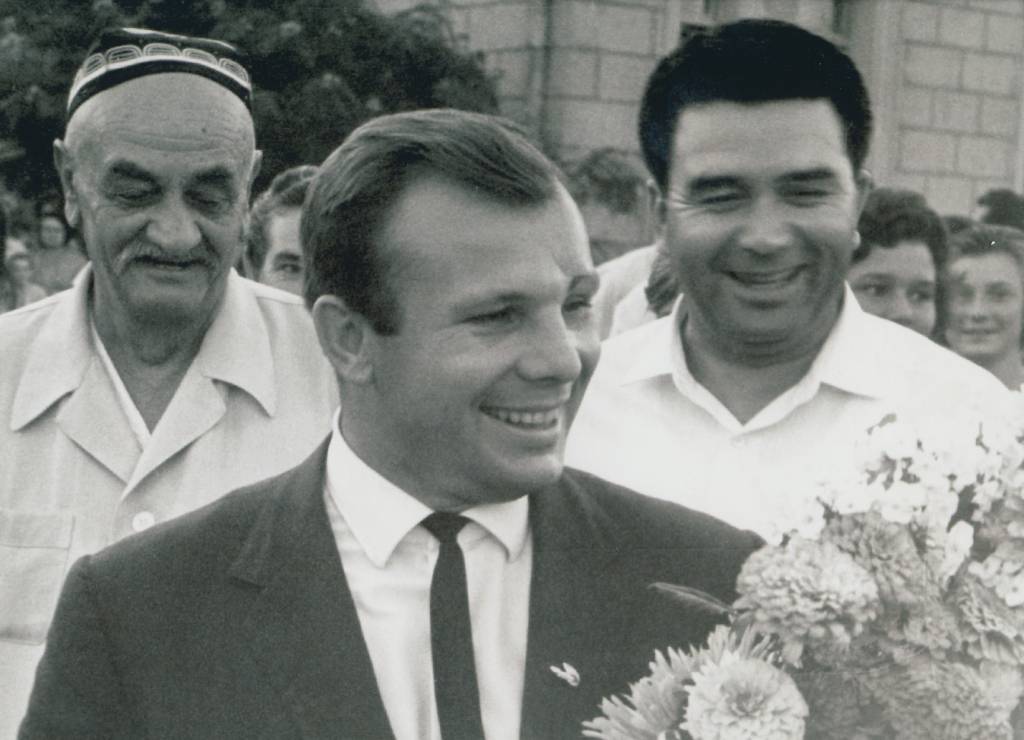
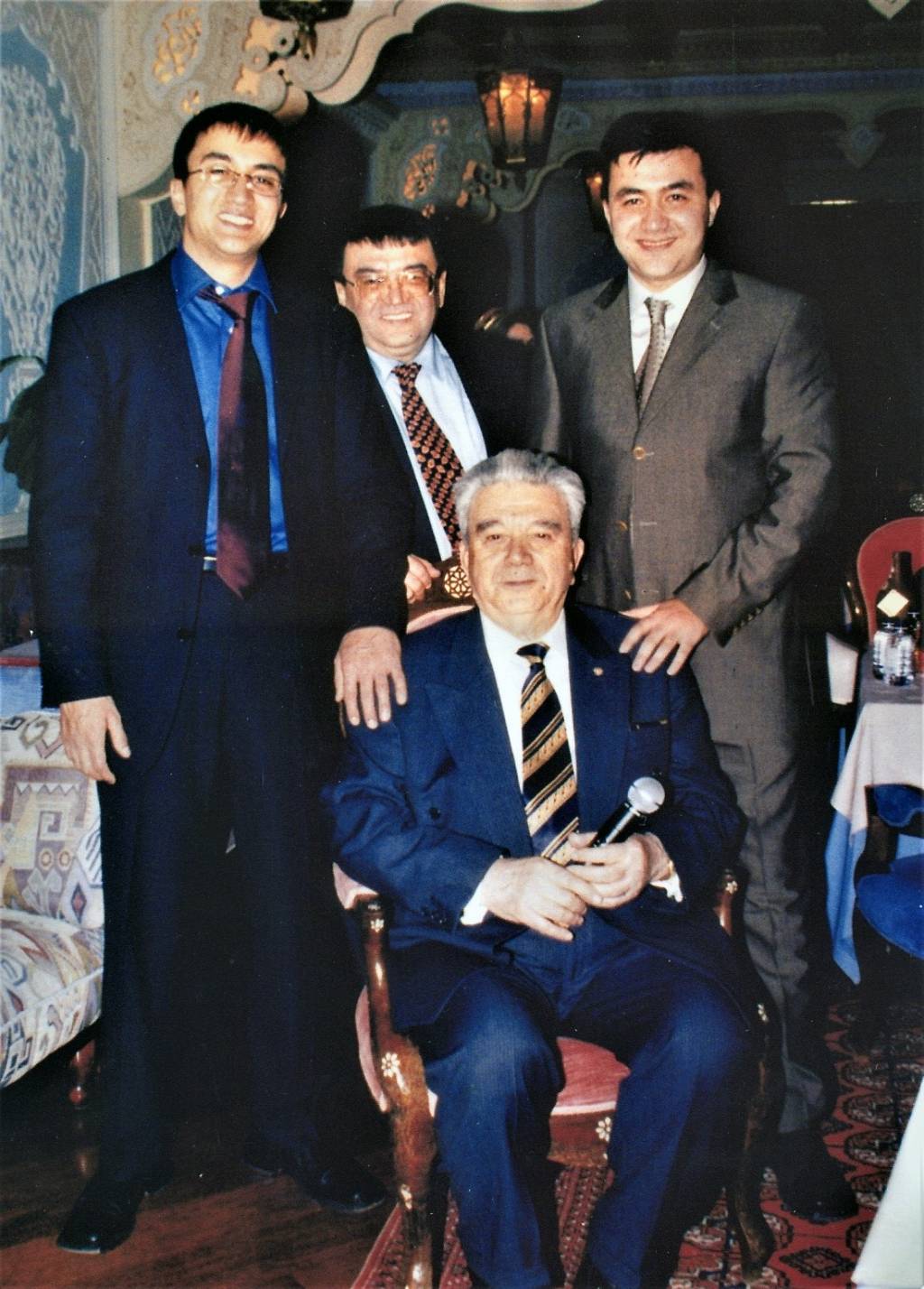
With the first cosmonaut of the world Yuri Gagarin

UzA