


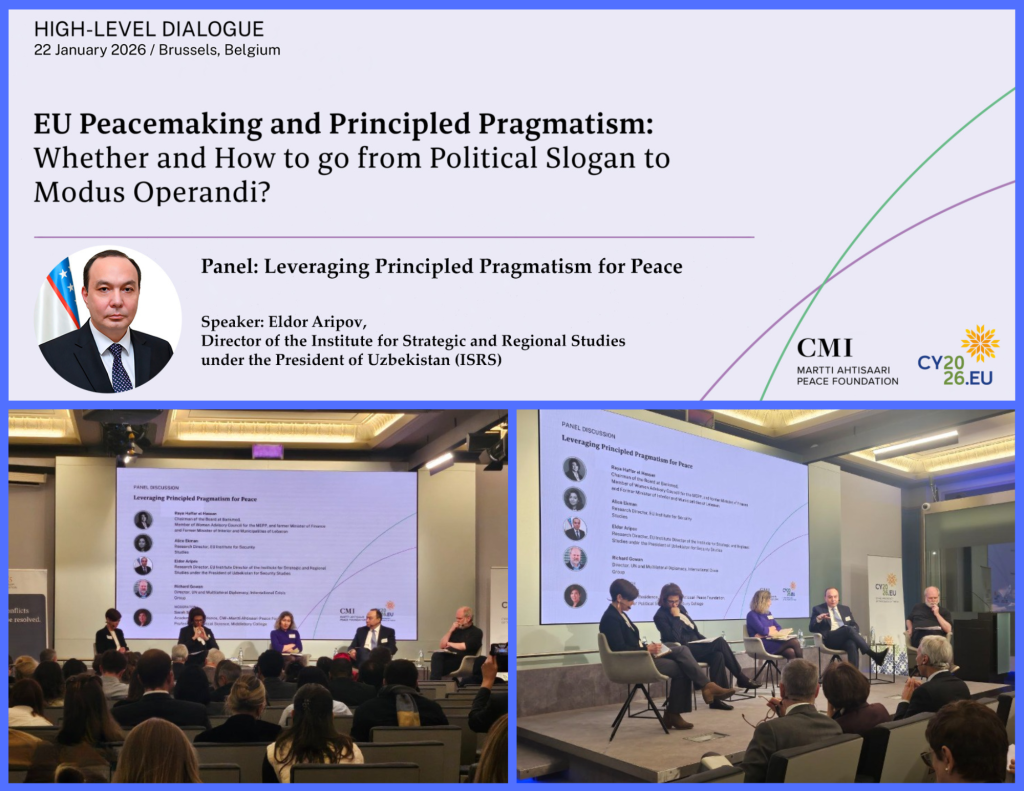
On January 22, 2026, a High-Level Dialogue was held in Brussels, Belgium, organized by the Martti Ahtisaari Peace Foundation in partnership with the Polish Presidency of the Council of the EU and the Ministry of Foreign Affairs, European Union and Cooperation of Spain.
The Martti Ahtisaari Peace Foundation, founded by Nobel Peace Prize laureate and former President of Finland, occupies a unique niche in European peace diplomacy. With over 100 international experts and 300 strategic partners, the Foundation actively supports more than 50 peace processes across the Middle East and Eurasia.
The event was attended by over 120 high-level representatives from various countries, including the leadership of the European External Action Service, EU Special Representatives, foreign ministers of EU member states, representatives of the UN, the African Union, leading European think tanks, and research institutes.
Among the key participants were Rebeca Grynspan, Secretary-General of the United Nations Conference on Trade and Development (UNCTAD); João Cravinho, the European Union Special Representative for the Sahel; Phumzile Mlambo-Ngcuka, a Member of the African Union Panel of the Wise; and other distinguished participants.
The central theme was the concept of “principled pragmatism”, which the European Union seeks to transform from a political slogan into the operational logic of its foreign policy.
Uzbekistan was represented at the event by Eldor Aripov, Director of the Institute for Strategic and Regional Studies under the President of the Republic of Uzbekistan (ISRS), who spoke at the panel session “Leveraging Principled Pragmatism for Peace”.
Central Asia and the ambitious peacebuilding efforts of the President of the Republic of Uzbekistan Shavkat Mirziyoyev were of particular interest to the dialogue participants. European experts praised President Shavkat Mirziyoyev’s consistent and systemic policies in Central Asia, noting their transformative impact on regional security architecture and global conflict-resolution processes.
It was particularly emphasized that Uzbekistan has developed a unique model of “inclusive diplomacy” that involves all stakeholders without preconditions.
The proactive policies of the region’s countries have enabled Central Asia to transform from an object of geopolitical rivalry into a subject of international relations capable of generating its own solutions to regional challenges.
In his speech, Eldor Aripov noted that just ten years ago, Central Asia faced serious challenges: unresolved border issues, water distribution disputes, closed borders, and limited people-to-people contacts. Today, the situation has changed dramatically.
All key disputes have been resolved, borders have become open and functional, and mutual trust has grown significantly. Regional trade has increased fivefold, mutual investment has doubled, and even during the pandemic, Central Asian countries have maintained open borders to supply vital goods.
“It’s not the geography that has changed – it’s the political thinking”, he noted.
The ISRS Director identified several key factors that have contributed to this positive dynamic. These include political will at the highest level – the conscious choice of regional leaders in favor of stability and development; a pragmatic approach to resolving complex issues – from border delimitation to water resource management; an awareness of the shared history and interdependence of the countries in the region; and the active role of local communities, where peace was strengthened through people-to-people contacts, cross-border trade, and tourism.
“Peace was perceived not as an abstract goal, but as a practical necessity for development”, the ISRS Director emphasized.
Speaking about interactions with external partners, Eldor Aripov specifically focused on Uzbekistan’s policy toward Afghanistan. According to him, Tashkent believes that isolation cannot be a tool for stabilization.
“Isolation contributes neither to modernization nor to stability; on the contrary, it creates fertile ground for extremism and terrorism”, he stated.
Uzbekistan views economic integration as a key factor for achieving sustainable peace in Afghanistan and the wider region. As an illustrative example, reference was made to the Termez International Trade Center, where Afghan and Pakistani entrepreneurs can conduct business under a visa-free regime. Currently, more than 200 Afghan enterprises are operating at the Center. Plans are also underway to establish an industrial cluster in Afghanistan.
In conclusion, the ISRS Director emphasized that Central Asia’s contribution to peacebuilding beyond the region lies not in exporting ready-made solutions, but in demonstrating the effectiveness of a pragmatic approach.
“Regional responsibility, economic integration, and pragmatic engagement can complement diplomatic and security measures, enhancing their impact”, he concluded.

During his stay in Brussels, Eldor Aripov held several substantive meetings with representatives of European and international research centers, including the International Crisis Group (ICG), the European Union Institute for Security Studies (EUISS), the Martti Ahtisaari Peace Foundation, the European Policy Center (EPC), and Carnegie Europe. He also held talks with representatives of the European External Action Service (EEAS).
During these discussions, ways to further develop multifaceted cooperation with European partners were discussed. Particular attention was paid to intensifying expert dialogue and cooperation between the EEAS and research, academic, and think tanks in EU countries. New ideas and proposals to strengthen bilateral and multilateral partnerships were considered.
UzA