The dawn of April 4, 2025, painted the skies over Samarkand in the symbolic colors of a new era in diplomacy. On this historic day, the ancient city, which for centuries served as a bridge between civilizations, once again appeared before the world in a truly special status – as a center of modern global diplomacy.

On its squares and in the halls of Registan, the leaders of the European Union and all five Central Asian states gathered at one table to lay the foundation of an unprecedented strategic partnership. This step, according to President of the European Commission Ursula von der Leyen, became “a clear signal to the whole world that Central Asia and Europe choose the path of joint creation”.

The fact that Uzbekistan, once a cautious observer of international processes, has today become the venue for such a large-scale dialogue has deep roots. This is not merely a coincidence or a set of circumstances, but the logical result of a deliberate and vigorous course pursued by President Shavkat Mirziyoyev, who, in just a few years, has transformed the country into a vibrant and sought-after player on the global stage.

In Mirziyoyev’s new diplomatic doctrine, three clear and well-defined principles are embedded – openness, pragmatism, and multi-vector policy. Openness means readiness for dialogue with anyone who shares the ideas of mutual respect and cooperation. Pragmatism is the ability to focus on concrete results, avoiding fruitless declarations and endless disputes. Multi-vector policy is the art of diplomatic balance, in which Uzbekistan successfully combines diverse interests, building trusted relations simultaneously with both East and West, leading powers, and regional partners.

Today, Uzbekistan’s voice is heard with respect and attention on the platforms of the UN, UNESCO, the SCO, the OIC, and other reputable international organizations. Heads of state and major international associations have publicly acknowledged the achievements of Shavkat Mirziyoyev and emphasized the important role the country plays in stabilizing the region, developing infrastructure, addressing humanitarian issues, and strengthening intercultural dialogue.

https://president.uz/uploads/2f363ab2-1881-4491-1d3f-1d4d15628a29_lists_slider_8024.jpg

Modern Uzbek diplomacy, led by President Mirziyoyev, demonstrates that in an era of global challenges, success is ensured not by isolation but by engagement, not by confrontation but by dialogue, not by opposition but by partnership. It is precisely thanks to this clear and consistent position, the personal determination, and the diplomatic wisdom of the Head of State that Uzbekistan has firmly established itself as a new phenomenon of global diplomacy, one that is discussed, listened to, and welcomed as a partner for moving forward.

In just the past three years, Tashkent has initiated ten special UN General Assembly resolutions – from recognizing the Aral Sea region as a zone of environmental innovation to adopting the program on connectivity between Central and South Asia. Uzbekistan became the first country in the region to host the 150th Assembly of the Inter-Parliamentary Union, hold the UN Public Service Forum 2025, and is preparing for the 43rd General Conference of UNESCO. In the economy, “handshake contracts” are rapidly becoming billion-dollar investments: Fitch upgraded the sovereign rating to BB, the EBRD expanded its portfolio to a record €5 billion, and Tashkent’s green bonds were oversubscribed threefold. On the map of Eurasia, new corridors are emerging – the China – Kyrgyzstan – Uzbekistan railway and the Trans-Afghan route to the Indian Ocean. On the energy map, these developments include the 1.5 GW ACWA Power wind farm and mandatory solar generation on every new rooftop.

However, perhaps the most important capital remains the trust of people and neighbors. When the presidents of Kazakhstan, Tajikistan, and Kyrgyzstan sign the Khujand Declaration of Eternal Friendship, they confirm that Tashkent has successfully transformed good-neighborliness into a tangible value. And when the leaders of the EU and all five Central Asian states gather at one table in Samarkand, it means that the formula of “soft borders and firm guarantees” proposed by Mirziyoyev has become a viable and effective political model. That is why, today, as one hears the diplomatic voices of different capitals, a unified and confident refrain is increasingly being heard: Uzbekistan is a reliable bridge between continents and cultures, a partner with whom it is worth building the future.

A New Diplomatic Course: Philosophy and Approaches

Uzbekistan’s modern diplomatic course, laid down by President Shavkat Mirziyoyev, is today perceived by the international community as a model of a balanced and pragmatic approach to complex global processes. At the core of the new foreign policy doctrine lies the principle of absolute openness: Tashkent has made it clear that its doors are open for equal and mutually respectful dialogue with any state in the world that is ready to seek joint solutions. This diplomatic philosophy enables Uzbekistan to remain flexible, respond promptly to international challenges, and simultaneously preserve stability and sovereignty in defending its own national interests.

Pragmatism is another key pillar of Uzbekistan’s foreign policy. Mirziyoyev has repeatedly emphasized that diplomacy should not be about loud statements, but about real actions that bring tangible benefits to citizens and the state. This approach has secured the country a solid reputation as a reliable partner, capable of turning words into deeds and agreements into concrete results. Today, it is precisely this pragmatism that attracts investors and partners from Europe, Asia, the Middle East, and America, transforming Uzbekistan into a dynamically developing platform for global cooperation.

Another fundamental element of Mirziyoyev’s diplomatic strategy is the balance of interests. The President has repeatedly noted that Uzbekistan seeks to build multi-vector relations, avoiding unnecessary confrontation and refraining from involvement in bloc politics. As Shavkat Mirziyoyev put it, “Today is not a time for walls and barriers, today is a time for bridges and paths of mutual understanding”. At the UN General Assembly, he clearly articulated this position, stressing that “modern international challenges cannot be overcome through force and pressure; they require precisely diplomatic patience, respect for international law, and a culture of dialogue”.

The negotiation style chosen by Shavkat Mirziyoyev has already become recognizable. It is a balanced and restrained manner of communication, marked by the readiness to listen attentively to the interlocutor and to take into account the position of the counterpart. This very approach makes it possible to find compromises even in the most difficult situations, whether in disputed border issues, water and energy problems, or international conflicts. Mirziyoyev has often emphasized that “diplomacy must work preventively”, rather than merely resolving crises that have already erupted. In his words, “true diplomacy is the ability to see a solution where others see a problem, and to open doors where others believe them to be closed”.

Today, it is precisely thanks to this style that Uzbek diplomacy has become a tool of peace and harmony, helping to stabilize the region and unite the efforts of different countries and peoples in achieving common goals. By his own example, Mirziyoyev demonstrates that in the 21st century, diplomacy can only be effective when equal partners sit at the negotiating table, ready to meet each other halfway and jointly seek paths to sustainable peace and prosperity.

Central Asia: A New Era of Cooperation

https://president.uz/uploads/d742d765-7546-17f6-acbf-3efb51af6e6d_lists_slider_8001.jpg

If Mirziyoyev’s “diplomatic revolution” set a new course for Uzbekistan, its first tangible result was a genuine breakthrough for the entire Central Asian region toward a format of constructive partnership. The driving force here was precisely Tashkent: thanks to Uzbekistan’s active position, the consultative meetings of the region’s presidents, once one-off gestures of goodwill, have evolved into a regularly functioning mechanism. Their expansion into the “C5+1” format with the participation of the United States gave the dialogue additional support: over the past two summits, a green corridor for cargo has been agreed upon, common principles of tariff policy have been developed, and in New York, a roadmap for digital integration was signed, opening the way for a unified payment and logistics window. In response, the American side announced the expansion of DFC and USAID credit lines to one billion dollars, but most importantly, consolidated a diplomatic consensus: the region itself formulates its agenda and manages it independently.

The most vivid symbol of the new trust was the Khujand Declaration of Eternal Friendship, signed on March 31, 2025, by the presidents of Uzbekistan, Tajikistan, and Kyrgyzstan. The document not only legally established the final “junction point” of the three borders but also set forth the commitment to resolve all future disagreements exclusively through direct negotiations. The Ministry of Foreign Affairs of Tajikistan called it a “historic milestone of regional reconciliation”, while the UN Security Council welcomed the declaration as “a model of preventive diplomacy”. Immediately after ratification, movement resumed through three border crossings, and trade turnover among the three countries grew by 27 percent in the first half of the year.

The infrastructure framework for rapprochement is being formed by megaprojects that until recently were considered “on paper”. In June 2024, Beijing, Bishkek, and Tashkent finalized the route of the China – Kyrgyzstan – Uzbekistan railway; construction and survey work has already begun in the Norin Gorge. In the south, Uzbekistan and Afghanistan have agreed on the technical and economic parameters of the Trans-Afghan Corridor, which will connect Mazar-i-Sharif, Kabul, and Peshawar for the first time, thereby establishing the shortest overland route to the Arabian Sea ports. Both routes have been supported by the Asian Development Bank and the Islamic Development Bank, with a combined freight potential estimated at more than 20 million tons per year.

Equally notable is the success achieved in the water and energy sectors, which have traditionally been the most sensitive areas for the region. In January 2025, the energy ministers of Kyrgyzstan, Kazakhstan, and Uzbekistan, with the mediation of the World Bank, signed an agreement on the joint financing of the 1.9 GW Kambarata HPP-1, which links the water release schedule with the supply of electricity to lowland areas during winter. With Tajikistan, Uzbekistan is already building the 140 MW Yavan HPP on the Zarafshan River – the first case in which a downstream country invests in the hydropower of an upstream neighbor. At the same time, work is underway to connect Dushanbe to the unified CAPS energy system, while the deputy prime ministers of the five countries agreed on the principle of “water in exchange for energy”, which helps to ease seasonal shortages.

Thus, in less than a decade, Central Asia has transformed from an archipelago of fragmented states into a complementary economic and transport ecosystem. Railway corridors, joint hydropower plants, open borders, and a unified tariff policy are shaping a new reality in which every capital benefits from collective stability. And in every key story – whether Khujand, the CKU (China – Kyrgyzstan – Uzbekistan) railway, or the Kambarata dam – the hallmark of Uzbek diplomacy is unmistakably present: preventing conflicts, seeking a balance of interests, and turning political declarations into tangible development projects.

Diplomatic Initiatives and the International Arena

The clearest indicator that Tashkent has finally moved from the category of “regional moderators” into the club of global initiators is the series of ten special UN General Assembly resolutions adopted at Uzbekistan’s initiative or with its co-authorship. Among them are document A/RES/75/278, which proclaimed the Aral Sea region a zone of environmental innovations and technologies, and resolution A/RES/76/295 on strengthening connectivity between Central and South Asia, which was adopted without a single vote against. The content of these texts demonstrates that Tashkent is able to transform its national agenda – ecology, transport, climate – into a universal interest for 193 states.

The same logic has placed Samarkand on the map of major multilateral forums. In October-November 2025, the ancient city will host the 43rd UNESCO General Conference – for the first time in the history of Central Asia – and already in June of the same year, it hosted the UN Public Service Forum under the slogan “Five Years to 2030: Accelerating Digital Transformation”. In effect, Samarkand is confirming its status as a diplomatic capital, where the culture of the Silk Road blends organically with discussions on global governance.

Equally notable was the choice of Tashkent as the venue for the 150th Assembly of the Inter-Parliamentary Union, from April 5 to 9, 2025, where delegates from more than 140 countries gathered to discuss the role of parliaments in the post-pandemic world. The very fact of holding the jubilee forum in Uzbekistan was explained by the IPU as recognition of the country’s “notable progress in parliamentary reforms and the expansion of public oversight”.

The pinnacle of this “global upgrade” was the first EU – Central Asia summit on April 4, 2025. In Samarkand, European Council President António Costa and the presidents of the five Central Asian countries met at one table; Ursula von der Leyen announced a €12 billion Global Gateway package and called the participants “partners of choice”, while the host of the meeting, Shavkat Mirziyoyev, emphasized that the region’s trade turnover with the EU had already reached €54 billion.

In other words, within a short historical period, Uzbekistan has managed to “reorient the compass” of world diplomacy: from practical local issues to solutions of planetary scale, from environmental innovations in the Aral Sea region to Eurasian corridors and digital governance. Each new platform and each resolution only strengthens the country’s reputation as a reliable architect of international consensus.

The diplomatic phenomenon of Uzbekistan is not only about broad recognition on the global stage, but also a chain of practical successes reflected in trust ratings, an unprecedented inflow of investments, and a portfolio of green megaprojects. Today, the country’s growing economic potential, accelerated digitalization, targeted social programs, and generous humanitarian agenda have become integral to its new foreign policy identity.

Most remarkable is that Tashkent has managed to change the very lens through which the world views Central Asia. If until recently external partners dealt with each country strictly “individually”, today, largely thanks to the persistent initiatives of Shavkat Mirziyoyev, the region is increasingly perceived as an interconnected whole, where the success of one state is amplified through joint projects and the consultative formats of the “C5”. It is precisely this partnership that is turning Uzbekistan into a reliable bridge between Europe, Asia, and the Middle East, fostering an atmosphere of trust and openness, and enhancing the overall investment attractiveness of Central Asia.

A course based on pragmatism, a balance of interests, and scrupulous respect for international law enables Tashkent to strengthen the country’s sovereignty while at the same time serving as a sought-after architect of regional harmony.

The scale of this phenomenon cannot be captured in a single publication. In the second part of the article, we will examine in detail Uzbekistan’s economic diplomacy and international credibility, analyze the success of digital transformation, the social and humanitarian spheres, as well as the special role of cultural diplomacy and the personal style of the leader, thanks to which a regional project has turned into a globally recognized success story.

Abduaziz Khidirov, UzA

English
Chinese
Turkish
Tajik
Kyrgyz
Turkmen
Japanese
Arabic
English
French
Spanish
Русский
German
Ўзбек
Oʻzbek
Қазақ
New Uzbekistan – An Important Initiator of an Open and Pragmatic Foreign Policy in the Global Community
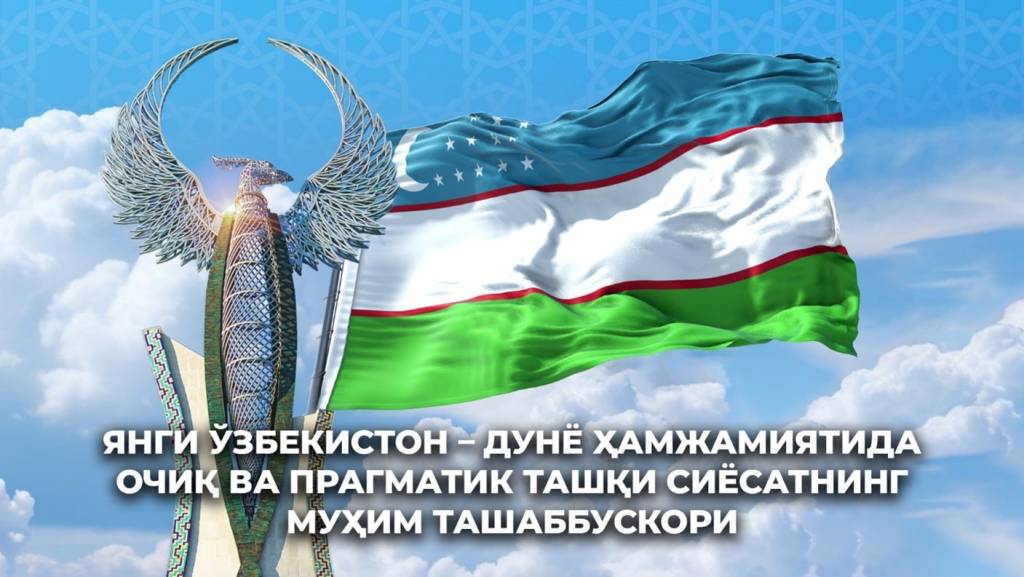
The dawn of April 4, 2025, painted the skies over Samarkand in the symbolic colors of a new era in diplomacy. On this historic day, the ancient city, which for centuries served as a bridge between civilizations, once again appeared before the world in a truly special status – as a center of modern global diplomacy.

On its squares and in the halls of Registan, the leaders of the European Union and all five Central Asian states gathered at one table to lay the foundation of an unprecedented strategic partnership. This step, according to President of the European Commission Ursula von der Leyen, became “a clear signal to the whole world that Central Asia and Europe choose the path of joint creation”.

The fact that Uzbekistan, once a cautious observer of international processes, has today become the venue for such a large-scale dialogue has deep roots. This is not merely a coincidence or a set of circumstances, but the logical result of a deliberate and vigorous course pursued by President Shavkat Mirziyoyev, who, in just a few years, has transformed the country into a vibrant and sought-after player on the global stage.

In Mirziyoyev’s new diplomatic doctrine, three clear and well-defined principles are embedded – openness, pragmatism, and multi-vector policy. Openness means readiness for dialogue with anyone who shares the ideas of mutual respect and cooperation. Pragmatism is the ability to focus on concrete results, avoiding fruitless declarations and endless disputes. Multi-vector policy is the art of diplomatic balance, in which Uzbekistan successfully combines diverse interests, building trusted relations simultaneously with both East and West, leading powers, and regional partners.

Today, Uzbekistan’s voice is heard with respect and attention on the platforms of the UN, UNESCO, the SCO, the OIC, and other reputable international organizations. Heads of state and major international associations have publicly acknowledged the achievements of Shavkat Mirziyoyev and emphasized the important role the country plays in stabilizing the region, developing infrastructure, addressing humanitarian issues, and strengthening intercultural dialogue.

https://president.uz/uploads/2f363ab2-1881-4491-1d3f-1d4d15628a29_lists_slider_8024.jpg

Modern Uzbek diplomacy, led by President Mirziyoyev, demonstrates that in an era of global challenges, success is ensured not by isolation but by engagement, not by confrontation but by dialogue, not by opposition but by partnership. It is precisely thanks to this clear and consistent position, the personal determination, and the diplomatic wisdom of the Head of State that Uzbekistan has firmly established itself as a new phenomenon of global diplomacy, one that is discussed, listened to, and welcomed as a partner for moving forward.

In just the past three years, Tashkent has initiated ten special UN General Assembly resolutions – from recognizing the Aral Sea region as a zone of environmental innovation to adopting the program on connectivity between Central and South Asia. Uzbekistan became the first country in the region to host the 150th Assembly of the Inter-Parliamentary Union, hold the UN Public Service Forum 2025, and is preparing for the 43rd General Conference of UNESCO. In the economy, “handshake contracts” are rapidly becoming billion-dollar investments: Fitch upgraded the sovereign rating to BB, the EBRD expanded its portfolio to a record €5 billion, and Tashkent’s green bonds were oversubscribed threefold. On the map of Eurasia, new corridors are emerging – the China – Kyrgyzstan – Uzbekistan railway and the Trans-Afghan route to the Indian Ocean. On the energy map, these developments include the 1.5 GW ACWA Power wind farm and mandatory solar generation on every new rooftop.

However, perhaps the most important capital remains the trust of people and neighbors. When the presidents of Kazakhstan, Tajikistan, and Kyrgyzstan sign the Khujand Declaration of Eternal Friendship, they confirm that Tashkent has successfully transformed good-neighborliness into a tangible value. And when the leaders of the EU and all five Central Asian states gather at one table in Samarkand, it means that the formula of “soft borders and firm guarantees” proposed by Mirziyoyev has become a viable and effective political model. That is why, today, as one hears the diplomatic voices of different capitals, a unified and confident refrain is increasingly being heard: Uzbekistan is a reliable bridge between continents and cultures, a partner with whom it is worth building the future.

A New Diplomatic Course: Philosophy and Approaches

Uzbekistan’s modern diplomatic course, laid down by President Shavkat Mirziyoyev, is today perceived by the international community as a model of a balanced and pragmatic approach to complex global processes. At the core of the new foreign policy doctrine lies the principle of absolute openness: Tashkent has made it clear that its doors are open for equal and mutually respectful dialogue with any state in the world that is ready to seek joint solutions. This diplomatic philosophy enables Uzbekistan to remain flexible, respond promptly to international challenges, and simultaneously preserve stability and sovereignty in defending its own national interests.

Pragmatism is another key pillar of Uzbekistan’s foreign policy. Mirziyoyev has repeatedly emphasized that diplomacy should not be about loud statements, but about real actions that bring tangible benefits to citizens and the state. This approach has secured the country a solid reputation as a reliable partner, capable of turning words into deeds and agreements into concrete results. Today, it is precisely this pragmatism that attracts investors and partners from Europe, Asia, the Middle East, and America, transforming Uzbekistan into a dynamically developing platform for global cooperation.

Another fundamental element of Mirziyoyev’s diplomatic strategy is the balance of interests. The President has repeatedly noted that Uzbekistan seeks to build multi-vector relations, avoiding unnecessary confrontation and refraining from involvement in bloc politics. As Shavkat Mirziyoyev put it, “Today is not a time for walls and barriers, today is a time for bridges and paths of mutual understanding”. At the UN General Assembly, he clearly articulated this position, stressing that “modern international challenges cannot be overcome through force and pressure; they require precisely diplomatic patience, respect for international law, and a culture of dialogue”.

The negotiation style chosen by Shavkat Mirziyoyev has already become recognizable. It is a balanced and restrained manner of communication, marked by the readiness to listen attentively to the interlocutor and to take into account the position of the counterpart. This very approach makes it possible to find compromises even in the most difficult situations, whether in disputed border issues, water and energy problems, or international conflicts. Mirziyoyev has often emphasized that “diplomacy must work preventively”, rather than merely resolving crises that have already erupted. In his words, “true diplomacy is the ability to see a solution where others see a problem, and to open doors where others believe them to be closed”.

Today, it is precisely thanks to this style that Uzbek diplomacy has become a tool of peace and harmony, helping to stabilize the region and unite the efforts of different countries and peoples in achieving common goals. By his own example, Mirziyoyev demonstrates that in the 21st century, diplomacy can only be effective when equal partners sit at the negotiating table, ready to meet each other halfway and jointly seek paths to sustainable peace and prosperity.

Central Asia: A New Era of Cooperation

https://president.uz/uploads/d742d765-7546-17f6-acbf-3efb51af6e6d_lists_slider_8001.jpg

If Mirziyoyev’s “diplomatic revolution” set a new course for Uzbekistan, its first tangible result was a genuine breakthrough for the entire Central Asian region toward a format of constructive partnership. The driving force here was precisely Tashkent: thanks to Uzbekistan’s active position, the consultative meetings of the region’s presidents, once one-off gestures of goodwill, have evolved into a regularly functioning mechanism. Their expansion into the “C5+1” format with the participation of the United States gave the dialogue additional support: over the past two summits, a green corridor for cargo has been agreed upon, common principles of tariff policy have been developed, and in New York, a roadmap for digital integration was signed, opening the way for a unified payment and logistics window. In response, the American side announced the expansion of DFC and USAID credit lines to one billion dollars, but most importantly, consolidated a diplomatic consensus: the region itself formulates its agenda and manages it independently.

The most vivid symbol of the new trust was the Khujand Declaration of Eternal Friendship, signed on March 31, 2025, by the presidents of Uzbekistan, Tajikistan, and Kyrgyzstan. The document not only legally established the final “junction point” of the three borders but also set forth the commitment to resolve all future disagreements exclusively through direct negotiations. The Ministry of Foreign Affairs of Tajikistan called it a “historic milestone of regional reconciliation”, while the UN Security Council welcomed the declaration as “a model of preventive diplomacy”. Immediately after ratification, movement resumed through three border crossings, and trade turnover among the three countries grew by 27 percent in the first half of the year.

The infrastructure framework for rapprochement is being formed by megaprojects that until recently were considered “on paper”. In June 2024, Beijing, Bishkek, and Tashkent finalized the route of the China – Kyrgyzstan – Uzbekistan railway; construction and survey work has already begun in the Norin Gorge. In the south, Uzbekistan and Afghanistan have agreed on the technical and economic parameters of the Trans-Afghan Corridor, which will connect Mazar-i-Sharif, Kabul, and Peshawar for the first time, thereby establishing the shortest overland route to the Arabian Sea ports. Both routes have been supported by the Asian Development Bank and the Islamic Development Bank, with a combined freight potential estimated at more than 20 million tons per year.

Equally notable is the success achieved in the water and energy sectors, which have traditionally been the most sensitive areas for the region. In January 2025, the energy ministers of Kyrgyzstan, Kazakhstan, and Uzbekistan, with the mediation of the World Bank, signed an agreement on the joint financing of the 1.9 GW Kambarata HPP-1, which links the water release schedule with the supply of electricity to lowland areas during winter. With Tajikistan, Uzbekistan is already building the 140 MW Yavan HPP on the Zarafshan River – the first case in which a downstream country invests in the hydropower of an upstream neighbor. At the same time, work is underway to connect Dushanbe to the unified CAPS energy system, while the deputy prime ministers of the five countries agreed on the principle of “water in exchange for energy”, which helps to ease seasonal shortages.

Thus, in less than a decade, Central Asia has transformed from an archipelago of fragmented states into a complementary economic and transport ecosystem. Railway corridors, joint hydropower plants, open borders, and a unified tariff policy are shaping a new reality in which every capital benefits from collective stability. And in every key story – whether Khujand, the CKU (China – Kyrgyzstan – Uzbekistan) railway, or the Kambarata dam – the hallmark of Uzbek diplomacy is unmistakably present: preventing conflicts, seeking a balance of interests, and turning political declarations into tangible development projects.

Diplomatic Initiatives and the International Arena

The clearest indicator that Tashkent has finally moved from the category of “regional moderators” into the club of global initiators is the series of ten special UN General Assembly resolutions adopted at Uzbekistan’s initiative or with its co-authorship. Among them are document A/RES/75/278, which proclaimed the Aral Sea region a zone of environmental innovations and technologies, and resolution A/RES/76/295 on strengthening connectivity between Central and South Asia, which was adopted without a single vote against. The content of these texts demonstrates that Tashkent is able to transform its national agenda – ecology, transport, climate – into a universal interest for 193 states.

The same logic has placed Samarkand on the map of major multilateral forums. In October-November 2025, the ancient city will host the 43rd UNESCO General Conference – for the first time in the history of Central Asia – and already in June of the same year, it hosted the UN Public Service Forum under the slogan “Five Years to 2030: Accelerating Digital Transformation”. In effect, Samarkand is confirming its status as a diplomatic capital, where the culture of the Silk Road blends organically with discussions on global governance.

Equally notable was the choice of Tashkent as the venue for the 150th Assembly of the Inter-Parliamentary Union, from April 5 to 9, 2025, where delegates from more than 140 countries gathered to discuss the role of parliaments in the post-pandemic world. The very fact of holding the jubilee forum in Uzbekistan was explained by the IPU as recognition of the country’s “notable progress in parliamentary reforms and the expansion of public oversight”.

The pinnacle of this “global upgrade” was the first EU – Central Asia summit on April 4, 2025. In Samarkand, European Council President António Costa and the presidents of the five Central Asian countries met at one table; Ursula von der Leyen announced a €12 billion Global Gateway package and called the participants “partners of choice”, while the host of the meeting, Shavkat Mirziyoyev, emphasized that the region’s trade turnover with the EU had already reached €54 billion.

In other words, within a short historical period, Uzbekistan has managed to “reorient the compass” of world diplomacy: from practical local issues to solutions of planetary scale, from environmental innovations in the Aral Sea region to Eurasian corridors and digital governance. Each new platform and each resolution only strengthens the country’s reputation as a reliable architect of international consensus.

The diplomatic phenomenon of Uzbekistan is not only about broad recognition on the global stage, but also a chain of practical successes reflected in trust ratings, an unprecedented inflow of investments, and a portfolio of green megaprojects. Today, the country’s growing economic potential, accelerated digitalization, targeted social programs, and generous humanitarian agenda have become integral to its new foreign policy identity.

Most remarkable is that Tashkent has managed to change the very lens through which the world views Central Asia. If until recently external partners dealt with each country strictly “individually”, today, largely thanks to the persistent initiatives of Shavkat Mirziyoyev, the region is increasingly perceived as an interconnected whole, where the success of one state is amplified through joint projects and the consultative formats of the “C5”. It is precisely this partnership that is turning Uzbekistan into a reliable bridge between Europe, Asia, and the Middle East, fostering an atmosphere of trust and openness, and enhancing the overall investment attractiveness of Central Asia.

A course based on pragmatism, a balance of interests, and scrupulous respect for international law enables Tashkent to strengthen the country’s sovereignty while at the same time serving as a sought-after architect of regional harmony.

The scale of this phenomenon cannot be captured in a single publication. In the second part of the article, we will examine in detail Uzbekistan’s economic diplomacy and international credibility, analyze the success of digital transformation, the social and humanitarian spheres, as well as the special role of cultural diplomacy and the personal style of the leader, thanks to which a regional project has turned into a globally recognized success story.

Abduaziz Khidirov, UzA