

Along with the government and state organizations, international organizations also make a significant contribution to the development of the country and the well-being of people. There are several international organizations in Uzbekistan. One of them is the U.S. Agency for International Development.
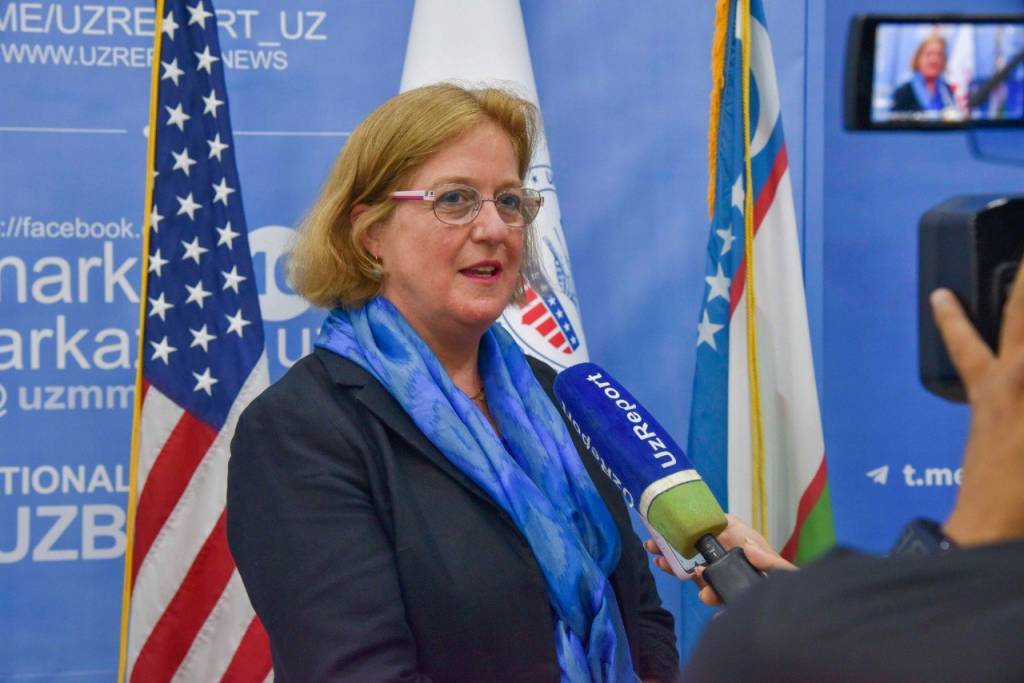
UzA Correspondent interviewed the USAID Mission Director in Uzbekistan, Mikaela Meredith, about the projects implemented by the organization and grants allocated for the country.
– Could you please tell us what projects are implemented by USAID in Uzbekistan?
– Assistance provided by the United States Agency for International Development (USAID) supports the key United States government policy objectives of strengthening our partnership with Uzbekistan and advancing Uzbekistan’s national sovereignty and economic independence by promoting stability, resiliency, and prosperity. USAID’s strategy mirrors the key priorities in Uzbekistan’s Development Strategy of the New Uzbekistan (2022-2026) and supports Uzbekistan’s wide-ranging political, economic, and social reform agendas. USAID assistance comes in a variety of forms including grants, donations, and technical assistance.
Critical to our approach is to support local partners – government institutions, civil society and the private sector – to enhance their self-reliance and ability to progress on their own development journeys.
USAID supports over 25 regional and bilateral programs in four main sectors that form the backbone of our work in Uzbekistan: Economic Growth and Environment, Education, Health, and Democracy and Governance.
Allow me to provide a few examples in each of the sectors:
To help advance Uzbekistan’s economic growth, USAID is supporting a range of initiatives to facilitate trade, diversify the economy, address climate change, and promote energy connectivity within the region. We are also providing $3.4 million to support Women’s Economic Empowerment initiatives, which are a combination of entrepreneurship, business skills, and vocational training. This year alone, USAID trained 1,500 rural women in business development, legal rights, e-commerce, and IT, and different vocational training. Over 500 of these women have already found jobs. USAID also assisted almost 1,000 producers and processors of agricultural goods to adopt new technologies or management practices, and 3,200 farmers to start, increase, or improve agribusiness activities.
To support the Ministry of Public Education’s (MOPE) reform initiatives, USAID has committed to spend up to $55 million. This includes USAID’s four-year, $29.5 million program supporting MOPE reform initiatives to improve reading and math in grades 1-4, enhance information and communications technology (ICT) instruction, and improve English language instruction. Last year, USAID piloted a new curriculum and materials for English as a Foreign language instruction in 213 schools. We are thrilled that the MOPE rolled out this instructional package on a national scale this year, printing USAID-supported textbooks for the entire public school system – approximately 6.5 million students and tens of thousands of teachers in over 10,000 schools. Also, USAID recently launched a $10 million activity, in partnership with the MOPE, to equip youth in grades 8-11 with the necessary skills to enter Uzbekistan’s economy as competent employees or entrepreneurs. This program includes school-based and after-school programs and focuses on empowering young women and youth with disabilities, groups which remain underserved and underrepresented in Uzbekistan’s economy. The activity also includes regular collaboration with the private sector to ensure that the knowledge and skills youth will acquire are relevant to Uzbekistan’s labor market.
USAID supports the National Tuberculosis Program (NTP) with $6 million per year to fight multidrug resistant TB and to create shorter, accessible outpatient care focused on early detection and treatment. (In our 20 years of partnership with the NTP, USAID has provided over $58 million in assistance.) To fight COVID, we provided over $16 million to support the Republican Sanitary and Epidemiological Services’ COVID response and coordinated the arrival and distribution of 9.6 million doses of U.S. Government-donated vaccines.
USAID works in partnership with the Ministry of Justice to promote legal reforms. This includes supporting approximately 20 local civil society organizations that have provided free legal aid to an estimated 500,000 victims of human trafficking and domestic violence, migrants, people with disabilities, low-income families and people who lost their jobs or saw their incomes fall sharply during the pandemic. We also work with the Supreme Court, the Higher School of Judges and the Supreme Judicial Council to ensure justice for all and promote gender equity in Uzbekistan’s justice system.
Finally, in partnership with local organization Sog’lom Avlod Uchun, USAID has donated over 1,400 tons of humanitarian food aid to vulnerable populations in Uzbekistan over the past 13 years, including the elderly, children with disabilities in orphanages, and those in in-patient TB care.
We also have three themes we emphasize in all of our work. The first theme is gender and youth integration. USAID is working to ensure that women, youth, and people with disabilities participate in social and economic life equally. The second is our work with the private sector to catalyze innovation, drive entrepreneurship, and create jobs. Finally, we promote digital transformation and support the Government’s Digital Uzbekistan 2030 Strategy.
– How much has USAID allocated to Uzbekistan so far, and in what areas?
– Since 1993, USAID has provided close to $600 million in assistance to diversify the country’s economy and increase regional trade, advance judicial reform, strengthen civil society, and modernize the basic educational system. USAID also addresses serious health threats, including COVID-19 and Tuberculosis (TB) to help build the government’s capacity to respond to the population’s needs. In partnership with the Government of Uzbekistan and its implementing partners, USAID’s assistance aligns with the priorities of the Government of Uzbekistan.
It is important to understand that USAID does not provide loans. Our assistance comes in a range of forms (grants, contracts, technical assistance, embedded advisors, and in kind contributions) with no strings attached. The benefits of this assistance go to Uzbekistani beneficiaries and Uzbekistan as a nation.
As I mentioned before, USAID primarily works in four sectors. USAID’s economic assistance is predicated on two basic principles. The first is the preeminent role of the private sector in driving economic growth. Second is the importance of regional economic integration. An economically integrated Central Asia will have the market size and diversity to attract greater investment. USAID is working throughout Central Asia to support and foster intra-regional economic cooperation, including through the C5+1 diplomatic platform and the Regional American Chambers Network. To advance Uzbekistan’s economy, USAID partners with the government and the private sector to improve the business enabling environment, diversify the agriculture sector toward high-value commodities, and create formal jobs for Uzbekistan’s population, including women and youth. USAID also facilitates trade by helping domestic producers add value to their products and assists traders in finding new markets. In addition, USAID promotes tourism, helps coordinate regional power systems and renewable energy development, promotes sustainable transboundary water resources management, and addresses emerging environmental and climate challenges both locally and regionally.
USAID partners with the Ministry of Public Education to reform and modernize the education system to improve the learning outcomes and skills of Uzbekistan’s children and youth. USAID’s assistance strengthens the instruction of literacy, numeracy, English as a Foreign Language, and Information Technology in the public school system. New programming in 2022 is improving the work readiness and employability skills of youth to better prepare them to transition to the job market once they graduate.
In Democracy and Governance, USAID helps to build trust between the government and civil society by facilitating dialogue on critical topics, improving access to public information and promoting partnerships between civil society and the government. USAID also supports Uzbekistan’s efforts to strengthen adherence to the rule of law, build the capacity of legal professionals and training institutions, enhance citizens’ access to justice, improve the legal operating environment for civil society, promote gender equality and combat gender-based violence, and create a healthier investment climate. In addition, USAID assists in identifying and testing new methods for the prevention of violent extremism in Uzbekistan, works to combat human trafficking, and promotes safe migration for prospective migrants and at-risk individuals.
In Health, USAID partners with the Ministry of Health and National Tuberculosis Program to improve prevention, care, and treatment services for drug-resistant types of tuberculosis, one of the most pressing challenges for the country's public health system. Through those partnerships, we advance the quality and accessibility of health services, while strengthening the Government of Uzbekistan’s ability to effectively manage and respond to diseases affecting Uzbekistan. Since the beginning of the COVID-19 pandemic, the United States Government has supported the Government of Uzbekistan’s efforts to respond to COVID-19. To date, USAID has provided over $16 million in direct assistance to fight COVID-19 in Uzbekistan. This assistance has come in the form of life-saving equipment and ventilators, laboratory and medical supplies, training for healthcare workers, technical assistance, and support for awareness-raising information campaigns.
– Is USAID planning any projects to be implemented in the IT field?
– We are. The United States believes that the development of the IT industry is critical to every country. IT drives economic growth, creates new jobs, increases exports, and is the ultimate tool for strengthening transparency, the rule of law, and equal opportunity.
As I mentioned, supporting the digital transformation of Uzbekistan and the Government’s Digital Uzbekistan 2030 Strategy is incorporated into all of USAID’s work.
A few examples of USAID support are:
USAID provides IT and entrepreneurship training to young women who want to enter the sector or open IT businesses. The trainings range from basic e-commerce for artisans to full-stack programming for aspiring developers. We also partner with IT Park Uzbekistan to implement the Tumaris.Tech project which creates entrepreneurial opportunities for young women in Uzbekistan and all over Central Asia including creating a female tech startup community in the region.
USAID donates IT equipment to improve government services. In the Health sector, USAID’s donations of GeneXpert molecular diagnostic machines and artificial intelligence equipped portable backpack X-rays are lowering TB diagnosis times for some patients from weeks to hours and bringing screening services to those living in hard to reach, isolated areas. We are also supporting Uzbekistan’s National Tuberculosis Program to migrate towards a digitized data collection system. This will enable better data analysis which will help inform decisions to strengthen programs.
USAID helps Uzbekistan’s IT companies connect to international peers like Google, Amazon, PayPal, SAP, and Microsoft, by funding business tours and participation in international IT sector events like the Central Asia-America IT Forum in New York City.
USAID also supports initiatives to help the Government of Uzbekistan use IT for training, communication, and citizen services. For example, in October, we completed an e-Governance project in partnership with the Ministry for Development of Information Technologies and Communications and the Ministry of Foreign Affairs of Estonia to develop and roll out e-Government platforms and digital public services for citizens and businesses.
These are only a few of the ways that USAID supports Uzbekistan’s digital transformation.
– In your current role, how would you rate the reforms being carried out in Uzbekistan?
– President Mirziyoyev’s reforms and efforts to improve relationships with Uzbekistan’s neighbors have fundamentally changed the region. Uzbekistan’s wide-ranging economic, judicial, and social reforms were a motivating factor in the United States Congress’ decision to elevate USAID from a country office to a full bilateral mission in 2020.
The recent economic reforms have greatly improved the investment climate, and further reforms will continue to bring more investment and technical expertise. Uzbekistan has also made significant progress in eliminating forced labor.
While more needs to be done, we can see that there is momentum for a greater appreciation for human rights, more freedoms for civil society and media, and a significantly improved business enabling environment.
In recent years the Government of Uzbekistan has taken important steps to fight gender-based violence and promote the inclusion of women and youth in the economic, political and social life of Uzbekistan.
The United States and Uzbekistan cooperation in the field of education has also expanded markedly in recent years, under President Mirziyoyev’s leadership, with an emphasis on overhauling Uzbekistan’s education system.
The United States is committed to support the people and Government of Uzbekistan as they pursue this reform agenda. We are building an enduring and strong relationship with the Government of Uzbekistan to support their goals of increasing institutional and systems capacity, maintaining national sovereignty, and achieving and preserving economic independence.
– As an international expert, what suggestions and recommendations would you give for the further development of Uzbekistan?
– President Mirziyoyev’s reform agenda has ushered in many positive changes, but there is still much to be done. Despite this progress, the opening for citizens to organize themselves and exercise their rights to freedom of speech and association remains fragile and is limited by a stifling regulatory environment. Uzbekistan can do more to bring its regulations and laws in line with international standards for the freedom of association.
Women's and youth’s potential, skills, experience, and productivity are still significantly underutilized. The United States is committed to helping Uzbekistan achieve rapid, sustainable economic growth, which can only come when women are empowered to participate in the economy as business owners, skilled employees and entrepreneurs. The Government of Uzbekistan can do more to reduce the barriers that limit women’s full participation, including addressing gender stereotypes, discrimination and gender-based violence.
There are also still significant regulatory obstacles that prevent the private sector, the preeminent driver of economic growth in any country, from helping to fully expand Uzbekistan’s economy.
We are committed to promoting Uzbekistan’s economic growth by ensuring proper legislation and intellectual property protection. Uzbekistan’s accession to the World Trade Organization will also help speed up the increase of trade and investment in the country.
Finally, education reforms take time to bear fruit. It is important to give new models of teaching and learning time to prove their efficacy and to employ a thoughtful, evidence-based approach to making further changes.
– What are your impressions of Uzbekistan?
– Since I arrived 18 months ago, I have fallen in love with the people and culture of Uzbekistan. During my time here I have been able to visit many of Uzbekistan’s regions, both at my work and during holidays. I’ve seen Bukhara, Samarkand, Khiva, Namangan, Fergana, Jizzakh, and Nukus.
In November, my sister and niece came to visit and I was able to share this beautiful country with them. Many other family members and friends have said they also plan to visit this extraordinary country. I believe the potential of Uzbekistan, and Uzbekistan’s people, is unlimited, and I am grateful to have the opportunity to work here.
Interviewed by Guzal Sattorova, UzA