ISRS delegation participates in the Central Asian Security Forum in Dushanbe
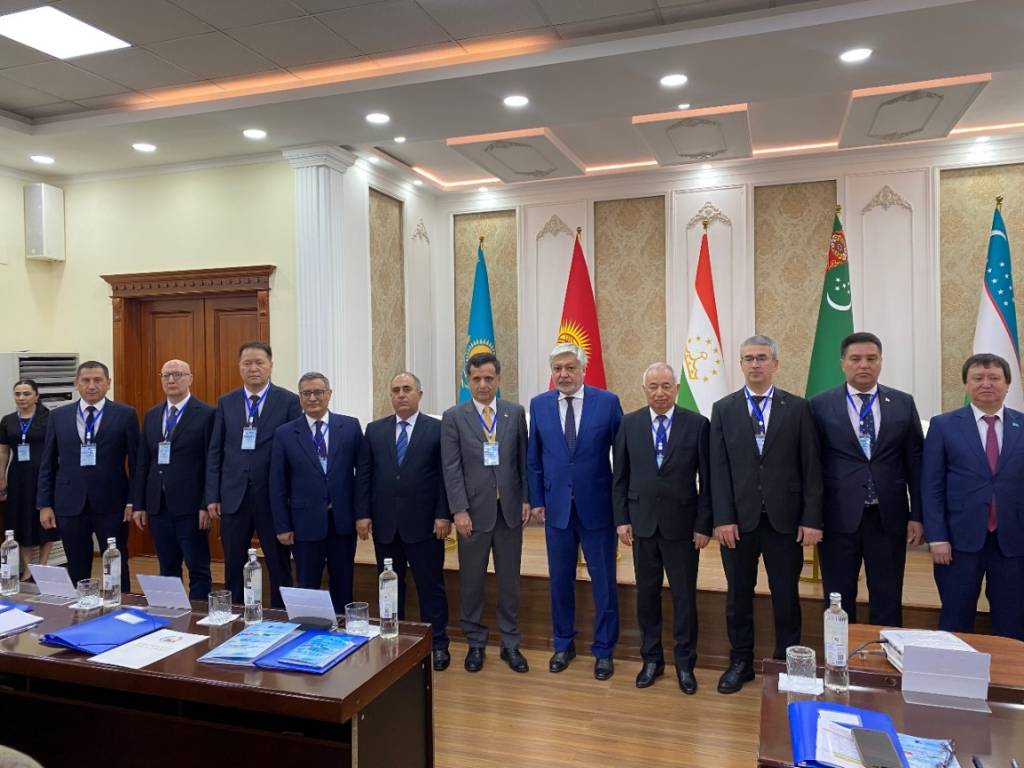
On 30 April, Dushanbe hosted the Central Asian Security Forum under the theme: “The Security Architecture of Central Asia: Contemporary Challenges, Threats and Strategic Opportunities”.
The event was attended by a delegation from the Institute for Strategic and Regional Studies under the President of the Republic of Uzbekistan (ISRS).
The forum was organized by the Center for Strategic Studies under the President of the Republic of Tajikistan, in collaboration with the Konrad Adenauer Foundation. It brought together representatives of expert-analytical and academic circles from the countries of the region, as well as representatives of international organizations engaged in regional security and peacebuilding.
During the discussions, participants focused on current security challenges and threats in Central Asia, issues related to forecasting and transformation, and the impact of transregional processes, socio-economic factors, and transport-logistics connectivity on the region’s resilience.
Particular emphasis was placed on the consequences of conflicts along the perimeter of Central Asia and the rise of non-traditional threats, primarily in the information and communications sphere.
Against this backdrop, the need to strengthen regional coordination and improve collective response mechanisms was underscored.

In their remarks, ISRS representatives outlined the key trends shaping the transformation of regional security amid growing geopolitical fragmentation and the increasing interdependence of global and regional processes. As noted by Murad Uzakov, Head of the ISRS Center, the deepening interconnectedness of economies, infrastructure, and information spaces objectively increases the impact of external factors on regional stability, thereby highlighting the importance of developing coordinated approaches among Central Asian states in the field of security.
It was noted that the countries of the region are consistently strengthening regional agency by establishing more resilient and institutionalized forms of cooperation. In this context, initiatives aimed at promoting regional dialogue, transport connectivity, and expanding multi-vector cooperation are gaining particular importance. Uzbekistan is making a significant contribution to these processes by advancing initiatives focused on integration and on strengthening the resilience of Central Asia.
Special attention was also devoted to the water-climate agenda, which is acquiring strategic significance for the region, as well as to the process of shaping a regional identity as an important factor of long-term stability and sustainable development.
During the discussions, participants also highlighted the exceptional importance of the Consultative Meetings of the Heads of State of Central Asia as a sustainable mechanism for coordinating regional cooperation. It was emphasized that the Central Asia Regional Security and Stability Concept and the Catalogue of Security Risks in Central Asia and Measures for Their Prevention for 2026-2028, adopted following the 7th Consultative Meeting, provide a foundation for deepening cooperation and implementing the agreements reached.
As part of the broader agenda, particular attention was paid to transport connectivity. Azamat Sulimanov, ISRS Department Head, emphasized its growing importance as a key driver of economic growth in Central Asia. In his assessment, amid geopolitical instability, the need to diversify routes and develop additional logistics corridors in the interests of the countries of the region, including Uzbekistan, is becoming increasingly urgent.
The expert noted that external crises, including those in the Middle East, significantly affect global supply chains, leading to higher transport costs, longer delivery times, and more complex logistics. Under these conditions, the role of regions capable of ensuring the stability of transit flows is increasing. Central Asia is therefore increasingly viewed as an important component of the emerging Eurasian geoeconomic architecture.
The growing significance of the region’s airspace as a stable transit route between Europe and Asia was also underscored, along with the gradual transition from a “land-locked” model to a “land-linked” model based on deep transport connectivity and an integrated infrastructure network.
At the same time, confidence was expressed that the implementation of a large-scale infrastructure agenda requires stronger interstate coordination and harmonized project management mechanisms, including the development of unified transport infrastructure, implementation of major projects (including the China – Kyrgyzstan – Uzbekistan railway, the Trans-Afghan Corridor, and Trans-Caspian routes), as well as the digitalization of logistics.
In this context, forum participants supported the initiative by the President of the Republic of Uzbekistan Shavkat Mirziyoyev to establish a Council for Infrastructure Development at the Deputy Prime Minister level as an important step toward strengthening regional coordination and enhancing the effectiveness of integration projects in Central Asia.
UzA