Islamic civilization’s heritage unites global media in Uzbekistan
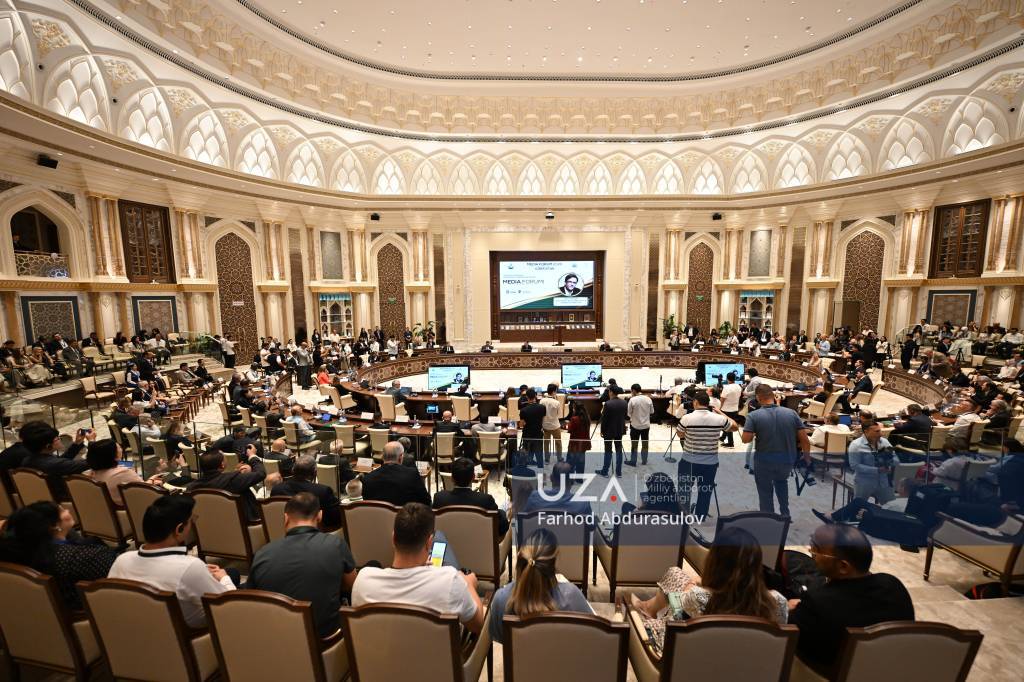
Uzbekistan has gathered journalists, media leaders, scholars, and creative industry representatives from across the globe. The International Media Forum “Islamic Civilization: New Perspective – New Discoveries” is taking place in Tashkent and Samarkand from August 24 to 27.
Nearly 300 participants from 43 countries are attending the forum, including representatives from top global media companies, journalists, documentary filmmakers, scholars, producers, and digital technology experts.
At the opening ceremony, Sherzod Asadov, Head of the Presidential Administration’s Communications Department, Press Secretary to the President of Uzbekistan, discussed current shifts in the information landscape. He emphasized that we live in an era where the information space has no borders. However, as information flows expand rapidly, false news and manipulation are also increasing. In this context, accuracy, responsibility, and professional ethics are more crucial than ever for journalism.
Artificial intelligence is quickly integrating into the media industry, but it will not replace journalists, instead, it enhances their skills. Modern journalists are no longer just writers. They take photos, produce videos, edit footage, and create content across multiple platforms. Essentially, today’s media landscape requires adaptable, multi-skilled professionals.
Forum participants naturally paid attention to the Islamic Civilization Center in Uzbekistan. Visitors from different countries observed that the Center serves as a hub where history, science, culture, and modern technologies come together.
The forum unites representatives from diverse countries, cultures, and media schools. Discussions avoid favoring any specific region, instead exploring global issues from multiple perspectives, experiences, and approaches.
The forum program also reflects this wide-ranging dialogue. Participants are exploring how Islamic civilization has contributed to fields such as mathematics, astronomy, medicine, philosophy, literature, architecture, and art, while also considering effective methods to present the legacy of renowned scholars to modern audiences.
Presentations and discussions covering the evolution from ancient manuscripts to artificial intelligence especially highlight the digitization of historical heritage, documentary films, virtual technologies, and new media formats.
Today’s audiences no longer rely solely on books to learn history. The new generation also explores history via screens, digital platforms, documentary films, interactive museums, and modern technologies. The main goal of the Tashkent forum is to present historical heritage in a contemporary way.
The event, which started in Tashkent, will continue in Samarkand. International media representatives will visit the city’s historic sites, including the Imam al-Bukhari Memorial Complex, to explore its rich cultural heritage.
[gallery-31057]
Dilshod Hakimov, photos by Farkhod Abdurasulov, UzA