


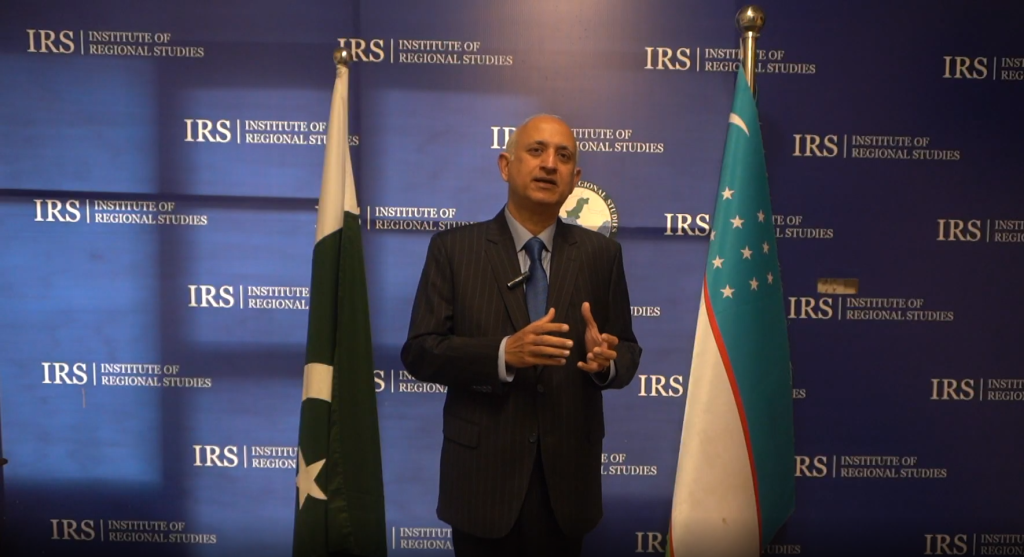
On January 29 this year, the Institute for Strategic and Regional Studies under the President of the Republic of Uzbekistan, jointly with the Institute of Regional Studies of Pakistan and with the support of the Embassy of Uzbekistan in Pakistan, organized an expert online conference titled “Uzbekistan – Pakistan: Strategic Partnership, Connectivity, and Sustainable Development in a Changing World”.
Speaking at the conference, former Minister of State and Chairman of the Board of Investment of Pakistan, Haroon Sharif, emphasized that he has been observing regional cooperation in South and Central Asia for more than 15-20 years. “I have observed the development of these processes from within, previously served as the World Bank’s regional manager for regional cooperation in South and Central Asia and other regions, and would like to share my experience”, he noted. The expert structured his remarks around three key themes: the timeliness of cooperation, the need for practical integration tools, and the importance of infrastructure connectivity.
Haroon Sharif noted that the current period is favorable for regional cooperation. He drew attention to the global shift toward regional markets – a phenomenon he described as Globalization 2.0. “After COVID-19, transportation and insurance costs increased, and geographic proximity became a key factor of competitiveness”, the expert emphasized. According to him, Uzbekistan and Pakistan possess the strategic advantage of proximity, which must be translated into economic benefit.
The expert also stressed the need for practical mechanisms of integration. “Do we want to live only with expectations and discussions about integration, or will we develop concrete instruments that demonstrate real progress?” Haroon Sharif asked. He underscored that political declarations and plans are one thing, while the creation of cross-border economic institutions is quite another. “These two words – ‘sustainable’ and ‘competitive’ – are essential”, he noted, adding that trade between countries should be complemented by mutual investment to ensure resilience and protection against geopolitical shocks.
Haroon Sharif paid particular attention to infrastructure connectivity as a driver of economic revitalization: “The question should not be framed as ‘how to connect two countries’, but rather as ‘how to ensure that this connectivity serves the interests of both countries’”. He proposed practical steps, including creating a market-oriented financial institution for the private sector and establishing joint dry ports with neutral management to shield the economy from geopolitical conflicts.
The expert also emphasized the importance of harmonizing business practices, accounting standards, and legal frameworks to attract investment from third countries. “Connectivity works only when it attracts private capital. Without this, it turns into ‘brick and concrete’ and a debt trap”, Haroon Sharif noted.
In conclusion, he called for the implementation of small but concrete steps capable of sending positive signals to markets and investors: “It is not money that decides everything – it is the structures capable of attracting money”, Haroon Sharif summarized, emphasizing that the creation of an institutional framework and the participation of the private sector are key to a sustainable and competitive regional partnership.
The conference was attended by leaders and experts from Uzbekistan’s and Pakistan’s leading think tanks and educational institutions, as well as representatives of the business community and diplomatic missions. The event was recognized as an essential practical step toward establishing an expert platform to strengthen Uzbekistan – Pakistan cooperation and regional integration.
UzA