


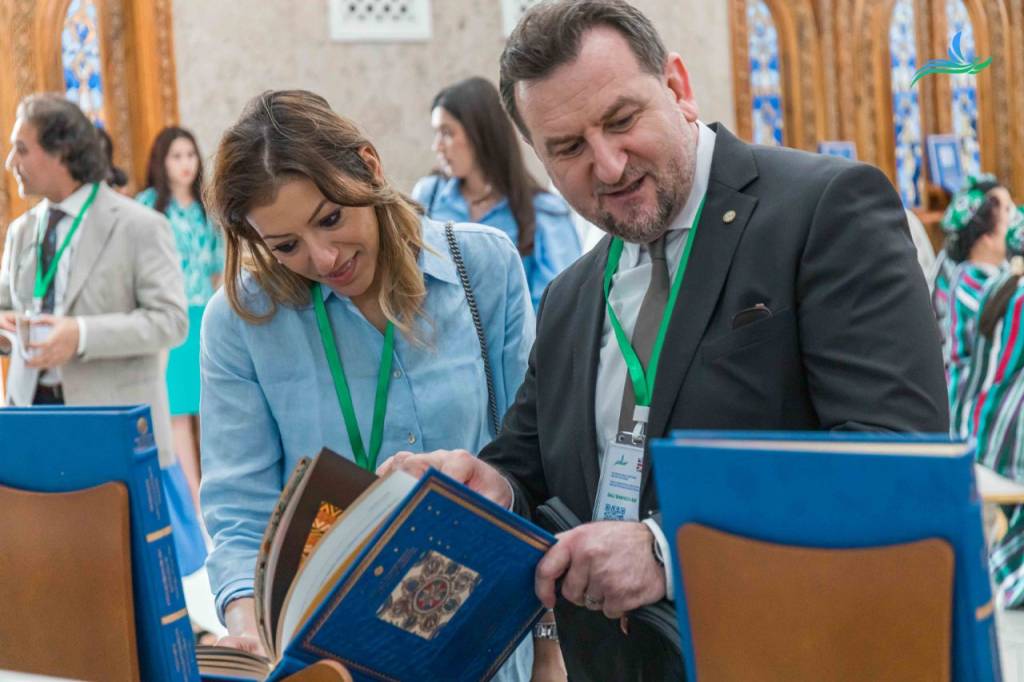
Tashkent hosted the Week “Cultural Heritage of Uzbekistan – the Foundation of New Renaissance” and the International Partnership Initiatives Week “New Uzbekistan: Development, Innovation and Enlightenment”.
The UzA Correspondent interviewed the Chairman of the World Society for the Study, Preservation and Popularization of the Cultural Heritage of Uzbekistan Firdavs Abdukhalikov about the events.
– The Week “Cultural Heritage of Uzbekistan – the Foundation of New Renaissance” is being held for the sixth time, – Mr. Abdukhalikov says. – Over the past 7 years, the issues of studying and preserving the cultural heritage of Uzbekistan have been elevated to the rank of state policy. Our country has opened its doors to the whole world. Scientists visit our country, and we implement projects with foreign museums. A reliable platform has been created with the help of which world scientists study the history and culture of Uzbekistan and annually present the research results at such events. Our researchers share their experiences.

– Who is the organizer of the Week, and what events took place within its framework?
– The Week was organized by the Ministry of Culture and Tourism and the World Society for the Study, Preservation and Popularization of the Cultural Heritage of Uzbekistan. More than 30 events were organized, including the exhibitions “Turkestan Avant-Garde”, “Treasures of the Temurids”, “Masterpieces of Applied Art of Uzbekistan”, “Historical Figures of Uzbekistan in Oriental Miniature”, music festivals, excursions, presentations, film screenings. Ceremonies of presenting two unique books were also held. One of them is “Memories of Edward Rtveladze”. Research Coordinator of the Cultural Heritage of Uzbekistan Project Elmira Gul presented her publication “Terms of Traditional Art of Uzbekistan. Art Encyclopedia”. A ceremony of transferring 50 volumes of album books of the series “Cultural Heritage in the World Collections” to the State Museum of Timurids History took place.

The participants visited the Institute of Oriental Studies and the Center for Islamic Civilization, historical places in Samarkand. The leadership of the State Museum of Timurids History, the State Museum of Arts named after Igor Savitsky, the Gallery of Fine Arts of Uzbekistan, the State Museum of Uzbekistan History, the Academy of Sciences of Uzbekistan, the Konrad Adenauer Foundation and our permanent partner, Eriell, provided great assistance in organizing the events.
– Which of the world’s scientists took part in the events?
– Our guests were orientalists, researchers from a dozen countries, and the President of the International Turkic Academy Shahin Mustafayev. He spoke about the role of prominent figures of the Turkic world in developing science and culture. The Founder and President of the Association of Art and History of Temurids in France Frederique Beaupertuis-Bressand prepared an interesting report on the heritage of Amir Temur and his contribution to developing culture and art. Another participant, Alexander Wilhelm, Marketing and Development Vice President at Mueller & Schindler, shared important information about the unique work “The Book of Fixed Stars”. Director of Research at the Cambridge Center for Persian Studies from the UK Firuza Melville spoke in detail about the masterpieces of Uzbek art stored in museums and libraries in the UK, and the head of the Al-Furqan Islamic Heritage Foundation Sali Shahsivari paid special attention to the contribution of Uzbek scientists to the development of world civilization.

– A very bright and discussed, as well as the most visited event, was the exhibition of portraits of historical figures of Uzbekistan. What is its uniqueness?
– We have been preparing this exhibition for a very long time. The exposition consisted of 24 rare portraits of famous rulers, historical figures, and prominent figures of science and culture of Uzbekistan, collected from miniatures preserved in different parts of the world – the USA, Türkiye, Iran, and Russia. Some are separate portraits, and some are part of some manuscripts, folios, quite ancient. Work on collecting such portraits continues.
– What is the secret of the success of another event – the exhibition “Turkestan Avant-Garde: Between Space and Time”?
– For the first time, experts have collected in one exposition all works of art that fit the definition of “Turkestan Avant-Garde”. The canvases of avant-garde artists were taken from all the museums of Uzbekistan. The exhibition is still taking place at the Gallery of Fine Arts, who did not have time to see these masterpieces, there is a chance to enjoy the art. The exhibition includes works by the leading masters of the Turkestan avant-garde – Ural Tansykbayev, Alexander Volkov, Zinaida Kovalevskaya, Nikolai Karakhan, and many others.

– A new office of the World Society for the Study, Preservation and Popularization of the Cultural Heritage of Uzbekistan has opened in Tashkent. Would you tell us more about it, please?
– This spacious, functional, and modern office presents many unique works of world scientists. There is a common room with an LED screen and sound equipment, 4 separate rooms equipped with computers, and 15 presentation smart TVs installed. The common hall, which can accommodate up to 80 people, is planned to host conferences, roundtable discussions, trainings, film screenings, scientific meetings, and workshops. For relaxation, a cozy area and a kitchenette are organized.
– Would you please tell us about the International Partnership Initiatives Week “New Uzbekistan: Development, Innovation and Enlightenment”?
– First and most importantly, the event has become a platform for dialogue, exchange of views, and experience of foreign and domestic experts in various fields. The week was organized by the Center for Sustainable Development, the “Yuksalish” movement, the Development Strategy Center, ministries and NGOs, and the World Society. The holding of this event has become a civil initiative, that is, it is a consolidation of the efforts of civil society.
The press services of all ministries and agencies of Uzbekistan actively participated in the breakout sessions and discussed key issues of their activities with world experts. More than 50 conferences and roundtable discussions were organized by scientific and analytical centers, the business community, ministries, agencies, and more than 300 foreign partners. The events were attended by 400 well-known political and public figures, big business representatives, experts from 60 countries, and five international organizations. Among them: 203 heads of foreign organizations, companies, and associations, rectors, and presidents of 70 prestigious universities and research centers. More than 4,000 high-ranking government officials, political scientists, experts, business community representatives, media, and civil society institutions also participated in the events. I want to take this opportunity to thank the press services of ministries and agencies and all organizations that assisted in holding this event.
The events contributed to the exchange of views and experience in various areas – reforming the sectors of the economy and the education system, innovative methods of developing human capital, building a social state, global trends in green development, creating a favorable business and investment environment, developing a knowledge economy and an innovative economy, sustainable development of digital technologies.
– Thanks for the detailed answers. I also want to thank the Press Service of the World Society for the Study, Preservation and Popularization of the Cultural Heritage of Uzbekistan for their help.
Interviewed by Nazokat Usmanova, UzA