
February 2 – World Wetlands Day

Navoi Regional Branch of the Union of Journalists of Uzbekistan organized a press tour of Aydar Lake. The journalists got acquainted with the nature and the security work in the Aydar-Arnasay System of Lakes.

This system of lakes is a unique natural water basin, a system of endorheic lakes, which includes Aydarkul, Tuzkan, and East Arnasay lakes. It is located in a salt marsh depression in the east of the Kyzylkum Desert, southwest of the Chardara reservoir. In 1969-1970, due to the abundance of water, the Chardara hydroelectric power station began to overflow, and the sluice gates were opened slightly to prevent the dam from breaking. As a result, water began to flow into the Arnasay depression, and Aydar Lake was formed. Until the middle of the last century, this area was arid. Due to the spring rains, Lake Tuzkan was formed, which evaporated with warming. This lake is the second salt lake in Uzbekistan after the Aral Sea.

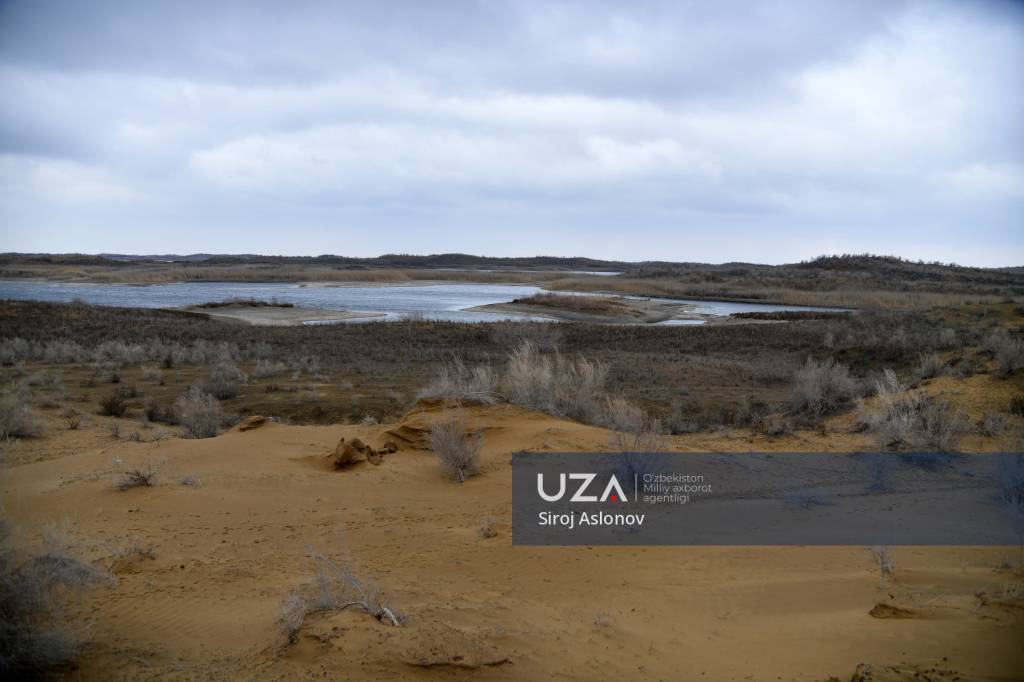
The lake’s dimensions are approximately 280-300 kilometers from east to west and 30-35 kilometers from north to south. Almost 10 billion cubic meters of water have accumulated in the basin. Currently, the surface of the lake is gradually shrinking.

“With the creation of this huge reservoir, new natural landscapes, unique flora and fauna were formed in the desert zone”, says Jasur Hakkulov, Chief Specialist of the Aydar-Arnasay System of Lakes. “According to data, the lake provides fish for a third of the population of our country. You can find carp, bream, catfish, pike, cyprinid fish, and pike perch here. Although Aydarkul is located far from populated areas, it is considered a very convenient place for recreation”.

On October 20, 2008, the Aydar-Arnasay System of Lakes was included in the List of Ramsar Sites.

There are no underwater streams in Aydarkul. The water to the west is saltier. The mineralization in the western part is more than 8 grams per liter. In the eastern part of the river, it is 3-5 grams, which creates conditions for bioorganic life. On the shores of the lake, you can find many species of waterfowl, including pink pelicans, swans, mallards, geese, and pheasants.

[gallery-15732]

Abduvali Buriyev, photos by Siroj Aslonov, UzA

English
Chinese
Turkish
Tajik
Kyrgyz
Turkmen
Japanese
Arabic
English
French
Spanish
Русский
German
Ўзбек
Oʻzbek
Қазақ
Aydarkul – the Pearl of the Kyzylkum Desert

February 2 – World Wetlands Day

Navoi Regional Branch of the Union of Journalists of Uzbekistan organized a press tour of Aydar Lake. The journalists got acquainted with the nature and the security work in the Aydar-Arnasay System of Lakes.

This system of lakes is a unique natural water basin, a system of endorheic lakes, which includes Aydarkul, Tuzkan, and East Arnasay lakes. It is located in a salt marsh depression in the east of the Kyzylkum Desert, southwest of the Chardara reservoir. In 1969-1970, due to the abundance of water, the Chardara hydroelectric power station began to overflow, and the sluice gates were opened slightly to prevent the dam from breaking. As a result, water began to flow into the Arnasay depression, and Aydar Lake was formed. Until the middle of the last century, this area was arid. Due to the spring rains, Lake Tuzkan was formed, which evaporated with warming. This lake is the second salt lake in Uzbekistan after the Aral Sea.

The lake’s dimensions are approximately 280-300 kilometers from east to west and 30-35 kilometers from north to south. Almost 10 billion cubic meters of water have accumulated in the basin. Currently, the surface of the lake is gradually shrinking.

“With the creation of this huge reservoir, new natural landscapes, unique flora and fauna were formed in the desert zone”, says Jasur Hakkulov, Chief Specialist of the Aydar-Arnasay System of Lakes. “According to data, the lake provides fish for a third of the population of our country. You can find carp, bream, catfish, pike, cyprinid fish, and pike perch here. Although Aydarkul is located far from populated areas, it is considered a very convenient place for recreation”.

On October 20, 2008, the Aydar-Arnasay System of Lakes was included in the List of Ramsar Sites.

There are no underwater streams in Aydarkul. The water to the west is saltier. The mineralization in the western part is more than 8 grams per liter. In the eastern part of the river, it is 3-5 grams, which creates conditions for bioorganic life. On the shores of the lake, you can find many species of waterfowl, including pink pelicans, swans, mallards, geese, and pheasants.

[gallery-15732]

Abduvali Buriyev, photos by Siroj Aslonov, UzA