


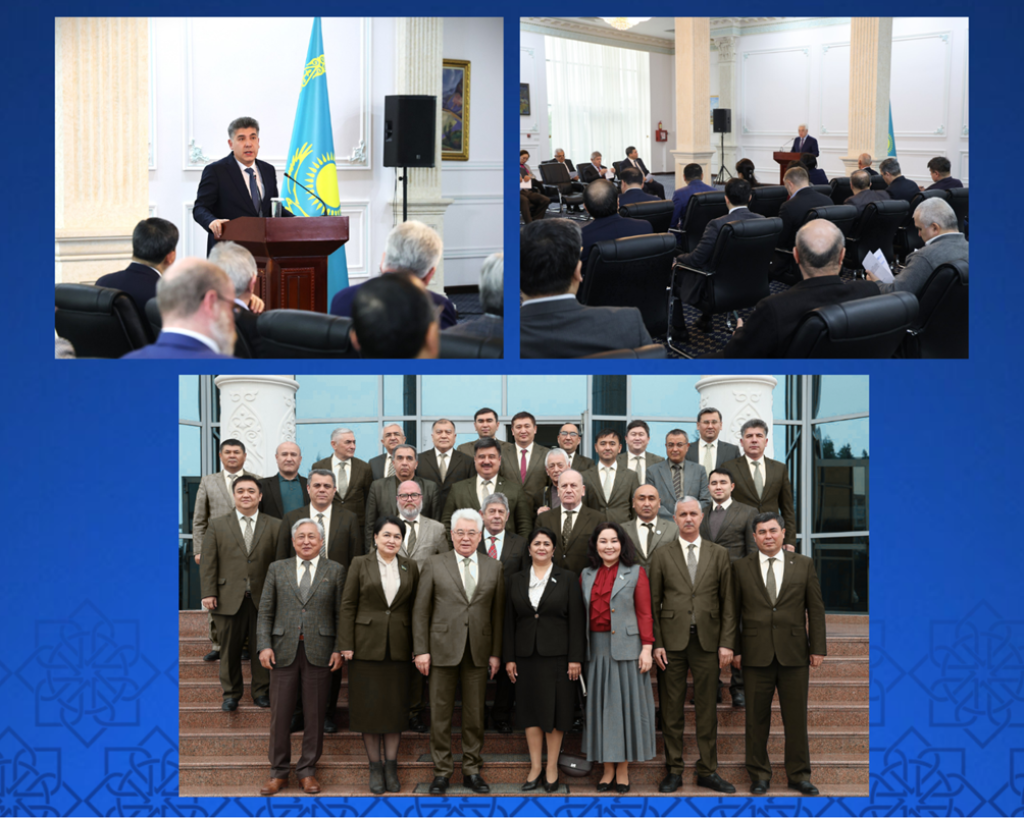
The remarks were made by Akramjon Nematov, First Deputy Director of the Institute for Strategic and Regional Studies (ISRS), at a roundtable discussion on “Political modernization in Kazakhstan: Reforms, public demand and the regional context” held on 27 January in Tashkent.
The event, organized by the Embassy of Kazakhstan in Uzbekistan, was attended by heads of diplomatic missions from Central Asia, Azerbaijan, and Russia, as well as representatives of Uzbekistan’s parliamentary, expert, and academic communities.
According to Akramjon Nematov, the key narrative consistently advanced by Kazakhstan’s leadership is the concept of comprehensive modernization, encompassing the transformation of public consciousness, state institutions, and the economic system.
It was emphasized that such an approach is particularly relevant in a turbulent international environment, where one of the principal factors of resilience is a state capable of formulating and implementing long-term development priorities. In this regard, Kazakhstan’s chosen course, the ISRS representative believes, sets an important vector not only for national development but also for the entire Central Asian region.
Akramjon Nematov paid particular attention to the similarities in the structural challenges faced by the region’s countries, including dependence on raw materials, technological lag, and demographic and climate risks. In this context, he noted that modernization processes are most effective when national strategies are aligned and coordinated at the regional level.
According to the expert’s assessment, Central Asia’s potential is truly significant. As a clear illustration, he cited Uzbekistan’s economy, which continues to demonstrate robust growth rates and strong qualitative characteristics. In particular, by the beginning of 2026, the gross domestic product had exceeded USD 145 billion, while exports reached USD 33.4 billion. Crucially – as Akramjon Nematov noted – both Uzbekistan and Kazakhstan are consistently moving away from a model of primarily quantitative growth towards a qualitative development trajectory based on knowledge, technology, and innovation.
In this context, the expert singled out the key role of the consistent implementation of the deep modernization agenda in the political program of the President of the Republic of Uzbekistan, Shavkat Mirziyoyev. In his view, the political will and systemic nature of the reforms initiated by the Uzbek leadership have enabled sustained strong economic growth, accelerated institutional reforms, and laid a solid foundation for a transition to a new development model focused on improving living standards and developing human capital.
The ISRS representative emphasized that the reforms being implemented in Uzbekistan are comprehensive and long-term, encompassing the economic, social, and governance spheres, and are already exerting a positive impact not only on the country’s domestic development but also on the overall dynamics of regional processes. In this context, Uzbekistan’s modernization course is viewed as one of the key factors strengthening the resilience and interconnectedness of Central Asia.
Developing this line of reasoning, Akramjon Nematov highlighted the potential for synergy between the value-based approaches underpinning Kazakhstan’s “Adal Azamat” concept and Uzbekistan’s “Inson Qadri” (Human Dignity) strategy. According to him, the alignment of these initiatives contributes to the formation of a shared standard of responsible citizenship, within which the individual is regarded as the central resource for development.
Drawing on the Address of the President of the Republic of Uzbekistan, Shavkat Mirziyoyev, to the Oliy Majlis, as well as the initiatives put forward by the President of the Republic of Kazakhstan, Kassym-Jomart Tokayev, the expert outlined several priority areas for regional cooperation.
First, he underscored the importance of pooling efforts in technological and innovative development. In the expert’s view, a coordinated transition towards a high-value-added economy, alongside the development of high-tech industries, scientific research, and innovation ecosystems, creates the necessary preconditions for strengthening the region’s position in the global division of labor.
Second, the need to combine national capacities to develop a human capital systemically was highlighted. The expert believes that adapting education systems and workforce training mechanisms to the evolving demands of the labor market, as well as fostering engineering, digital, and managerial competencies, lays the foundation for Central Asia’s long-term competitiveness.
Third, attention was drawn to the growing importance of coordinated action in environmental sustainability and climate adaptation. According to the expert, joint approaches to energy efficiency, the development of green energy, and the enhancement of agriculture’s productivity and resilience can transform the climate agenda from a source of risk into a driver of growth.
Fourth, particular emphasis was placed on the relevance of aligning transport and logistics policies. The establishment of a multi-option system of transport corridors and the coordination of infrastructure projects, as the ISRS representative noted, create the conditions for transforming Central Asia into a major transport and logistics hub of Eurasia.
Fifth, the importance of pooling efforts to advance digitalization and deploy artificial intelligence (AI) technologies was underscored. The harmonization of digital strategies, the development of AI solutions, and the provision of e-government services generate economies of scale, accelerate reforms, and enhance the quality of public governance.
Sixth, the need for cultural and humanitarian alignment was highlighted. In the expert’s view, the formation of a shared cultural and historical space and the strengthening of regional identity serve simultaneously as a factor of resilience and a driver of long-term development.
In conclusion, Akramjon Nematov emphasized that the consistent modernization efforts of Kazakhstan and Uzbekistan are laying a solid foundation for the sustainable growth of the entire Central Asian region. Should these efforts be systematically aligned at the regional level, he assessed, the region could achieve three key outcomes: strengthening international agencies, increasing investment attractiveness, and enhanced resilience to external shocks.
“Modernization is not merely a political choice. For Central Asia, it represents an objective pathway towards more effective regional cooperation, sustainable development, and social progress”, concluded the ISRS representative.
UzA