Akramjon Nematov: Central Asia is strengthening its role as an independent actor and emerging as a key hub for Eurasian connectivity
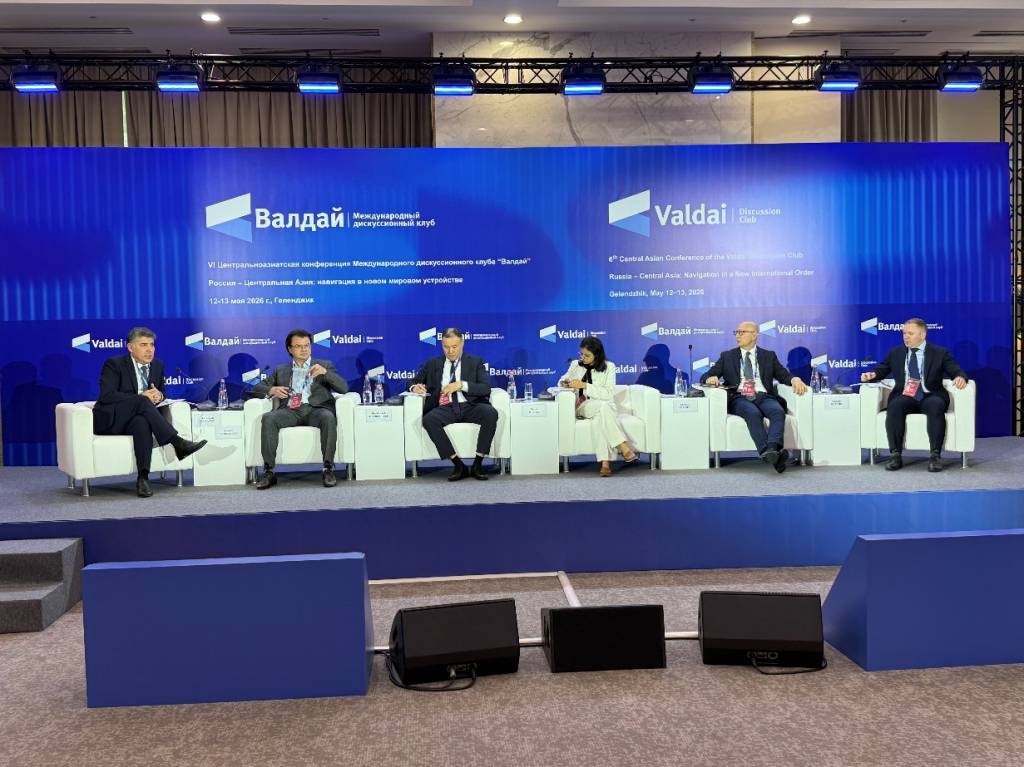
On May 12-13, Gelendzhik hosted the 6th Central Asian Conference of the Valdai Discussion Club “Russia – Central Asia: Navigating the New World Order”, which brought together representatives of leading analytical and research institutions from the Central Asian countries, Russia, China, India, Mongolia, and other states.
The conference agenda focused on developing cooperation between Russia and the Central Asian states amid the ongoing transformation of international relations, strengthening regional security, enhancing transport and logistics connectivity, and expanding engagement across the trade, economic, scientific, educational, and cultural spheres.
The Russian side was represented by officials and experts from the Ministry of Foreign Affairs of the Russian Federation, the Primakov National Research Institute of World Economy and International Relations of the Russian Academy of Sciences (IMEMO RAS), the Institute of Oriental Studies of the Russian Academy of Sciences, the Higher School of Economics (HSE University), MGIMO University, Kuban State University, Tomsk State University, as well as the administrations of Krasnodar Territory and the city of Gelendzhik.
The forum was also attended by a high-level delegation from Uzbekistan, comprising leadership and experts from the Institute for Strategic and Regional Studies under the President of the Republic of Uzbekistan (ISRS), the Center for Economic Research and Reforms, the International Institute for Central Asia, and the Institute for Macroeconomic and Regional Studies.

Moderating the second session on the priorities of cooperation between the Central Asian states and Russia, First Deputy Director of the Institute for Strategic and Regional Studies under the President of the Republic of Uzbekistan Akramjon Nematov emphasized that the development of a long-term cooperation agenda should be based on Central Asia’s qualitatively new role. According to him, thanks to a consistent policy of strengthening good-neighborly relations and pragmatic cooperation, the region has become more resilient, strengthened its role as an independent actor, and is now emerging as one of the key centers of Eurasian economic and transport connectivity.
It was emphasized that Central Asia is gradually transforming from a peripheral transit zone into a major crossroads of the East-West and North-South corridors. The countries of the region seek not only to leverage their geographic location but also to capitalize on it by developing industrial hubs, production chains, and high-value-added logistics services along key transport arteries. In essence, the region is moving beyond a purely transit model toward a model of industrial and logistics integration, in which transport corridors drive deep industrialization and integration into emerging value chains.
According to Akramjon Nematov, this new role for Central Asia should serve as the basis for a constructive, mutually beneficial agenda for cooperation between Russia and the countries of the region. He emphasized that the Central Asian states pursue an open foreign policy and advocate constructive relations with all external partners. The region is not interested in geopolitical confrontation and views Eurasia as a space for broad, inclusive, and mutually beneficial cooperation.
The ISRS representative noted that the modern world is undergoing a profound transformation, marked by growing uncertainty and declining global stability. Under these conditions, the importance of shared regional responsibility for ensuring a stable, predictable environment for development is steadily increasing. For the Central Asian countries, Eurasia is a natural space for cooperation, shaped by deep-rooted economic, transport, and humanitarian ties.

According to Akramjon Nematov, Uzbekistan has consistently pursued a policy to foster an open, mutually beneficial space for cooperation across Eurasia. Within this strategy, Uzbekistan advances a practical agenda through multilateral platforms such as the CIS, SCO, EAEU, CICA, ECO, and OTS, focusing on transport connectivity, industrial cooperation, energy partnerships, and the development of resilient value chains. Since 2016, Uzbekistan has put forward dozens of initiatives to deepen regional integration and expand economic cooperation.
In furtherance of this policy, the country’s top political leadership has consistently advanced a comprehensive regional agenda to strengthen trust and institutionalize cooperation in Central Asia. President of the Republic of Uzbekistan Shavkat Mirziyoyev has put forward several major initiatives to build a new framework for regional interaction, including the development of a Code of Good-Neighborliness, Trust and Cross-Border Partnership, as well as the Samarkand Solidarity Initiative for Common Security and Prosperity.
The expert stressed that the key objective is not isolation but the creation of a region that is both internally resilient and open to external engagement. Thanks to this policy, Central Asia is becoming more stable, evolving into a dynamic market, and strengthening its role as a key logistics hub and center of industrial growth.
It was separately emphasized that Central Asia is increasingly emerging as a cohesive region with a growing international role. On the one hand, this enables the countries of the region to address internal challenges more effectively, on the other hand, it allows Central Asia to serve as an independent pillar of stability in Eurasia. In essence, the region is becoming a key pillar of the broader Eurasian architecture, and supporting this trend aligns with the interests of all external partners.
Particular attention was paid during the discussion to the growing strategic importance of the “Central Asia – Russia” format. According to the ISRS representative, expanding industrial cooperation, joint infrastructure projects, energy collaboration, and humanitarian ties helps strengthen the resilience of the entire Eurasian space.
Summing up the discussion, Akramjon Nematov emphasized that Central Asia is moving beyond its former perception as a buffer zone and increasingly asserting itself as an independent actor with its own agenda. Its strategic objective is to build open, mutually beneficial engagement with all external partners while taking greater responsibility for the region’s security, stability, and sustainable development.
“A strong, economically interconnected, and stable Central Asia aligns with the strategic interests of all participants across Eurasia. Amid ongoing global transformation, regional formats of cooperation provide the foundation for a new model of stability”, the ISRS representative stated, emphasizing that, by advancing an agenda of regional responsibility, Uzbekistan seeks to build a practical model of constructive, mutually beneficial cooperation, in which partnership with Russia serves as one of the key pillars of the long-term development and resilience of the entire Eurasian space.
UzA