A citizen-centred state: A new governance model starting at the mahalla level
“The mahalla is the level of government closest to the people. Their everyday concerns should be resolved right there, without unnecessary hassle”.
– Shavkat Mirziyoyev
Today, the effectiveness of public administration is measured not by the number of decisions adopted or the number of new structures established, but by the extent to which citizens feel these changes in their own lives. If a person is compelled to visit several offices, to gather various certificates, or to spend days on end merely to obtain a basic public service, even the most refined legal reform loses its practical value.
For this reason, in the twenty-first century, countries around the world are seeking to bring public administration closer to the interests of the individual. In this process, digital technologies, integrated public services, and data-driven decision-making systems are gaining priority.
In Uzbekistan, likewise, the principal objective of the reforms undertaken in recent years is precisely this: to bring public services closer to the citizen, to organise governance effectively, and to direct the activities of state bodies towards a single unified result.
Based on the tasks set by President Shavkat Mirziyoyev, a new stage in the modernisation of public administration has commenced. In this stage, attention has focused not on central agencies, but on the tier of governance that maintains the closest contact with the population, namely, the mahalla.
This choice is not accidental. Nearly all social, economic and legal matters arising in a person’s life manifest themselves, first and foremost, at the level of the mahalla. Unemployment, social protection, entrepreneurship, youth policy, and the prevention of offences all originate at the mahalla level. It is therefore natural that the most significant changes in public administration should likewise begin at this very tier.
To this end, pursuant to the Decrees of the President of the Republic of Uzbekistan aimed at improving public administration, an entirely new model for organizing local governance has been developed. This model is being put into practice in the country for the first time through the concept of the Mahalla Information and Service Centre.
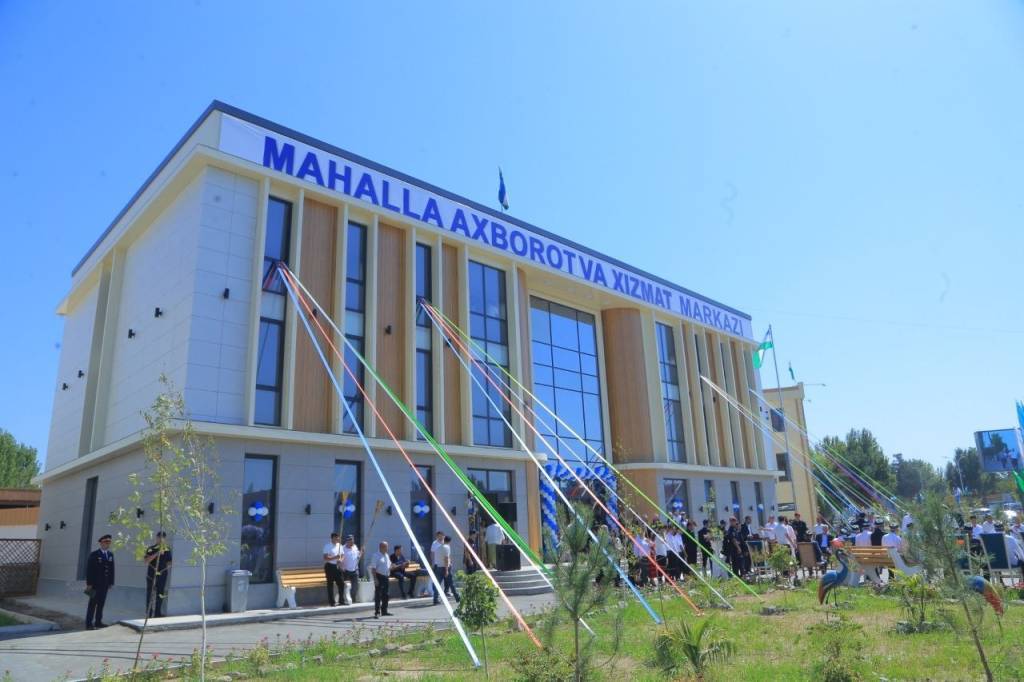
The Yangi Namangan mahalla in Namangan region has been selected as the first practical demonstration of this model. At first glance, one can observe that modern buildings, an electronic queuing system, and digital services have been established there. Yet the true significance of the project does not lie in its infrastructure. What is changing here is not how public services are delivered, but the very system of public administration itself.
Why did the reform begin with the mahalla? The institution of the mahalla has for centuries served as the social foundation of Uzbek society. In recent years, however, its activity has also changed in substance. Today the mahalla has become not only a body of citizens’ self-governance, but also one of the most important tiers through which state policy is implemented in the localities.
At present, the “mahalla of seven” system operates within the mahallas across such directions as securing employment for the population, social protection, the development of entrepreneurship, work with young people and with women, and the prevention of offences. While this system has expanded the capacity of the State in the localities, the need for its further improvement has, over time, also become apparent. The issue did not lie in personnel or in the scope of powers. The problem consisted, above all, in the insufficient level of coordination between the various state bodies, in the fragmentation of data, and in the absence of a mechanism for a comprehensive approach to citizens’ appeals.
For instance, information concerning a single household was held separately, and simultaneously, by the social protection, employment, tax, preventive and other state bodies. As a result, although the problems of one family were being examined by several organisations, the elaboration of a unified solution was rendered difficult. The citizen, in turn, was compelled to apply to various agencies to resolve his or her problem.
Based on the tasks set by the Head of State, the Agency for Governance Efficiency under the President of the Republic of Uzbekistan conducted a comprehensive analysis of the local governance system. The analysis drew on data from the country’s 8,992 mahallas, the 54,771 representatives of the “mahalla of seven” operating within them, and findings from a public opinion survey of 104,000 citizens. The study revealed a fundamental truth: for the mahalla institution to function effectively, a new governance mechanism was needed even more than new buildings.
The analysis showed that unless the underlying causes are examined in depth, even the soundest decision will fail to produce the expected result. The new approach adopted for improving mahalla governance was itself formulated based on such comprehensive analysis.
Pursuant to the instruction of the President, the Agency for Governance Efficiency undertook a wide-ranging study of the activities of the country’s mahallas. This process was not confined to a particular territory or to selected indicators. The analysis covered all 8,992 mahallas across the country.
At present, 54,771 representatives of the “mahalla of seven” are engaged in these mahallas. Their number includes mahalla chairmen, assistants to the hokim, social workers, youth leaders, women’s activists, crime prevention inspectors and tax inspectors. Together they constitute an extensive governance network that works in the closest possible contact with the population.
One of the important stages of the analysis was the study of public opinion. The nationwide social survey involved 104,000 citizens. Its results indicated that, although the overall assessment of the mahalla system was positive, citizens continued to encounter a range of difficulties in obtaining public services.
In certain cases, a citizen was required to travel to the district centre to obtain a simple certificate or a public service and had to submit separate applications to different agencies with respect to one and the same matter. Although each organisation acted within the limits of its own competence, no unified outcome was produced for the citizen.
The analysis brought to light a further essential point: the population was dissatisfied not with the absence of a given public service, but rather with the way it had been organised. This demonstrated the need for a comprehensive review of the public services system.
During the study, it was established that each state body operating within the mahalla maintains its own separate information database. Data concerning a single household is recorded in one form within the social protection system, in another within the sphere of employment, in yet another within the tax authorities, and in an entirely different form within the prevention system. This state of affairs gave rise to the duplication of information, to excessive paperwork and, most importantly, to a weakening of coordination between state bodies.
For example, information concerning a family’s unemployment, low-income status, entrepreneurial activity or need for social services may be held by various organisations. However, since such data has not been consolidated within a single digital environment, the responsible officials have been unable to obtain a complete picture of the situation. As a result, despite the simultaneous involvement of several agencies with a single family, achieving the expected result was difficult.
For this reason, the new model has been directed, first and foremost, at ensuring the exchange of information between state bodies.
In developing the new model of mahalla governance, international experience was likewise examined in depth. China’s digital village management system, Hungary’s Smart Village concept and the experience of several countries in integrating local public services were subjected to analysis. These models, however, were not adopted directly. Foreign experience was harmonised with national values, with the existing legislation and with the distinctive features of the mahalla institution. The outcome was an entirely new approach for our country, namely the concept of the Mahalla Information and Service Centre.
The central idea of this concept is not to gather public services within a single building, but rather to integrate the activities of state bodies into a unified digital governance environment, to work comprehensively with each household, and to adopt decisions based on real data.
How was the new model created? The model developed by the Agency for Governance Efficiency was first shaped in conceptual terms, after which pilot territories were selected for its practical testing. To this end, the Yangi Namangan mahalla in Norin district of Namangan region and the Qahramon mahalla in Khavos district of Syrdarya region were designated as pilot sites.
The principal objective was to eliminate artificial barriers between state agencies, interconnect their information systems, bring services closer to the individual, and establish entirely new governance standards at the mahalla, the lowest tier of the system. It is precisely these features that distinguish the concept from an ordinary public services centre. Its significance lies in its character as an institutional reform of local governance.
A person entering the Yangi Namangan mahalla Information and Service Centre for the first time may, at the outset, perceive it simply as a modern public institution. A stately three-storey building, an electronic queuing system, public service delivery points, spacious reception halls, digital infrastructure. Outwardly, it resembles one of the many modern facilities being constructed across the country in recent years. Yet the true significance of this Centre does not lie in its architecture. The most substantial innovation is not to be found within its walls, but within its system of governance. What warrants discussion here as a new model is not the fact that state agencies are housed in a single building, but rather the fact that they have, for the first time, begun to work towards a shared objective.
The change here is manifested not in the number of services, but in the way they are organised. Today, through the Centre, more than 27,000 residents of Yangi Namangan and of seven surrounding mahallas make use of 980 types of public and other services.
These figures are significant. Yet what is more significant still is the transformation of the very mechanism by which such services are delivered. Whereas previously the citizen would travel to a state agency in search of a service, today the public service is brought to the territory in which the individual resides. This shift also imparts new substance to the relationship between the State and the citizen.
One of the most important features of the new model is manifested in the entirely different form in which cooperation between state bodies is organised. Previously, each official at the mahalla level acted independently, within the scope of his or her own duties. The assistant to the hokim dealt with one line of work, the social worker with another, and the crime prevention inspector confined himself to matters falling within his own competence.
Although this arrangement was properly organised from the standpoint of the legislation, in practice it did not always make it possible to resolve the problems of a single family in a comprehensive manner. The new model has transformed this approach. The responsible officials now act not in isolation, but as a single team. Regardless of which organisation’s competence a citizen’s appeal falls within, all the relevant agencies are drawn into the process of resolving it. A single matter thereby becomes a shared task of several organisations. This raises inter-agency cooperation to a new level and enhances the effectiveness of coordination within public administration.
One of the most important aspects of the Yangi Namangan experience lies in the fundamental transformation of how work with the population is carried out. Whereas previously state bodies worked, principally, with citizens’ appeals, the new model provides for working with the household. To this end, a digital profile is compiled for each family. It consolidates within a single database the family’s social situation, employment status, sources of income, level of education, participation in state programmes, need for social services and other essential information. On this basis, state bodies undertake a comprehensive assessment of the needs of each household. If there is unemployment within a family, this is no longer a matter for the employment authority alone. If social assistance is required, this too is not confined to the responsibility of the social protection system alone. Where necessary, the assistant to the hokim, the social worker, the tax service, the youth leader, the women’s activist and other responsible officials act jointly. This approach makes it possible to address a problem not in isolation, but together with the underlying causes from which it arises.
Whereas the State previously waited for the citizen’s appeal, it now seeks to identify problems in advance and to propose solutions. This constitutes an essential element of proactive governance, which is acquiring ever greater relevance within modern public service.
The true value of any state reform is measured not by the legal instruments adopted or the facilities constructed, but, first and foremost, by the effect it produces on the life of the individual. If the citizen begins to obtain public services more quickly, more easily and without undue inconvenience, the reform is attaining its objective. In substance, this reflects a transformation in the very philosophy of public administration.
The delivery of 980 types of public and other services through the Centre signifies, first and foremost, an expansion of the range of opportunities created for the population. A branch of the Public Services Centre operates on the premises. Citizens are now able to make use, within the mahalla itself, of a wide range of services, including the state registration of business entities, the retrieval of archival records, the issuance of licences, the obtaining of subsidies and many others.
According to expert estimates, tens of thousands of public services are expected to be delivered through this branch over the course of a year. This will make it possible to save time and expense for the thousands of citizens who previously had to travel to the district centre to obtain a service.
At the same time, the “self-service” zone established within the Centre is likewise acquiring considerable importance for the development of digital public services. Through info-kiosks, citizens are acquiring the skills to use electronic services independently.
Matters of economic development also occupy a distinct place within the Mahalla Information and Service Centre. The banking services point established on the premises provides the population with advice and practical assistance on loans, mortgages, deposits, plastic cards, online payments and the financing of entrepreneurial activity. Its importance lies in the fact that banking services are now becoming accessible to the population not only in city or district centres, but at the mahalla level as well.
A new approach has likewise been formulated with respect to the activities of the tax authorities. The tax service is now acting not as a supervisory body, but as an institution supporting entrepreneurship and stimulating economic activity.
The provision within the mahalla itself of consultations concerning the state registration of business activity, self-employment, tax incentives and electronic services serves to expand the economic opportunities of the population.
The Yangi Namangan experience leads to an important conclusion regarding what a modern model of public administration ought to be. Modern governance does not consist in establishing more agencies or in preparing more reports. Modern governance is a system that swiftly discerns the needs of the individual, ensures cooperation between state bodies, adopts decisions based on accurate data, and organises services at the very place where the individual resides.
Ulugbek Khusainov,
Director of the Governance Efficiency Agency