


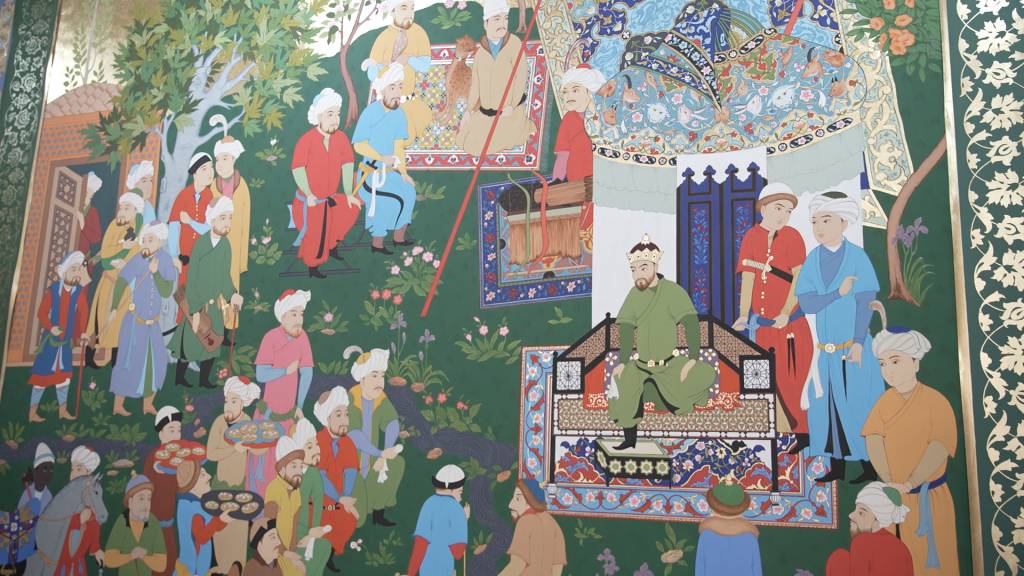
A press tour was held, featuring scientists and specialists, to familiarize them with the process of preparing miniatures for display on the “Wall of Civilizations and Discoveries” at the museum of the Center for Islamic Civilization in Uzbekistan.
The length of the Wall of Civilizations and Discoveries, on which miniatures of the Second Renaissance era will be placed, will be 52 meters, with a height of 5 meters, taking into account the frame with a meter ganch pattern.
There will be more than 10 miniatures on the wall, which 50 artists are working on.
According to the Doctor of Philosophy in Art Studies, Artist Behzod Khojimetov, miniatures of the Herat, Bukhara, Samarkand, and partly Indian schools of miniature art have been selected for the wall.

“Among the almost 50 miniatures reviewed, there were also examples of miniature schools in Shiraz, Isfahan, and Tabriz, but we selected works depicting our thinkers and significant historical events. We have excluded the hunting and battle scenes, because the main focus is on civilizations, outstanding personalities, and discoveries. At the moment, 80% of the work on creating miniatures on the wall has been completed. The height of the museum walls is 8 meters, and the wall with miniatures will be located at a height of 3 meters. The compositions are created on high-quality fabrics using professional dyes and liquid gold leaf produced in Italy. The finished works will be fixed to the wall using special glue. When selecting miniatures, we tried to avoid repeating facsimiles, exhibits, and manuscripts that are already stored in the museum”.
Some miniatures were not preserved in their original form, so they were restored based on the traditions of miniature schools. There will be frames with patterns of the Bukhara and Herat schools between the miniatures. These patterns were chosen by the members of the scientific council”, said Mr. Khojimetov.

Particular attention in the project is given to miniatures depicting Amir Temur as the ruler of Mawarannahr and his contribution to culture and architecture. For this purpose, miniatures from Sharafiddin Ali Yazdi’s book “Zafarnoma”, kept in the British Library, were used. In the center of the wall, a miniature “Balkh Qurultoyi” will be displayed, depicting the coronation ceremony of Amir Temur. The primary focus is on his image as an educator.
Attention will also be paid to the image created by Behzod, depicting the construction process of the Bibi Khanum Mosque in Samarkand.
Additionally, Mirzo Ulugbek’s contributions to science will be presented. Two miniatures created during his lifetime will take their place in the overall composition. One of them is found in Nizami’s book, “Hamsa”, while the other depicts the constellation Cepheus in As-Sufi’s work, “Kitab suwar al-kawakib al-thabita”.
The contributions of Hussein Baykara and Alisher Navoi to the Timurid era will be presented separately. Through ancient miniatures, we will convey the atmosphere of Herat, featuring images of cultural figures such as Navoi, Hussein Baykara, Abdurakhman Jami, Kamoliddin Behzod, and Khondamir. The purpose of the exhibition is to show Hussein Baykara as a patron of science and culture. To achieve this, we used miniatures from various manuscripts.
The composition will pay special attention to the legacy of Babur and the Baburids. The section dedicated to Babur uses miniatures from his manuscripts. The image of Amir Temur surrounded by Babur and his descendants occupied a special place.

Historical miniatures will be displayed on the wall, showcasing the scientific and cultural life of the Sheybanid and Ashtarkhanid eras. These dynasties ruled in Central Asia after the Timurids.
Historians, art historians, members of the working group, and artists who participated in the press tour shared their professional opinions on the Wall of Civilizations and Discoveries project. During the discussion, suggestions were made to optimize the existing elements of the project.
Rustam Jabborov, Scientific Secretary of the Center for Islamic Civilization in Uzbekistan, shared his recommendations based on the opinions of artists:
– The process of enriching the internal content of the exhibition space of the Museum Center, including wall decoration with miniatures and paintings, continues. During the expanded meetings of the Center, scientists and specialists proposed to supplement the section “The Era of the Second Renaissance” with a composition of miniatures reflecting the beginning of the reign of Amir Temur. Each miniature corresponds to the designated theme. During this period, prominent artists such as Kamoliddin Behzod and Mahmud Muzahhib, along with their students, created works that reflected the state and social aspects of life at that time.
The Wall of Civilizations and Discoveries, featuring miniatures of the Second Renaissance era, will allow visitors to travel back in time and experience the spirit of that era.
UzA