The concept of the Amir Temur Mausoleum is changing
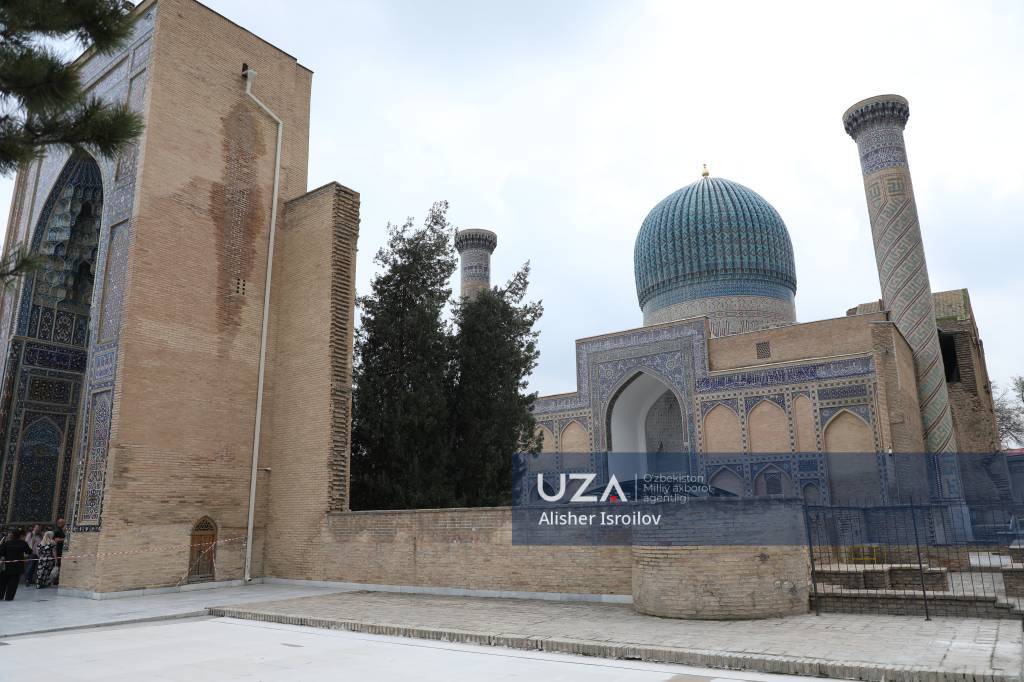
The Amir Temur Mausoleum is one of the most well-known historical and architectural landmarks in the city of Samarkand.
The complex, built in the late 14th and early 15th centuries, was constructed for Muhammad Sultan Mirza. Its construction started during Amir Temur’s lifetime and was finished by Mirzo Ulugbek.
In addition to Muhammad Sultan, the spiritual mentor of the great commander, Mir Sayyid Baraka, is also buried here, which is why the mausoleum is also called “Gur-e Amir”.
According to his will, Amir Temur was buried at the feet of his teacher’s grave. His sons Miranshah and Shahrukh, along with his grandson Mirzo Ulugbek, were also laid to rest in the mausoleum.
Later, members of the Timurid dynasty, including the daughters of Mirzo Ulugbek and Muhammad Sultan, were also buried on the complex’s grounds.
Visiting the mausoleum in Samarkand is an important part of official ceremonies celebrating significant dates and milestones in the city’s history.
Official delegations, as well as local and foreign tourists, get to explore unique examples of architecture and art from the time of Amir Temur and the Timurids.
Last year, the mausoleum’s exposition was significantly updated and expanded. The collection was enriched with unique artifacts from the era of Amir Temur and the Timurids, enhancing its historical value and enabling a more comprehensive presentation of the period.
“The renovation of the mausoleum exhibition last year on the eve of the 43rd session of the UNESCO General Conference became an important historical event”, noted the mausoleum guide Ashrafjon Yusufzoda. “The column elements discovered during archaeological research, as well as fabrics with gold and silver threads extracted during the 1941 scientific expedition, provide valuable insights into the architecture and burial traditions of that period. In addition, copies of documents and photographs related to the opening of the tomb are presented, along with marble panels featuring epigraphic patterns that reflect the high level of calligraphy and decorative art of the Timurid era”.
The collection includes historical manuscripts and publications, as well as books by Russian and French authors. The sources help to gain a better understanding of Amir Temur’s personality, his political activities, and his role in world history.
This year, in celebration of the 690th anniversary of Amir Temur’s birth, large-scale reconstruction and improvement works are being carried out on the territory of the Amir Temur Mausoleum.
“The entrance area of the complex is being significantly expanded, special passages have been organized, and a comfortable space is being created for the free movement of people with disabilities”, said the head of the Amir Temur Mausoleum, Khushnud Abdullayev. “Modern ticket offices and waiting halls are being built. Electronic information panels will be installed for visitors, and an audio guide system will be introduced. Special monitors will display information on the state and political activities, architectural projects, science, and culture from the era of Amir Temur and the Timurids. The use of artificial intelligence technologies will enable the demonstration of historical images that recreate the atmosphere of that time. Additional facilities will also be provided for the comfortable reception of official delegations on the complex’s territory.
The number of tourists visiting Samarkand, now the main gateway of New Uzbekistan, is increasing each year. For instance, just last Sunday, more than 5,000 residents and around 1,000 international visitors visited the mausoleum.
[gallery-28598]
Golib Khasanov, UzA