President reviews projects to develop mahallas and social infrastructure in Tashkent
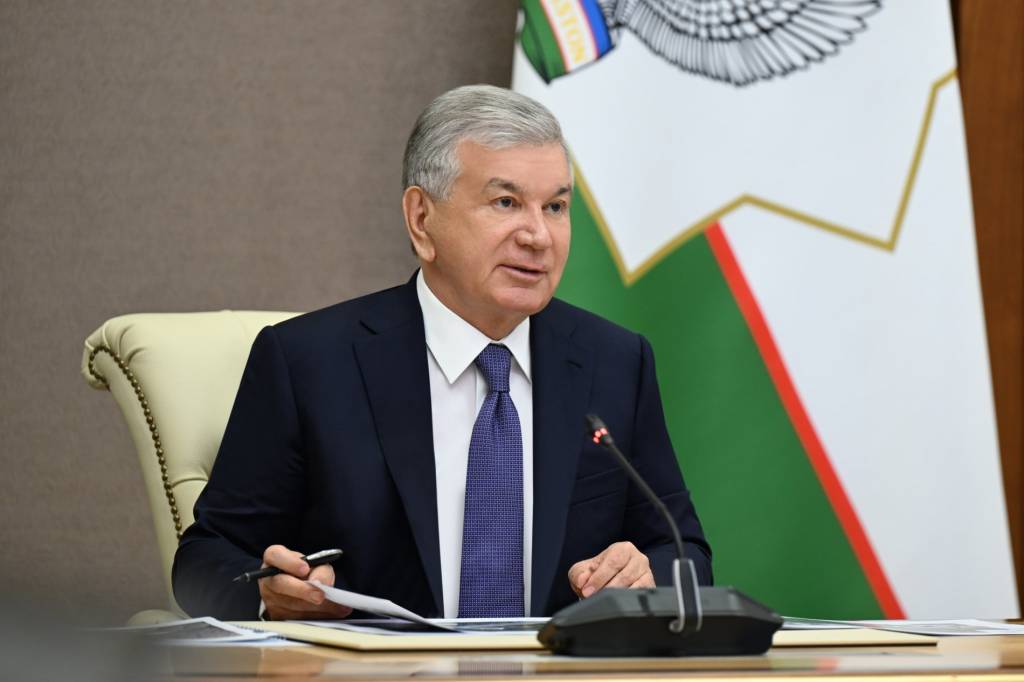
President Shavkat Mirziyoyev reviewed a presentation on projects to improve mahallas, build new schools and kindergartens, and develop the urban environment in Tashkent.
The presentation included a project for the comprehensive renewal of the Vatandosh, Mohinur, Al-Bukhari and Tong mahallas in Yashnabad district. Together, they cover 75 hectares and are home to 18,386 residents.
The project is based on the “15-minute mahalla” concept. Under this approach, shops, essential services, educational and healthcare facilities, and recreational and sports areas will be located within easy reach of residents.
Plans include expanding green spaces, creating a three-kilometer walking avenue, upgrading children’s playgrounds and sports grounds, and building a multifunctional sports facility. Existing schools will be expanded to provide 2,000 additional places, while four kindergartens with capacity for 540 children and three outpatient clinics will be established.
Proposals also include moving car parking outside residential courtyards, upgrading public transport stops, and creating safe pedestrian and cycling paths. The facades of 76 residential buildings and utility networks will be renovated, street lighting improved, and the number of waste collection points increased. New shops, service facilities, cafes and spaces for residents to meet and relax will also be created.
As part of the “15-minute mahalla” concept, 100 mahallas in the capital will undergo comprehensive modernization by 2027, with the number set to reach 400 by 2030. All infrastructure in these mahallas, including heating, water supply, sewerage, electricity, gas and lighting networks, as well as apartment building facades, roads, pavements, children’s playgrounds and sports facilities, will be fully upgraded. Tree and shrub coverage per resident will also be aligned with international standards.
By 2030, 130,000 new jobs will be created across 400 mahallas, including 22,000 jobs in 100 mahallas by 2027. To support this effort, banks will establish a streamlined system for developing and implementing standardized “conveyor” projects.
As Tashkent’s population grows, demand for school places continues to increase. In the 2025/2026 academic year, the shortage stood at 141,000 places. With the number of schoolchildren expected to rise by 71,000, or 14 percent, over the next five years, the shortage could reach 212,000 places by the 2030/2031 academic year. To address this, plans are in place to create 48,000 additional school places through the national budget and 78,000 through the local budget by 2030. As a result, the school occupancy ratio is expected to fall from the current 1.4 to 1.2 by 2030.
Projects for 24 new schools with a combined capacity of 38,000 students and a total area of 64,600 square meters have been prepared for the 2026/2027 academic year. The updated standard school designs incorporate 17 new features, including additional learning spaces, libraries, flexible halls for sports and cultural activities, and enhanced facilities for teachers. The new designs also include ramps and lifts, inclusive education classrooms, medical rooms, and advanced safety and energy-efficiency solutions. Motion and water sensors will reduce electricity consumption by up to 20 percent and water consumption by up to 10 percent. The improvements will reduce land requirements by 50 percent, increase space efficiency per student by 15 percent and triple the size of sports facilities. Overall, the efficiency of standard school designs will increase by 40 percent.
Cooperation between private educational centers and public schools will also be established, creating new opportunities for students to prepare for university admission and learn new languages within their schools.
The capital is home to 253,000 children aged 3 to 7. Preschool education coverage currently stands at 79.2 percent, with a shortage of 65,000 kindergarten places. To address this gap, plans are in place to create 8,000 additional places through the national budget and 32,000 through the local budget by 2030, raising coverage to 92 percent. For the 2026/2027 academic year, projects have been prepared for 28 new kindergartens of five different types, with a combined capacity of 16,000 children and a total area of 32,000 square meters.
The updated kindergarten designs include 14 new features to support children’s development and health. These include sensory and speech therapy rooms, spaces for psychological and educational support, medical facilities and multifunctional halls for various activities. The facilities will also feature video surveillance systems and impact-absorbing surfaces to enhance children’s safety, as well as air purifiers to create a more comfortable environment. Energy-efficient lighting and solar panels are also planned. These improvements will increase the efficiency of standard kindergarten designs by 38 percent.
The presentation also featured a project to develop Uchtepa City, a modern business center in Uchtepa district, through foreign direct investment. The 37-hectare project will be implemented in two phases. During the first phase, the investor will allocate $1 billion to construction across 26 hectares. The second phase will involve constructing residential buildings and service facilities on the remaining 11 hectares. The center will feature multi-storey residential buildings, offices, a shopping and entertainment complex, an internationally branded hotel and a landscaped walking area.
An architectural concept for the Uzbek-Turkish Friendship Park and Ataturk Street was also presented.
The Head of State instructed responsible officials to further refine the proposed projects, taking into account residents’ needs and urban planning requirements.
UzA