What benefits does an integrated nuclear power plant offer?
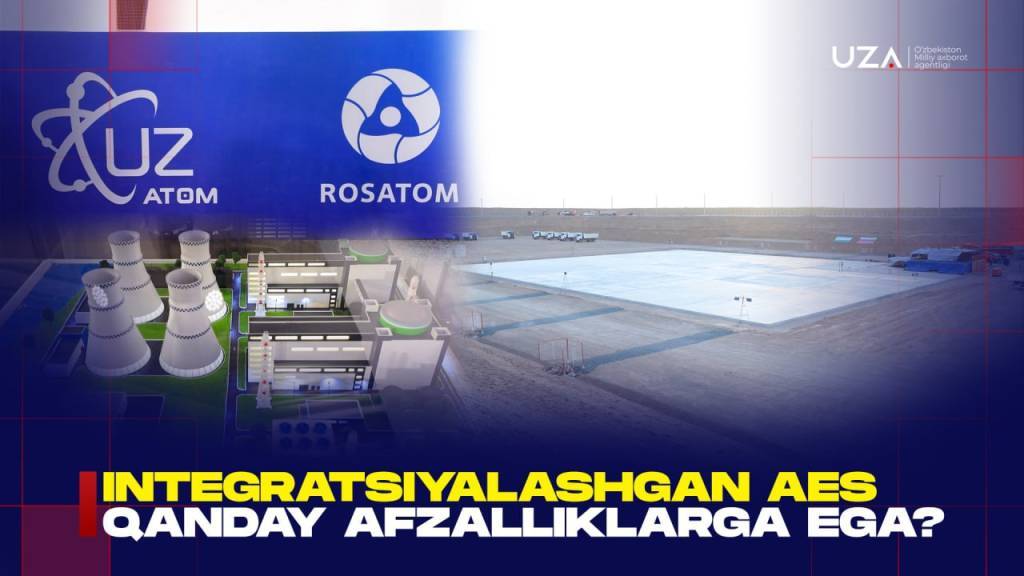
Recently, the Presidents of Uzbekistan and Russia launched construction of the first power unit at a nuclear power plant in Uzbekistan.
A ceremonial event took place in Farish district of Jizzakh region, featuring participants from the Uzatom Agency, Rosatom State Corporation, the International Atomic Energy Agency (IAEA), industry experts, students, and the local community.
As part of the event, participants shared their views on the project’s importance and prospects.
Azim Ahmedkhodjayev, Director of the Uzatom Agency:
– This project is of great importance for diversifying Uzbekistan’s energy system, providing the population with stable, environmentally clean energy, and strengthening the country’s energy security. In addition, developing nuclear energy will contribute to training highly qualified personnel, introducing advanced technologies, and enhancing the country’s industrial potential.
At the initiative of the Head of State, an integrated nuclear power plant project is being implemented, under which two large and two small reactors will be located at a single site, ensuring uninterrupted electricity generation.
According to the signed agreement, the total cost of the project is $9.5 billion. Negotiations with the BRICS New Development Bank on financing are planned in the near future. Dialogue is also ongoing with other international financial institutions and partner countries. Domestic funds will also be allocated to finance the project, but credit resources will cover the bulk of the costs. Thus, 85-90 percent of the funds are planned to be attracted from external sources.
According to calculations conducted with international partners and consulting companies, the project’s implementation will deliver more than $165 billion in long-term economic benefits to the country. In this sense, the project is a highly efficient strategic initiative. In addition, during its implementation, it is planned to bring the level of production localization to 30 percent.
Rafael Mariano Grossi, Director General of the International Atomic Energy Agency:
– This is an important event for Uzbekistan, as the country is implementing a nuclear energy project for the first time. Its distinctive feature is its combination of small and large reactors. In addition, it is being implemented in cooperation with Rosatom, one of the world’s leading technology suppliers.
In my view, this is a highly effective and promising partnership. For the International Atomic Energy Agency, the key priority is to ensure that the project is implemented in full compliance with international safety requirements and non-proliferation standards. This approach has already proven effective in Rosatom’s projects in various countries.
We have been supporting Uzbekistan for many years because the construction and effective operation of a nuclear power plant require modern infrastructure, an independent, highly qualified regulatory body for nuclear safety, and firm political will from the country’s leadership.
We see all these factors in Uzbekistan. Therefore, I believe this project is being implemented at an opportune time, as interest in nuclear energy is growing noticeably worldwide. That is why Uzbekistan’s decision to diversify its energy mix by developing nuclear energy appears entirely logical.
I am confident that the date on which the Presidents of the two countries officially launched the project will hold an important place in history.
Pavel Bezrukov, Director of the NPP Construction Project in Uzbekistan:
– We have witnessed a historic event – the first concrete has been poured into the foundation of the world’s first integrated nuclear power plant.
The integrated NPP will include two small power units with a capacity of 55 MW each and two large power units with a capacity of 1,000 MW each. This configuration will ensure system flexibility through the small units and stable electricity generation through the large units.
This project is a unique solution that combines the best features of small- and large-scale nuclear energy. The power units will operate simultaneously in continuous mode. However, when the grid load changes, the operating mode of the small units will adapt. This will help ensure the stability of the power system and the stability of the electric current frequency.
This is another innovative solution in the field of nuclear energy. Dry cooling towers will also be used in the project. This technology requires virtually no additional water and significantly reduces the need to draw on the country’s water resources for the plant’s needs.
Interviewed by Nasiba Ziyodullayeva, UzA