Javlon Vakhabov: Central Asia’s key task is to diversify economic ties and routes
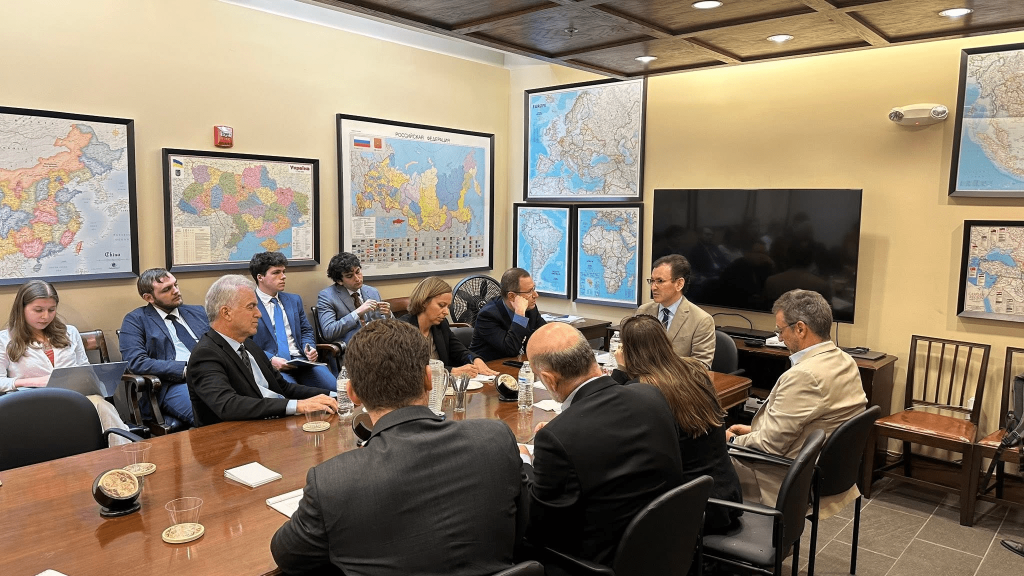
During his working visit to Washington, Javlon Vakhabov, Director of the International Institute for Central Asia in Tashkent, took part in a roundtable discussion at the American Foreign Policy Council on the priorities of the multi-vector foreign policy of Central Asian countries in the context of the changing geopolitical situation in Eurasia.
The event was also attended by experts and researchers from leading American think tanks and the scientific community specializing in Central Asian issues.
The participants discussed the expansion of Central Asian countries’ partnerships with key external players, the development of transport connectivity, energy security, and critical minerals, and the strengthening of cooperation.
Mr. Vakhabov noted that Central Asia is increasingly viewed not through the prism of geographical constraints, but as a region seeking to transform its position between Russia, China, Europe, South Asia and the Middle East into a source of strategic flexibility.
According to him, the key task of the region is to diversify economic ties, transport corridors, energy routes and international partnerships.
It was noted that this transformation already has a practical dimension. The population of Central Asia exceeds 80 million people, intraregional trade has doubled since 2017 and reached about $11 billion, and the total GDP has grown 2.5 times and amounted to about $520 billion. These indicators show the region’s growing economic independence and its desire for a more coordinated regional agenda.
In turn, Ilan Berman, Senior Vice President of the American Foreign Policy Council, stressed that this creates an opportunity for the United States to move from political visibility to practical results within the C5+1 framework. Transport and logistics, energy, nuclear safety, critical minerals, digital infrastructure, agriculture, education, and human capital development were identified as promising areas.
G. Khonnazarov, UzA