A Nation Undergoing Major Transformation
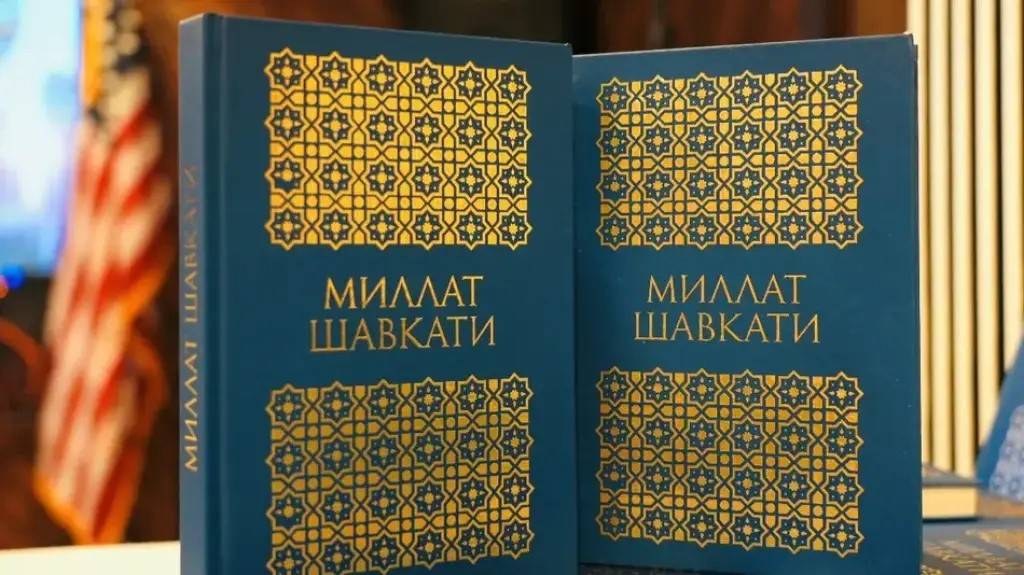
Regarding the book “Millat Shavkati” (“The Nation’s Glory”), which was showcased in the United States
A few days ago, my cell phone rang.
– Hello!
– Hello, I’m listening…
The call came from Vatan Global Alliance.
– We are reaching out on behalf of our Chairman, Ozodjon Soliyev. A presentation of the book “Millat Shavkati” will take place in Philadelphia, with guests from the Senate of the Oliy Majlis of Uzbekistan expected to attend. We invite you to join us. We will send you an electronic copy of the book via Telegram shortly.
I thanked them for the invitation, then hung up. Within minutes, the book was already in my hands.
At first, I thought: with a delegation arriving, I wondered whether an author would be among the guests, prompting a meeting with the writer. I assumed they had sent me a new novel or novella, so I decided to read it.
I turned on my computer and opened the book, but it didn’t take long for me to realize I was mistaken.
What I found wasn’t a typical novel or novella, but a unique book that serves as both a mirror and a compass. It acts as a mirror, reflecting your life, the country’s history, struggles, mistakes, and hopes as you read. At the same time, it functions as a compass, prompting reflection on our current direction and the kind of Uzbekistan we aspire to become tomorrow.
Certain pages feel like re-experiencing your own life.
I am now 69 years old, born in Samarkand, and a graduate of the Tashkent University of Information Technologies (former Tashkent Electrotechnical Institute of Communications). Having lived a long life, I have developed my own perspectives and the right to compare experiences. So, when I read “Millat Shavkati”, scenes from the past naturally resurfaced, especially events from the last decade.
The book offers many examples from life in contemporary Uzbekistan. The author speaks honestly and directly about recent events, openly questioning what we had before, what we have achieved now, and what direction we plan to take moving forward.
As an ordinary reader, I sincerely thank the author, Qudratilla Rafikov, a renowned statesman, political scientist, and member of the Senate of the Oliy Majlis of the Republic of Uzbekistan. I especially appreciate his honesty, civic outlook, and his effort to analyze events deeply and understand their development and interconnections.
Years pass remarkably fast. Surrounded by daily worries and responsibilities, people get used to change. What once seemed nearly impossible now feels normal. We seldom reflect on the effort behind every new project, road, school, international pact, economic reform, or sporting achievement.
Nothing occurs automatically. Significant changes are always rooted in human effort, understanding, energy, accountability, well-being, and sometimes sleepless nights.
A famous Abraham Lincoln quote states that the best way to predict the future is to create it.
This idea truly resonates with me. The future isn’t something to wait for. We must create itthrough our efforts. We should cherish the present, embrace responsibility, and recognize that tomorrow starts today.
Reading “Millat Shavkati” inspired me to reflect further. The common saying that comparison clarifies everything still holds true.
A Decade of Significant Change
A calm review of Uzbekistan’s past decade reveals extensive changes across multiple sectors. These include foreign policy, the economy, relations with neighboring countries, the business environment, transport, culture, tourism, education, and sports.
Naturally, I cannot cover everything in one article. I will instead highlight what stands out most to me as someone who has lived abroad for many years and observes developments from the perspective of a fellow countryman from afar.
Neighbors Have Become Close Again
I find the shifts in relations with Central Asian countries especially significant.
Not so long ago, borders between neighboring countries were closed, and travel faced many restrictions, making personal contact difficult. Sometimes, traveling thousands of kilometers was easier than visiting relatives in a nearby republic.
Significant changes have occurred in recent years, with Uzbekistan strengthening its relations with Kazakhstan, Kyrgyzstan, Tajikistan, and Turkmenistan. Additionally, connections between people, such as travel, trade, cultural exchanges, and family visits, have resumed and grown closer.
This issue transcends politics. It involves restoring the natural harmony among communities that have coexisted for centuries.
Our ancestors believed that when happiness or, God forbid, hardship arrives at your home, it is not a distant relative but your neighbor who comes first. This piece of folk wisdom reflects a deep philosophy.
This is why maintaining normal, respectful, and good-neighborly relations in Central Asia is crucial for the region’s future.
Uzbekistan’s international engagement has risen significantly in recent years, hosting leaders from Central Asia, the CIS, China, India, Pakistan, Türkiye, Iran, European nations, and the Middle East.
Uzbekistan has hosted various international conferences, forums, and summits, including those of the Shanghai Cooperation Organization, the Economic Cooperation Organization, and other global entities.
Uzbekistan has gained much greater international visibility, and global attention has increased significantly.
The Economy: Personal Experiences of Change
My generation remembers certain things vividly, such as currency conversion. Back then, officially buying foreign currency through a bank was very challenging. People often waited weeks or even months for currency exchange. This situation led to the rise of a parallel system, causing problems for both citizens and entrepreneurs.
The situation fundamentally changed after the 2017 liberalization of the foreign exchange market.
Today, this might seem obvious, but those who recall earlier years can compare it to what came before.
Another example is the cotton-picking campaign, which for many years turned cotton harvesting into a nearly nationwide duty. Students, public-sector workers, and employees from various enterprises and institutions were sent to pick cotton. Often, individuals were removed from their usual jobs and studies to participate.
The gradual abandonment of this practice has been a key change in recent years and reflects a new perspective on human labor.
During this period, the country has undergone substantial economic and social changes, actively attracted foreign investment, created new businesses, and expanded its infrastructure.
Naturally, many issues still exist. It would be inaccurate to say all are solved. However, it is also important to acknowledge the progress being made.
Peace Begins with Security
The country’s defense capability is a distinct matter. An age-old adage holds true: if you wantpeace, you must be ready to defend it. Robust armed forces are essential not for waging war, but forpreventing war from reaching your borders.
Today, Uzbekistan maintains a professional army, a modern defense system, and significant military capabilities. For a nation situated in a complex region, this is crucial for national security, independence, and the peace of its citizens.
Culture, Spiritual Heritage and Tourism
Another noticeable aspect is the perspective on historical and spiritual heritage.
Uzbekistan holds unique treasures. Cities like Samarkand, Bukhara, Khiva, Shakhrisabz, and Termez are more than mere locations – they are chapters of world history.
Today, the world is increasingly interested in them.
The Islamic Civilization Center has been established in Tashkent, Uzbekistan. Significant efforts focus on honoring the legacy of eminent scholars and thinkers born in our land.
A prominent figure among them is the renowned hadith scholar Muhammad ibn Ismail al-Bukhari, whose name is widely recognized across the Muslim world. His mausoleum and memorial complex near Samarkand serve as one of the country’s principal spiritual centers.
Being from Samarkand, I take special pride in knowing that millions from various nations will visit our land, not just as tourists but also as pilgrims honoring the memory of the great scholar.
Tourist arrivals in Uzbekistan have risen markedly in recent years, with the book noting 11.7 million foreign visitors in 2025 and 7.75 million in the first seven months of 2026.
However, these dry figures represent much more. They represent aircraft, hotels, restaurants, artisans, tour guides, drivers, museums, trade, new jobs, and, importantly, a shifting international perception of Uzbekistan.
Today, visitors are greeted by modern airports, Afrosiyob high-speed trains, intercity buses, and new hotels. However, the most important aspect remains the same – our hospitality.
“Well Done, Boys!”
Sports deserve special mention.
Uzbekistan’s World Cup qualification was a historic achievement and brought immense joy to millions.
One can’t help but say: “Barakalla, yigitlar! Well done, boys!”
But it’s not just about football. Our young men and women are also excelling in the Olympic Games and World Championships, with achievements in boxing, judo, chess, and numerous other sports.
Each victory signifies more than a medal. When Uzbekistan’s flag is raised and our country’s name is announced, the athlete immediately becomes its ambassador to the world.
A straightforward question naturally comes to mind: why not us? What differentiates us from others? Nothing! We just have to put in effort, stay confident, and keep progressing.
Our Greatest Wealth Is Our Youth
Uzbekistan’s population is very young.
The book highlights that approximately 40 percent of the population is under twenty, and over half of the citizens are under thirty. This represents a significant strength, but also a major responsibility.
Young individuals require education, a career, employment, the chance to start a family, and confidence in what lies ahead.
It is crucial for young people to have the chance to study both in Uzbekistan and at top universities worldwide, to gain experience and learn modern skills and technologies. Equally important is ensuring that this experience ultimately benefits their home country.
I see it like an ocean wave: it rushes to shore with great energy, then recedes into the ocean. The same applies to our youth.
Encourage our young men and women to travel internationally, pursue studies, explore the world, earn degrees, and build skills. However, one day, a meaningful portion of this global talent should come back to contribute to the homeland.
To build homes, create businesses, care for people, educate children, advance scientific research, develop new technologies, and continue developing the New Uzbekistan.
Recently, I learned that at four schools in Karakalpakstan, Gulistan, Khorezm, and Fergana, one in every eleventh-grade graduate was admitted to a higher education institution.
If that’s the case, all that’s left to say is: “Bravo to the teachers! Bravo to the students!”
Such results are not accidental. They stem from hard work, high standards, a teacher’s trust in the student, and the student’s own resolve.
This shows that with enough desire, many things are genuinely achievable. It’s also rewarding to observe the talented generation rising in Uzbekistan today.
We Were Also Young Once…
Why is this subject especially meaningful to me? Because I previously worked in a city youth organization, and I consider myself lucky to have experienced that valuable life lesson.
We felt like one big family, sharing common causes, friendships, debates, and plans. Young people actively helped build enterprises, cities, and roads.
Today, former Komsomol officials and activists belong to the older generation.
However, as the saying goes, there’s still powder in the flask. We have gathered experience, knowledge, connections, and memories, all of which can also benefit the country.
The older generation should actively participate rather than observe as young people create the future. If we have advice, experience, or knowledge to offer, we ought to contribute.
Avoid commanding or endlessly lecturing the young; instead, sincerely assist them, since they will shape the future.
A Prayer for the Homeland
Another trait of our people becomes truly evident after many years living away from the homeland.
After a meal at the table, the eldest family member raises their hands, followed by the others, and they recite a simple prayer.
“May the country’s leader enjoy good health. May the homeland remain peaceful. May our children’s future be bright. May workers be blessed with prosperity. May the Almighty inspire conscience in those who have strayed. May the spirits of our ancestors guide their descendants. May the Almighty keep us all safe from harm”.
In Uzbek, these words carry a particularly warm tone:
“Yurtboshimizning boshlari omon bo‘lsin, yurtimiz tinch bo‘lsin, bolalarimizning kelajagi porloq bo‘lsin, mehnat qilganlarga baraka bersin, yomonlarga insof bersin, o‘tgan bobokalonlarimizning arvohlari madad qilsin, Yaratganning o‘zi hammamizni o‘z panohida asrasin”.
This is not a political slogan. It reflects a centuries-old tradition of a people who have always prioritized peace in the country, family wellbeing, and the security of their children as some of their highest values.
There Is Still Much Work Ahead
We should not become complacent about our achievements. Once complacency sets in, progress halts.
A basic principle states that every action has a reaction. Additionally, a common saying suggests that success comes to those who keep moving forward on their journey.
The primary focus is not on declaring a single day as the moment when “we have done everything”, because such a day will never arrive for any nation. Instead, we need to keep advancing, correct mistakes, listen to people’s voices, embrace criticism, safeguard our accomplishments, and pursue new objectives.
What I truly care about is something else: today, I perceive Uzbekistan as a nation eager to progress. That drive for advancement is noticeable even from a distance – from America.
When the Homeland Is Far Away, It Feels Closer
Someone who has been away from their country for many years might see their homeland in a different light.
From afar, one can especially appreciate the significance of familiar language, the scent of flatbread, a Samarkand morning, an old friend’s voice, an Uzbek song, and the simple word “mahalla”.
Reading a book about your homeland from thousands of kilometers away creates a unique perception. Faces, events, and cities flash by, evoking pride, questions, concern, and hope. All of these feelings can be captured in one word: Homeland. This was exactly how I felt while reading “Millat Shavkati”.
Azam Ahrorov,
Entrepreneur, Fibre-Optic Communications Specialist,
Member of the Tashkent Business Club named after Ilhom Karimov
UzA