Uzbekistan-Serbia: A New Era of Cooperation
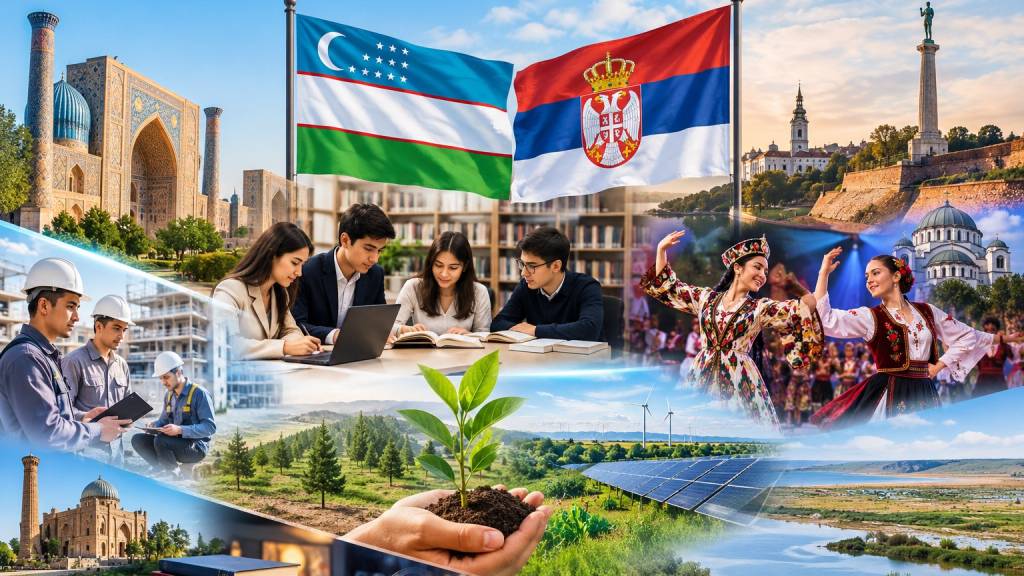
In recent years, the strategic convergence between Uzbekistan and Serbia has expanded to encompass not only trade and technology but also socio-humanitarian and environmental sustainability initiatives. Intergovernmental agreements reached between Tashkent and Belgrade have laid a solid foundation for deepening cultural and academic exchanges and accelerating the transition to a "green" economy.
Partnership in the social and academic spheres is primarily aimed at establishing direct ties in higher education and science. Memorandums of understanding have come into effect between the University of Belgrade and Uzbekistan's leading higher education institutions—the Tashkent State University of Oriental Studies and the Muhammad al-Khwarizmi Tashkent University of Information Technologies.
A system has been established for exchanging experience among professors, faculty, and students, financing joint research projects, and introducing educational grants.
If we focus on cooperation in migration, intergovernmental working groups have been formed to provide contractual and legally protected employment for Uzbek specialists, set against the backdrop of rapid growth in Serbia's industrial and construction sectors.
Moreover, the bonds of friendship between the peoples are being strengthened by holding cultural days in both countries and jointly implementing projects in cinema and the arts.
Additionally, against the backdrop of global climate change, Uzbekistan and Serbia are strengthening cooperation in environmental protection and resource conservation. The experience of Serbia, which adheres to the "green" standards of the European region, is proving useful in addressing climate challenges in Central Asia. Specifically, within the framework of the "Yashil Makon" nationwide project, Serbian technologies for forest restoration and planting seedlings in arid climates are being studied.
In the area of waste-free and water-saving technologies, joint projects based on European standards for solid waste recycling and the efficient management of water resources are being implemented.
Notably, Serbian and Uzbek scientists are conducting joint research on expanding "green cover" and vegetated areas on the dried-up bed of the Aral Sea.
F. Yakhshiboyeva, UzA