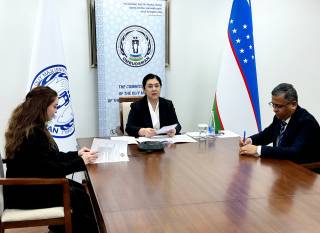
Uzbekistan delegation attends IAEA General Conference

The 64th annual IAEA General Conference has concluded with resolutions adopted towards strengthening the Agency’s work in the areas of nuclear science, technology and applications, safety and security, and safeguards.
The 64th annual IAEA General Conference has concluded with resolutions adopted towards strengthening the Agency’s work in the areas of nuclear science, technology and applications, safety and security, and safeguards.
The General Conference – held in both physical and virtual format this year due to requirements related to the COVID-19 pandemic – is an opportunity for all IAEA Member States to jointly consider matters related to the IAEA’s ongoing work, budget and priorities.
According to IAEA, this year, around 500 delegates registered to attend the General Conference from 141 of the IAEA’s 171 Member States and from international organizations, non-governmental organizations and the media.
In his opening statement, IAEA Director General Rafael Mariano Grossi said that despite the unprecedented disruption caused by the pandemic, the Agency had maintained its operational activities and implemented its largest-ever operation helping countries respond to the COVID-19 pandemic. Mr Grossi emphasized that the IAEA would continue to support countries in fighting the coronavirus as a top priority.
Conference delegates adopted resolutions to continue strengthening the Agency's activities related to nuclear science, technology and applications in general, and particularly in relation to the Zoonotic Disease Integrated Action (ZODIAC) Project, nuclear knowledge management and the renovation of the Agency’s Nuclear Applications Laboratories at Seibersdorf.
Resolutions were also adopted requesting the IAEA to continue carrying out its functions during the COVID-19 pandemic in all domains of its mandate, and on strengthening the effectiveness and improving the efficiency of Agency safeguards. A resolution was adopted on the implementation of the Treaty on the Non-Proliferation of Nuclear Weapons safeguards agreement between the IAEA and the Democratic People's Republic of Korea.
Uzbekistan delegation led by the Minister of Energy of Uzbekistan Alisher Sultanov and the Ambassador of Uzbekistan to Austria Abat Fayzullayev took part in the conference.
Alisher Sultanov informed the participants about the success of the country’s interaction with the IAEA in various fields of nuclear science, cooperation in development of the country’s nuclear energy infrastructure.
A total of 39 side-events took place online during the week, highlighting the innovative work underway at the IAEA and in Member States using nuclear techniques.
A two-day Scientific Forum focused on ‘Nuclear Power and the Clean Energy Transition’. The Forum featured experts, government representatives and international organization representatives and academics, who spoke about how nuclear power can contribute to climate change goals and play a role in the clean energy transition.