Uzbekistan and the World Urban Forum: From National Transformation to International Dialogue
This May, Baku will be the world’s leading platform for discussions about the future of cities. From May 17 to 22, Azerbaijan’s capital will host the 13th Session of the World Urban Forum – the United Nations’ leading global forum on sustainable urbanization. The forum’s theme is “Housing for All: A Better Urban Future”. Organizers say the forum will address both the global housing crisis and the broader impact of housing on the development of inclusive, resilient, and climate-adapted urban environments.
According to UN-Habitat, nearly 3 billion people worldwide lack access to safe and affordable housing, more than 1.1 billion live in informal settlements or slums, and over 300 million are entirely without shelter.
For Uzbekistan, participation in this forum offers an opportunity to present its unique model of urban transformation to an international audience. Having moved beyond its image as a predominantly agrarian country with historic cities, the country today projects a new reality – expanding agglomerations, large-scale infrastructure modernization, and the growing significance of regional centers.
According to the National Statistics Committee, as of January 1, 2026, the permanent population of the Republic of Uzbekistan exceeded 38 million, and the urbanization rate reached 51 percent, representing nearly 20 million urban residents.
These figures mark a significant historical milestone. Uzbekistan has entered a stage in which national strength is measured not only by the throughput capacity of export corridors or the number of industrial zones, but also by the quality, connectivity, environmental sustainability, and economic productivity of its cities.
In contemporary Uzbekistan, a city is no longer merely an administrative unit. It is a place where young people receive education, entrepreneurs launch businesses, families seek affordable housing, and the state tests new approaches to infrastructure, transportation, and territorial governance. Rapid urbanization, however, is often viewed as a source of risk.
Indeed, when a city grows faster than its engineering networks, transportation arteries, and social infrastructure – schools, hospitals, and parks – it begins to generate social tension rather than opportunity.
The Uzbek experience, however, is of particular interest precisely because urbanization is increasingly treated as a manageable resource for development. This process encompasses not only the construction of new districts but also a transition toward a fundamentally higher quality of the urban environment.
As the President of Uzbekistan has noted, each 1-percentage-point increase in the urbanization rate generates at least 1 percent of additional economic growth, accompanied by commensurate increases in investment flows, business and startup activity, and labor productivity. For this reason, Uzbekistan is developing a unified approach to the sustainable management of urbanization nationwide.
To this end, the National Committee on Sustainable Urbanization and Housing Market Development has been established to implement state policy in the areas of urbanization, housing construction, urban renewal, and mortgage lending. The Committee will also coordinate and advance programs across these domains.
The Future of Uzbekistan’s Cities
According to World Bank projections, more than half of Uzbekistan’s population currently lives in cities, and this share could exceed 60% by 2050. Such a trajectory means that urban planning, transportation, waste management, utility services, and public spaces are no longer merely matters of convenience – they are becoming a key determinant of national competitiveness.
This is where the core analytical insight lies: for Uzbekistan, urbanization is not a byproduct of demographic growth but a powerful lever of modernization, and its economic rationale is abundantly clear. Quality infrastructure stimulates labor mobility, a livable urban environment attracts investment and talent, and the development of regional centers alleviates pressure on the capital.
While Tashkent naturally plays a pivotal role as the primary center of gravity, the country’s sustainable development requires a deliberate shift in focus toward other cities.
Supported by the Asian Development Bank, cities such as Jizzakh, Khavast, Khiva, and Yangiyer are emerging as anchor points in this new geography, where modern and inclusive infrastructure projects are being implemented. These cities exemplify the transformation of regional centers from peripheral locations into autonomous hubs of growth.
This approach fundamentally reframes the development philosophy. At its core is not merely the decongestion of Tashkent, but a comprehensive strategy to create genuine alternatives in the regions – with new employment opportunities, public spaces, transportation connectivity, a business-enabling environment, and high-quality municipal services.
To give powerful impetus to entrepreneurship in the regions, establish the production of high-value-added goods, and introduce urban living standards and conditions in rural mahallas, a program has been approved to create 33 model districts and cities that embody the “New Uzbekistan” vision. The strategic objectives set by the President of Uzbekistan in this domain are ultimately aimed at transforming the architectural character of New Uzbekistan while ensuring a dignified standard of living for the population and confidence in the future.
All of these measures are critically important for a country with a predominantly young population, since young people must not perceive relocation to the capital as the only viable path to self-fulfillment. In this sense, second-tier cities offer a new way of life – education, employment, business, and a dignified existence without having to leave one’s hometown.
Large-scale investment is being mobilized to realize this potential. In December 2025, the World Bank approved a $250 million financial package for Uzbekistan. The funds will support improvements to municipal infrastructure and urban services in 16 districts and cities. The program covers areas with a combined population of about 3.6 million and is expected to directly improve living conditions for roughly 1 million people by 2030. Anticipated outcomes include improved transportation access for 300,000 residents, the development of parks and public spaces for 400,000 residents, and the creation of approximately 10,000 temporary construction jobs.
Uzbekistan’s Positive Achievements in Urban Development and Urbanization
The figures matter not merely as investment statistics. They demonstrate that urban infrastructure is a form of social policy.
A compelling illustration of this principle is the experience of the Aral Sea region, which can serve as a practical case study for implementing new approaches to territorial adaptation, water resource management, community support, and climate risk mitigation.
It is here that questions of urbanization acquire particular depth. How does one develop settlements in an ecologically vulnerable zone? How does one create employment where the natural environment has suffered severe degradation? How does one integrate afforestation, water security, public health, infrastructure, and the local economy into a coherent whole?
The answers to these questions are relevant not only to Uzbekistan but also to many regions of the world where climate change, land degradation, and water scarcity are already affecting urban quality of life. Indeed, the story of Uzbek urbanization is significant not only as a national case study but also as a reflection of a broader strategic shift underway across Central Asia.
This shift marks a move beyond the traditional perception of the region, framed by geopolitics, energy, raw materials, and transportation corridors. Today, the relevant question is framed differently: what will the cities of Central Asia look like?
Will they simply expand, consuming land and straining infrastructure? Or will they evolve into spaces where economic growth is reconciled with environmental responsibility, affordable housing, public transportation, green spaces, and meaningful civic participation?
Uzbekistan stands at this crossroads. Its advantages include its scale, demographics, and growing attention to regional development. Its challenge is to ensure that the quality of urban planning keeps pace with rapid urban growth.
In this sense, Baku – as host of the World Urban Forum – becomes a symbolic platform for the entire region. For Uzbekistan, it is an opportunity to demonstrate that its urbanization agenda has both national and international significance. The country has the potential to offer the world a pragmatic yet human-centered approach – one in which the region functions not only as an economic node but also as a mechanism for social resilience.
Altogether, Uzbekistan today stands at the threshold of the most ambitious urbanization reforms in its history. The new strategic plan envisions decisive measures to support demographic growth and improve the welfare of the population. This is the central meaning of Uzbekistan’s new urbanization.
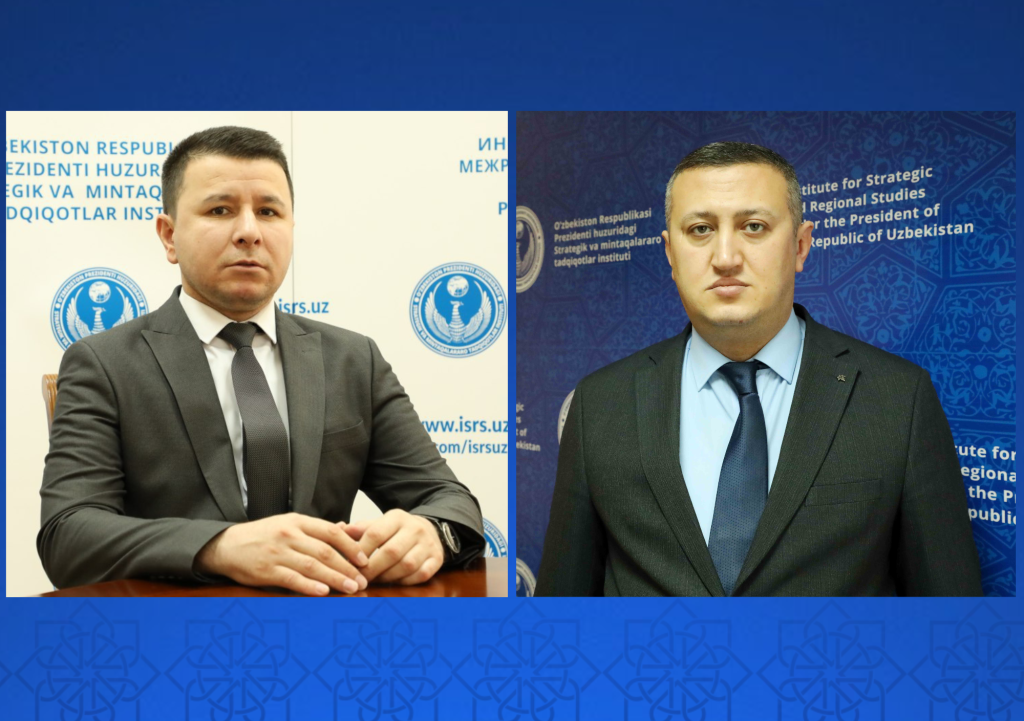
Tursunboy Zikirov, Alisher Nizamov,
Heads of Departments,
Institute for Strategic and Regional Studies under the President of the Republic of Uzbekistan