Taj Mahal – Symbol of Eternal Love
Impressions from Agra, India... When you think of this country, you envision its vibrant culture, ancient civilization, rich history, and distinctive architectural monuments. However, at the core of India is a site indispensable to any impression of the nation. This is the world-renowned Taj Mahal in Agra.
Ahead of the BRICS Summit, India is experiencing increased momentum in international cooperation, dialogue, and information exchange. Journalists and bloggers from different nations, here to cover the event, also get a chance to explore India’s vibrant cultural heritage alongside its political scene.
The global media team, comprising about 60 journalists and bloggers from nearly 20 countries, including Uzbekistan, visited the historic city of Agra today.
The very name Agra evokes a sense of history. Located on the right bank of the Yamuna River in Uttar Pradesh, Northern India, Agra served as the capital of the Baburids from the 16th to the 19th centuries. The city flourished especially during the reigns of Akbar and Shah Jahan. Agra has preserved remarkable Islamic monuments from the 16th and 17th centuries.

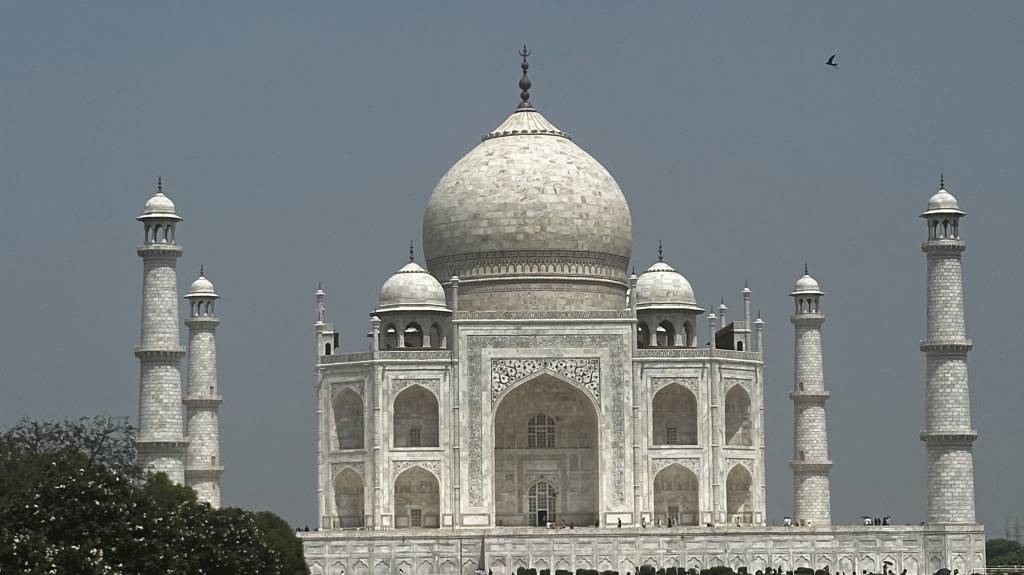
Agra is home to the Taj Mahal, a magnificent masterpiece of Eastern architecture. Recognized as one of the world’s rare wonders, the Taj Mahal was built by the Baburid Prince Shah Jahan in memory of his beloved wife, Mumtaz Mahal. Avenues and an expansive garden surround the complex. As one steps onto the site, it is not so much its grandeur as its astonishing elegance that first captures the eye. Built of white marble, the structure seems suspended between earth and sky.

As journalists and bloggers entered the Taj Mahal grounds, they immediately began taking photos with cameras and smartphones. Everyone was eager to capture the marvel firsthand and preserve the moment for history. Some focused on the harmonious architecture, others on the sunlight reflecting off the white marble, and some admired the Taj Mahal’s majestic presence from a distance. Seeing the Taj Mahal just once is never enough. The more you observe it, the newer details you discover.
A Love That Transcends Time
The Taj Mahal’s history begins in the 17th century. According to UNESCO, the main mausoleum began construction in 1632 and was completed in 1648. The mosque, guest house, main gateway, and other parts of the complex were completed later, by 1653. For centuries, the Taj Mahal has been recognized not just as an architectural masterpiece but also as a symbol of eternal love carved in stone.
Shah Jahan’s wife, Mumtaz Mahal, died in 1631. A year later, construction began on the magnificent monument dedicated to her memory. Today, nearly four centuries later, millions of people from around the world experience this love story not by reading about it, but by seeing it with their own eyes. The Taj Mahal’s main structure is built of white marble. It stands on the right bank of the Yamuna River, within an extensive garden complex covering nearly 17 hectares. UNESCO regards it as one of the greatest achievements of Indo-Islamic architecture.
Its architecture features proportions and symmetry, with domes, arches, and towering minarets harmoniously blended, resembling a unified work of music. The four corner minarets and the massive central dome especially contribute to the Taj Mahal’s iconic grandeur.

The monument exhibits varying hues throughout the day. In the morning, it looks delicate and serene, whereas in the bright daylight, its white marble gleams more intensely. As evening approaches, its color shifts subtly, giving the impression that it is harmonizing with the natural environment.
In 1983, the Taj Mahal was added to the UNESCO World Heritage List. Its construction engaged skilled artisans from the Baburids Empire, including stonecutters, decorators, calligraphers, and artisans from Central Asia and Iran. UNESCO lists Ustad Ahmad Lahori as the chief architect of the Taj Mahal.
Architectural traditions from various regions of the ancient East came together in Agra. This fusion created a masterpiece that has lasted through the ages and is now a universal heritage. Visiting the Taj Mahal today reminds one that great art transcends boundaries.

For international journalists visiting the Taj Mahal, this trip was more than just sightseeing. They arrived in India to cover the BRICS Summit. However, a journalist’s understanding of a country extends beyond official meetings, statements, and political discussions. To truly grasp a nation’s essence, you must experience its history, culture, and daily life. In this context, the visit to Agra held special importance.
Here, the past and present come together. Modern India discusses global economic and political issues, while the Taj Mahal, admired for nearly four centuries, remains a symbol of history. One looks forward, and the other reminds us of valuable lessons from the past. What connects them is India’s openness and dedication to sharing its rich history and cultural heritage.
The white marble serves as the paper, with patterns representing words, the dome embodying a verse, and the entire Taj Mahal resembling a grand epic read over centuries. Its main theme is love. Shah Jahan aimed to eternalize his love for Mumtaz Mahal through this magnificent mausoleum. Over the centuries, though, the Taj Mahal has become a shared heritage for all humanity.

The admiration of the journalists and bloggers who visited Agra today was visible not only through their camera lenses but also in their eyes. Each glance reflected a genuine appreciation for a wonder that has stood the test of time.
Standing before the Taj Mahal, one naturally reflects on a simple truth: while times, states, and political boundaries may change, genuine art and profound emotions rooted in the human heart remain enduring. Agra’s marvels exemplify this every day. The Taj Mahal stands as a monument to love, carved in stone, a victory over time, and a timeless symbol of human creativity.
Hearing Babur’s Name in Agra
Our visit to the Taj Mahal became even more memorable because of another experience. The guide, who was sharing details about the monument’s history, architecture, and the love story of Shah Jahan and Mumtaz Mahal, also spoke extensively about our ancestor Babur. Hearing him discuss Babur’s influence on Indian history, especially regarding the Baburid dynasty, and mention Uzbekistan brought a unique emotion to journalists and bloggers from Uzbekistan. It’s hard to describe that feeling in words.

Standing in a foreign country before the Taj Mahal and hearing the name of our great ancestor Zahiriddin Muhammad Babur, who made his mark on this land centuries ago, filled us with a deep sense of pride.
Nurillo Nasriyev, UzA
Delhi, India