Contrarian and Right: Nasim Nosirov’s Road from Uzbekistan’s Industrial Heartland to Silicon Valley Hardware
He built his first computer at 11, won his country’s national science Olympiad at 18, and walked away from a promising government career to build AI hardware in San Francisco. Meet the Uzbek founder who thinks in watts, milliseconds and megawatts.
Some founders come to hardware from software. Nasim Nosirov came to it from the factory floor.
He grew up in the old part of Navoi, a heavy-industry city in central Uzbekistan that produces much of the country’s gold, electricity, uranium and other natural resources. His childhood backdrop was not playgrounds and shopping streets but smokestacks, substations, high-voltage lines and manufacturing plants. That landscape shaped how he sees the world: as a set of machines, each with an energy input, a heat output and a point of failure.
Today Nosirov is the founder and CEO of Beroony Inc., which operates as Obround, a San Francisco company that builds hardware devices for AI. He holds patents from the United States Patent and Trademark Office, has more applications pending, and was the first Uzbek founder accepted into CES Eureka Park, the startup showcase at the world’s largest consumer electronics show. People who meet him often reach for the word prodigy. He describes himself more simply: “I’m a hardware guy. Everything else I learned so I could build the best deeptech company”.
A factory-town childhood
Nosirov was the kind of child who took things apart to see how they worked. He was drawn early to building, architecture, computers and physics, and he was restless until he understood the mechanism behind whatever was in front of him.
At 11, he decided he wanted a computer of his own. Rather than ask for one, he saved money from small chores and side hustles, bought the components one by one and assembled the machine himself. No one taught him. He learned processors, motherboards, power supplies and cooling the hard way, through mistakes and second attempts.
“That’s where I learned how electronics and mechanics actually work”, he says. “I still think the same way today. Where does the energy come from? Where does the heat go? Where does the signal get lost?”
In middle and high school, he excelled across the board. He competed in Olympiads not only in physics and mathematics but also in geography and history, treating the world as one interconnected system rather than a set of separate subjects. That breadth earned him a place at Academic Lyceum No. 1 under the Navoi State Pedagogical Institute, the highly competitive specialized school known locally as the “Turk Lyceum”. There he learned English, a skill that would later open every door that mattered.
At 18, he won the National Science Olympiad of the Republic of Uzbekistan, taking the top honor among more than 500,000 participants nationwide. For a boy from a small industrial town, it proved something he had suspected: he could compete with the best in the country if he saw the work through to the end.
He then won a place at TSUL, one of Uzbekistan’s most selective universities, which admits around 300 students out of more than 10,000 applicants each year, an acceptance rate below 3 %. Nosirov spent his freshman year immersed in economics: markets, price formation, jurisprudence. He made the dean’s list in multiple semesters, ranking in the top 5 % of his class. But his hands kept pulling him back to hardware.
Compute is electricity
While still a student, Nosirov and a group of friends started mining bitcoin. They built the rigs themselves, tuned them and repaired them when they failed. It was his first real hardware business, and it taught him a lesson the rest of the industry would only learn at scale years later: computing power is, at bottom, electricity. Whoever secures cheap, reliable energy and solves cooling wins.
Today the entire AI industry is wrestling with exactly that constraint as it races to power new data centers. Nosirov learned it as an undergraduate. The money he earned from mining would later become the first capital in his own company.
Then COVID changed everything. His family lost loved ones, including his grandmother, to whom he was deeply close. The loss triggered an existential crisis. “I started asking myself what I was spending my life on”, he says. “After that, the idea of a ‘safe path’ stopped meaning anything to me”.
On paper, his path was already very safe. From 2021, he worked as head consultant at the Ministry of Justice of Uzbekistan, leading digital-transformation initiatives for public legal services that reached more than 2 million citizens across 14 regions, and supervising a team of more than 10 experts.
The work taught him scale. “In a system that reaches two million people, there are no small mistakes”, he says. It also taught him that the best software is worthless without the infrastructure beneath it: servers, networks, energy.
He had a fast-rising career in government. He gave it up. In 2022, he was named a winner by the El-yurt Umidi Foundation, one of Uzbekistan’s most prestigious national recognitions for professional achievement and leadership potential, and left for the United States to pursue his dreams where the hardest problems were being solved.
From Illinois to Silicon Valley
Nosirov chose the University of Illinois Urbana-Champaign, one of the world’s top engineering and computer science schools and the birthplace of the first widely used web browser – Mosaic. He earned a STEM master’s degree in Management and Quantitative Research, along with a second master’s degree in law.
The real draw, though, was research. At UIUC, he worked on hardware, edge computing and energy economics, the questions that still define his work: How close to the user should computation sit? What does that cost? How much power does the device draw? “In America, nobody asks you to wait for permission”, he says. “If you have an idea, build it, sell it, prove it”.
He did. With Luminous AI, an AI-driven system for monitoring eye diseases such as diabetic retinopathy and glaucoma, he won the AWARE Prize at a University of Illinois startup competition in 2024, selected from more than 200 teams. The prototype was later tested and adopted by three mid-size clinics. That same year, he received the Commitment to Entrepreneurship Award at the Cozad New Venture Challenge, standing out among more than 500 participants.
From campus, he moved straight into Silicon Valley’s startup machine. He worked with several startups, including Scale AI’s Outlier AI team, where he helped improve reinforcement learning algorithms for content moderation. It gave him an inside view of how frontier AI models are trained.
He then joined the founding team of Palo Alto-based Numeo AI. In two months, the company grew from 3 to more than 35 enterprise clients. He secured more than 10 strategic partnerships with leading technology companies, cut overhead by 25 percent and led a cross-functional team of 15 engineers, data scientists and specialists building the company’s machine learning products.
What made it work is that he speaks both languages. He writes code, ships products on his own and assembles devices with his own hands. “Engineers can tell instantly when a leader doesn’t understand the technology”, he says. “I can talk to an engineer and an investor in the same hour, in their own language”. That combination is rare, and he used all of it.
Betting his own money on hardware
When Nosirov started his own company, he did not wait for a term sheet. He funded it with his own money, the capital he had earned mining bitcoin.
He started where hardware is hardest: power. His first work was on drone batteries and battery management systems. A two-person team made custom batteries for unmanned aerial vehicles, dealing with energy density, thermal limits and power control. “The hardest constraint on anything that moves is the battery”, he says. “If you don’t solve that, everything else is theory”.
From batteries, he moved into AI wearable devices and edge computing. Obround now works on a problem most of the industry avoids: running artificial intelligence in real time on a small, energy-efficient device that a person actually wears.
That work has produced intellectual property. The USPTO granted Nosirov a patent worth USD 1,099,330 for an AI wearable device design. Further utility patent applications are pending, covering an ornamental AI wearable device case, an AI earphone case, and a technology titled “Private Audio Assistant with Acoustic Path Verification & Reply Control”. In plain terms, the last one describes a voice assistant that checks whether a command is really coming from its owner through the expected acoustic path before it responds, and controls when and how it replies. The result is a device that can’t be fooled by a stranger’s voice or a recording: more security and privacy, and a truly hands-free experience.
On the world’s biggest stage
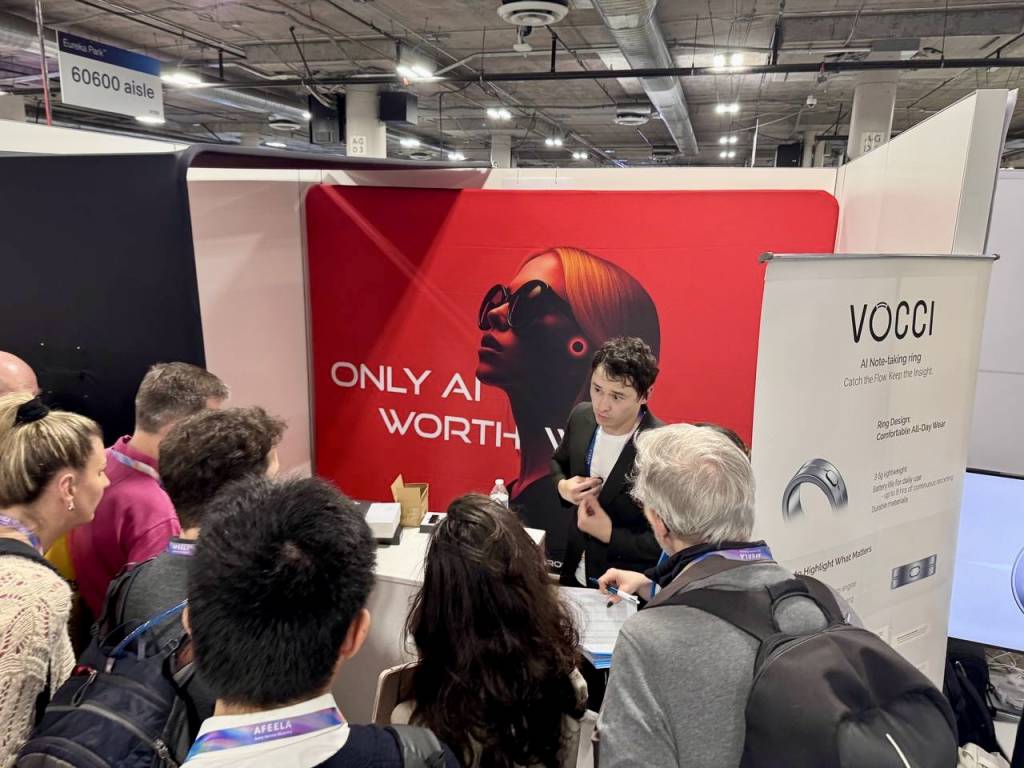
Obround’s hardware earned Nosirov a place in CES Eureka Park, the curated startup zone at CES in Las Vegas, the world’s largest consumer electronics show. He was the first founder from Uzbekistan ever accepted. Eureka Park is not a pitch competition. Companies show working products, and Obround had one.
He was also invited to appear on Shark Tank in the United States.
Nosirov treats both milestones as signals more than trophies. “At CES, a lot of people heard about Uzbekistan for the first time from me”, he says. “If my product is weak, they’ll draw that conclusion about my country too. So ‘good enough’ is never good enough”.
The judge’s eye
Nosirov competes, and he also evaluates the competition. In 2026, he won the Y Combinator hackathon twice, in April and June. That same year, he served as a judge and technical mentor for Uzbekistan’s National AI Hackathon, evaluating teams building AI prototypes. He also appeared as a panelist at Plug and Play’s Play Smart Tech pitch session, presenting Obround’s technology to the Plug and Play team and the attending startups.
Asked what he looks for when judging a team, he answers without hesitation:
1. Is this a real problem? Is there actual demand, or is it just a cool-sounding product nobody really wants?
2. Can the team build? “Plenty of teams can make slides. Very few show up with a working prototype. I bet on those”.
3. Does economics work? What does it cost to serve one user, and does that number fall or rise at scale?
His scholarly work sits at the intersection of technology and governance; in 2020, one of his articles won the Best Article of the Year award. He is an expert resident member of the Central Asian Association for Artificial Intelligence and a resident member of the FinTech Association of Uzbekistan, both invitation-only, and an active member of the Association for the Advancement of Artificial Intelligence (AAAI).
Alongside Obround, he has built or backed a portfolio of AI ventures, each aimed at a specific pain point:
• Unicaption (unicaption.com): an AI copilot for professional interpreters and language providers.
• Exma AI (exma.uz and exma.ai): an AI stenographer for court hearings and higher-education institutions.
• Ardus (ardus.ai): distributed small-scale data centers of 1 to 10 megawatts, turning stranded industrial grid capacity into AI compute.
Ardus, in particular, brings him full circle. The boy who grew up among substations is now repurposing industrial power for artificial intelligence. “That’s not a coincidence”, he says.
Where AI will live
Most conversations about artificial intelligence focus on models. Nosirov starts from the hardware and works upward, and from there he sees four shifts coming.
Open weights will win. In his view, nearly everyone will eventually run open models. Once the model is a commodity, the competition moves to where it runs, how fast and how cheaply. That makes it a hardware and energy problem.
Agents will dwarf today’s usage. “What we see now is nothing compared to what’s coming”, he says. Over the next decade, he expects trillions of new users to come online, and they will be AI agents, not people. Each one consumes compute continuously, and today’s infrastructure is not built for that load.
Humanoid robots will live or die on latency. A humanoid robot cannot process everything on board; battery, weight and heat won’t allow it. Nor can it send every decision to a distant data center and wait, because by the time the answer comes back, the robot has already fallen. “Robots will have to lean on the nearest edge compute”, Nosirov says. “Edge computing is critical for humanoid robotics”.
The future is local and edge, together. He has lived this tradeoff in Obround’s own products. Running AI locally on a wearable eliminates latency, but capability is limited and the battery drains fast. Sending everything to the cloud brings back latency and privacy problems. The answer, he argues, is a system in which the device and the edge cloud work together seamlessly: fast, personal tasks run on the device, while heavy tasks are handed off in milliseconds to the nearest edge site.
His own companies map onto that architecture. Obround is the local layer, the device on the user’s body. Ardus is the edge layer, megawatt-scale compute sited close to users. “Most people build one or the other”, he says. “We’re building both, because the future is where they meet”.
Contrarian, and right
Nasim is bullish on his home country. Uzbekistan, he points out, has two things the world now wants: energy resources and deep engineering talent, reinforced by a science Olympiad culture that produces thousands of gifted young people every year. His advice to Uzbek founders is blunt: don’t stop at apps. While everyone writes software, the teams that understand hardware, infrastructure and energy will win. And build for the global market from day one, using the home market as a proving ground rather than a final destination.
Over the next five to ten years, he intends to make his company a global technology powerhouse, build the edge infrastructure that brings AI compute closer to users and bring Uzbekistan into that supply chain through its engineers, energy and manufacturing. “Navoi showed me what industry is”, he says. “Silicon Valley showed me how to scale it. I want to bring those two worlds together”.
He often returns to a principle borrowed from the investment world: to win big, you have to be contrarian, and you have to be right. Being only contrarian is easy; you disagree with everyone. Being only right is easy too; you repeat what everyone knows. The outsized results come when both happen at once.
Nasim Nosirov has made that bet more than once. He left a secure career when most people around him called it a mistake. He chose hardware when everyone around him was writing software. So far, the boy from a small industrial town who assembled his own computer at 11 has been both contrarian and right. He insists he is only getting started.
Nozimbek Mardonov, UzA