A New Stage in Training Personnel for Public Safety
The resolution by our country's leader aims to establish a system of continuous education for training professional personnel with modern knowledge and advanced practical skills in the field of public safety.
Response
Today, ensuring the rule of law, the reliable protection of citizens' rights and freedoms, maintaining public order, and forming a safe and stable social environment are among the priority areas of state policy in our country.
The effective implementation of these tasks is, first and foremost, closely linked to training professional personnel with modern knowledge, high professional skills, strong legal thinking, and practical expertise. In this regard, the Presidential Decree of August 26, 2022, "On additional measures to further improve the system of training professional personnel in the field of public security," is particularly significant as a key legal document that serves to elevate the sector to a new level.
The decree of the head of our state is aimed at creating a system of continuous education for training professional personnel with modern knowledge and advanced practical skills in the field of public security.
It defines the task of transforming the University of Public Security into a flagship higher education and research institution for personnel training and research activities in this field. This approach envisions transforming the higher education institution into an integrated system that connects practice, science, innovation, and personnel policy, rather than limiting its functions solely to teaching.
The decree's emphasis on the practical orientation of the personnel training system is particularly noteworthy. Specifically, it is planned to gradually orient undergraduate educational programs toward practical training, organize cadets' practical exercises in the relevant units of internal affairs bodies, and ensure their direct exposure to the real service environment. Such a system will enable future specialists to correctly apply theoretical knowledge in practical situations, make prompt and well-founded decisions, communicate effectively with citizens, and develop a deep sense of professional responsibility.
Another important aspect of the decree is the widespread introduction of digital technologies into the educational process. The document provides for the development of knowledge and skills in using artificial intelligence technologies, drones, geographic information systems, video surveillance, biometric identification, and behavioral analysis technologies.
A perfect command of foreign languages is also of great importance in training professional personnel. The decree establishes a system for teaching cadets and trainees two foreign languages based on the "1+1" program, as well as for certifying foreign language proficiency through national and international certificates. This requirement will expand future opportunities for the direct study of international experience, the use of foreign scientific sources, active participation in international cooperation projects, and the implementation of best practices into national practice.
The decree also takes a systematic approach to enhancing the professional capacity of the faculty. It provides for connecting professors and instructors with practice, evaluating the effectiveness of their pedagogical activities, rewarding high performers, and, where necessary, involving specialists with practical service experience in pedagogical activities. This serves to increase the relevance and practical significance of the educational content.
The tasks set for the development of research activities further enhance the strategic importance of the decree. It provides for establishing a scientific and practical research institute on public security issues, studying, assessing, and forecasting security threats, developing modern solutions, and holding scientific and practical events at the international and national levels. The direct implementation of scientific research results into practice will strengthen the scientific basis of decision-making within the public security system.
Developing international cooperation is also one of the decree's key priorities. It envisages establishing strategic partnerships with leading foreign training centers, involving foreign experts, trainers, and practitioners in the educational process, and providing professional development and retraining for faculty and staff abroad. This will create an opportunity to adapt advanced teaching methods, simulators, virtual education technologies, and modern service practices that have proven effective in global practice to the national education system.
Another noteworthy aspect of this resolution is that it defines specific mechanisms, deadlines, and responsible parties for the implementation of reforms. The program of measures outlines a phased approach to tasks such as improving the education system, developing research activities, strengthening international cooperation, introducing digital technologies, and enhancing the material and technical base. This approach demonstrates that the document is geared towards practical implementation rather than being merely declarative.
In conclusion, this important resolution by our head of state is a comprehensive and forward-looking document aimed at radically improving the system for training professional personnel in the field of public security. It encompasses interconnected areas such as the integration of education with practice, research activities, digitalization, the use of artificial intelligence and modern security technologies, foreign language learning, international cooperation, increasing the capacity of the faculty, and monitoring the professional activities of graduates.
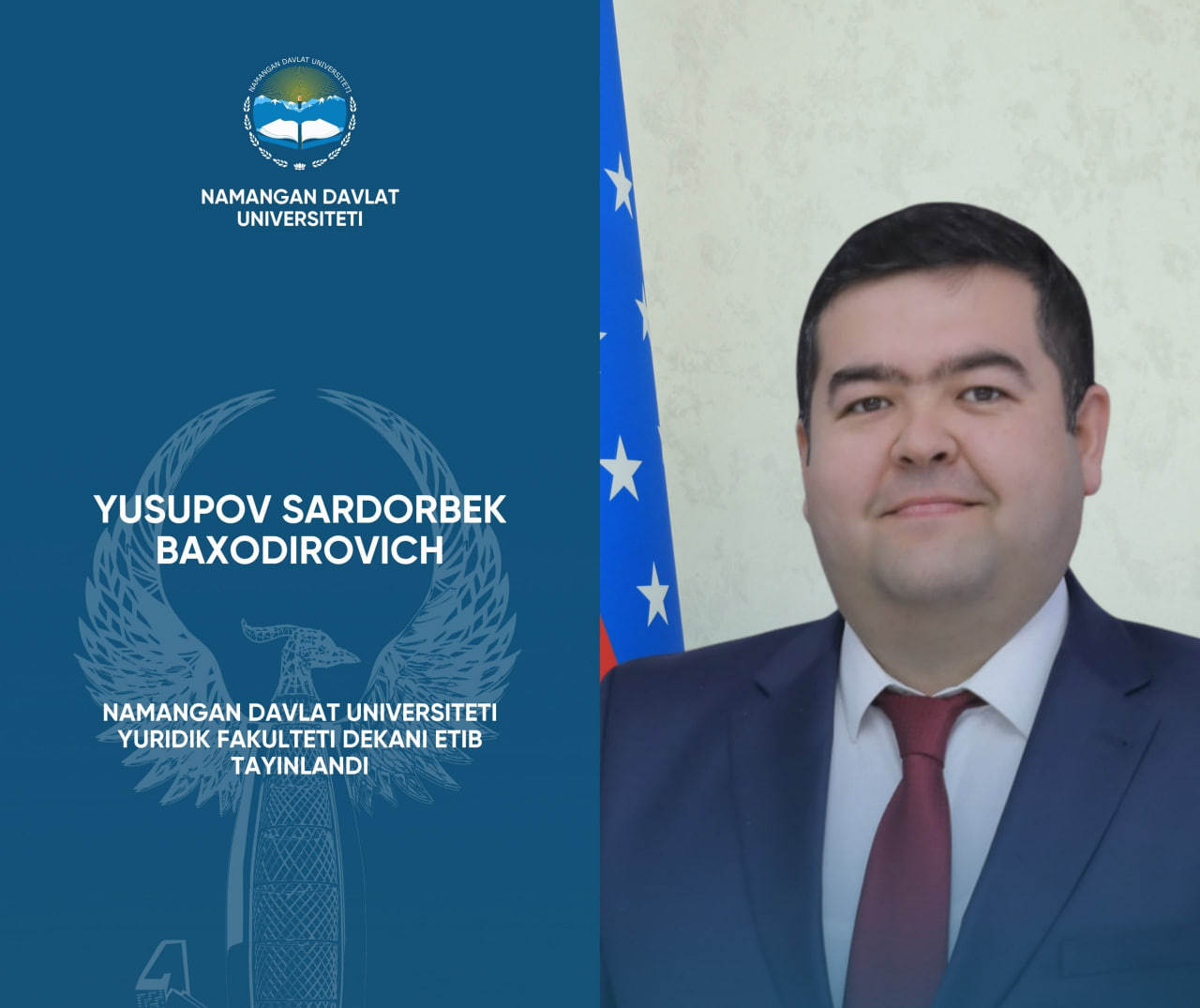
Sardorbek Yusupov,
Dean of the Faculty of Law, Namangan State University, Doctor of Law, Professor.
Ibrohim Otamirzayev,
Head of the Department of Criminal Procedure Law at the University, Doctor of Philosophy in Law.
UzA.